
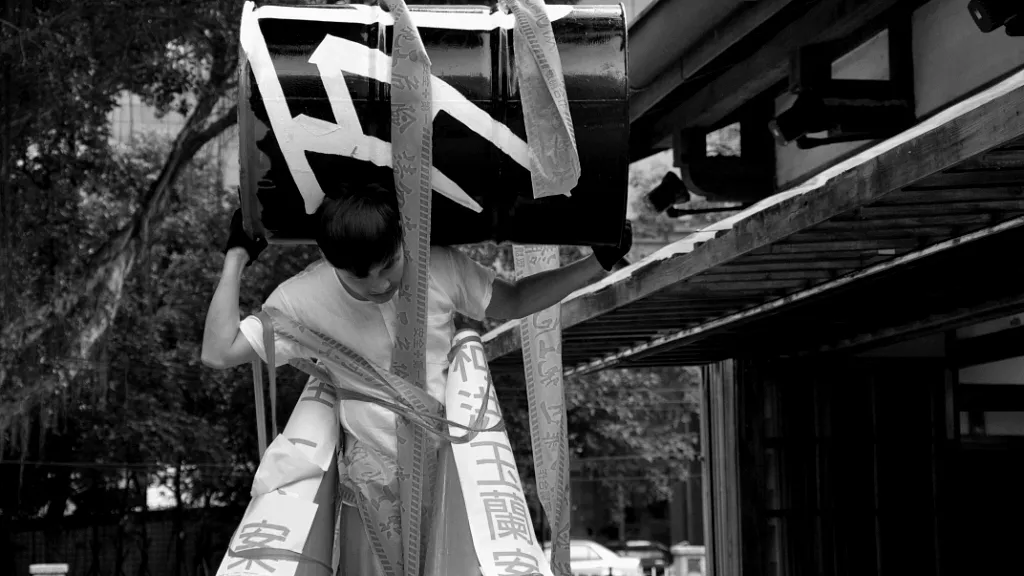
Torture Echoing Through Dancers' Bodies: Academia and the Arts Community Jointly Call on the Prosecutor-General to File an Extraordinary Appeal – Press Conference on the Extraordinary Appeal in the Chiou Ho-shun Case
Last edited: 2026-07-27
Between 1949 and 1987, Taiwan was under martial law. The judiciary under the authoritarian regime was not an independent organ; the scales of justice tipped according to political correctness rather than fairness and justice. Torture, forced confessions, and arbitrary imprisonment were commonplace. The Chiou Ho-shun case took place in the year following the lifting of martial law, when the lingering poison of authoritarianism still penetrated judicial organs. To resolve public pressure over the long-unsolved "Lu Cheng Elementary School Student Kidnapping Case" and "Salesperson K'o Hung Yu-lan Dismemberment Case," the judicial organs ignored evidence favorable to the defendant, used confessions obtained through torture to convict him, and unjustly pinned both cases on Chiou Ho-shun.
Although martial law was lifted 27 years ago, Chiou Ho-shun has been unable to overturn his wrongful conviction and remains hidden from the light in death row. Therefore, the Tsai Jui-yueh Culture Foundation specifically used dancers' physical movements to present the pain of the torture and injustice suffered by Chiou Ho-shun back then, hoping to draw public attention; meanwhile, legal scholars will point out the omissions and absurdities in the court judgments and call on the Prosecutor-General to file an extraordinary appeal for the Ch'iu case.
On July 9 this year, the Control Yuan unprecedentedly released the third investigation report on the Chiou Ho-shun case, setting the highest record for investigations conducted by the Control Yuan into a single case. In the investigation report, the Control Yuan expressed deep grief over the violations of law and human rights committed by the judicial organs in the Chiou Ho-shun case, and formally requested the Prosecutor-General to study and file an extraordinary appeal.
| Report | Control Yuan (82) Yuan-Tai-I-Tzu No. 1608 Investigation Report (Aug. 3, 1994) | Control Yuan 102nd Judicial Investigation No. 0032 Investigation Report (June 14, 2013) | Control Yuan 103rd Judicial Investigation No. 0038 Investigation Report (July 9, 2014) |
|---|---|---|---|
| Doubts Raised by the Control Yuan | The prosecutors and police subjected the individuals involved to "violence and coercion" and "perfunctorily closed the case" during the handling process, and impeached 10 police officers and 2 prosecutors who participated in the case at the time. | Pointed out that regarding the Lu Cheng case portion, the confessions among co-defendants contradicted one another, filled with improper methods such as prosecutorial-police inducement and threats with inducements, using Chiou Ho-shun's confessions and guilty statements—which lacked voluntariness and admissibility as evidence—as evidence, and that the excessively long detention period violated the defendant's human rights. | Regarding the K'o Hung Yu-lan case portion, the prosecutors and police were consistently in a high-pressure state during interrogation, and the overall process lacked confession voluntariness and admissibility as evidence; moreover, just before the conclusion of the investigation, police officers who assisted in the investigation back then petitioned the Control Yuan regarding acts by the Taipei City Police Department's Criminal Investigation Division back then that exceeded the Code of Criminal Procedure and infringed upon human rights. There are still many doubts in the case that await clarification, and clear evidence and investigation reports indicate the fact that torture occurred during the investigation process back then; the court's act of adopting the defendant's confession violates the Code of Criminal Procedure. |
Over the past three years, Chiou Ho-shun's defense team has twice petitioned former Prosecutor-General Huang Shih-ming to file an extraordinary appeal, but both petitions were dismissed. Ch'iu's defense team has once again submitted a brief to petition for an extraordinary appeal. (See Appendix) It is hoped that the new Prosecutor-General, Yen Ta-ho, will attach importance to the opinions of the Control Yuan, respond to the questions raised by the legal community, fulfill the Prosecutor-General's function of protecting human rights, and return Chiou Ho-shun his deserved innocence.
Appendix
Attendees
Representative Co-signing Scholars / Associate Professor Wu Ching-ch'in, Associate Professor Tseng Chien-yuan, Professor Lu Ying-chieh, Assistant Professor Hsieh Yü-wei
Chiou Ho-shun Case Defense Team / Attorney Koo Li-hsiung, Attorney Yu Po-hsiang, Attorney Cheng K'ai-hung, Attorney Sung I-hsin, Attorney Chou Han-wei
Rescue Organization Representatives / Judicial Reform Foundation, Taiwan Association for the Abolition of the Death Penalty, Taiwan Innocence Project, Taiwan Association for Human Rights
Introduction to the Tsai Jui-yueh Culture Foundation
Dancer Tsai Jui-yueh was born in Tainan City in 1921.
During World War II, the ravages of war swept across Europe, and artists fled to foreign lands one after another. At the tender age of 16, Taiwanese dancer Tsai Jui-yueh went to Japan to follow Baku Ishii, the father of Japanese modern dance, immersing herself in the baptism of the height of the "New Dance Movement." After the war in 1946, Tsai Jui-yueh returned to her hometown, founded the "Tsai Jui-yueh Dance Research Institute" in Tainan, and immediately launched the promotion of Taiwan's dance movement. In 1953, the dance institute relocated to No. 10, Lane 48, Section 2, Chungshan N. Rd., Taipei City, and was officially registered. This was Taiwan's earliest dance school and has a history of 54 years to this day. Starting in 1953, senior Taiwanese dancers used the "Tsai Jui-yueh Dance Research Institute" as their base to engage in dance teaching, dance creation, and dance performances, opening up a new horizon for Taiwan's dance community and developing diverse dance genres, including rich creative resources in modern dance, ballet, ethnic dance, and Taiwanese folk dance. In 1999, the dance institute was designated as a historic site, finally preserving the rooting ground of Tsai Jui-yueh's lifelong dedication to Taiwanese modern dance. Tsai Jui-yueh, the mother of Taiwanese modern dance, cared for Taiwan throughout her life and insisted on dedicating her life to dance, opening up a new horizon for Taiwan's dance community and making significant contributions to the history of Taiwanese dance. Although the senior dancer Tsai Jui-yueh has passed away, her spirit of persistently pursuing dreams remains in our hearts.
This Foundation continues Ms. Tsai Jui-yueh's perseverance in dance and her courageous spirit of pursuing dreams, carrying on cultural and artistic promotion activities to raise Taiwan's cultural living standards and build a new world full of love and hope for Taiwan.
This article is an AI-generated translation of the original Chinese text. In the event of any discrepancy, the Chinese version shall prevail.