
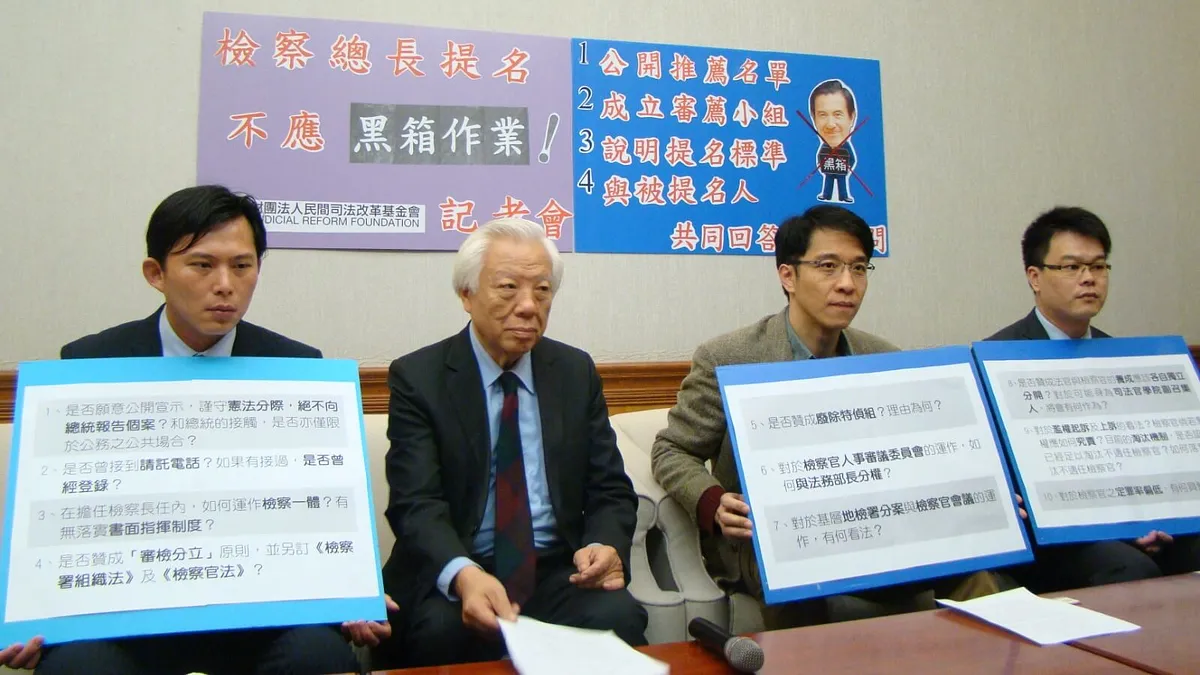
Nomination of the Prosecutor General Must Not Be a Backroom Deal! Press Conference Calling on President Ma: "Disclose the List of Nominees, Establish a Selection Committee, Explain Nomination Criteria, and Jointly Answer Ten Questions with Nominees"
Last edited: 2026-07-27
Prosecutor General Huang Shih-ming is about to step down. His unconstitutional abuse of power alongside the Special Investigation Division he led triggered political infighting and social turmoil, demonstrating the immense power of the Prosecutor General and the critical importance of selecting a suitable candidate. To select the right person, the nomination process must not be shrouded in secrecy. We therefore solemnly demand that the President make the nomination process open and transparent to maintain public trust. The appeals of our Foundation are as follows:
1. The President should immediately disclose the list of candidates recommended by the Judicial Yuan, the Ministry of Justice, and other organizations:
- It has been reported by the press that the Judicial Yuan and the Ministry of Justice have submitted their lists of candidates to the Office of the President for the President's selection, yet they remain tight-lipped about the contents of the lists, which is perplexing. In fact, being qualified as a candidate for Prosecutor General should be a matter of great honor; keeping the list under absolute secrecy creates an initial public impression of lacking uprightness and transparency.
- Furthermore, the Prosecutor General occupies a vital position with immense power, and the nomination procedure should be rigorous and prudent, especially since the legal amendments granted tenure protection precisely in the expectation that the Prosecutor General would maintain distance from high-level politics. Keeping the potential lists entirely confidential inevitably leaves outsiders with the impression of "backroom dealings," easily undermining the public expectation of openness and transparency that should exist between the Prosecutor General and political elites. Therefore, we call upon the President to immediately disclose the list of candidates nominated by the Judicial Yuan, the Ministry of Justice, and other groups, so as to avoid unnecessary insinuations and speculations by the public.
2. The President should follow the model of Control Yuan member nominations by immediately establishing a selection committee and explaining the nomination criteria:
- The Prosecutor General holds a high and powerful office, and their investigative powers are second to none compared to Control Yuan members. At present, the nomination process for Control Yuan members not only involves the establishment of a selection committee but also broadly incorporates opinions from all sectors of society. This raises the question of why the President has been so reluctant to establish a selection committee when nominating the Prosecutor General.
- Secondly, regardless of whether a selection committee is established, since the President must ultimately nominate the Prosecutor General, the President undoubtedly holds specific criteria in mind. We therefore jointly call upon the President to publicly explain the nomination criteria to maintain public trust.
- Would you be willing to publicly pledge to strictly observe constitutional boundaries and never report individual cases to the President? Would your contact with the President be strictly limited to public official occasions?
- Have you ever received any lobbying phone calls? If so, were they properly logged?
- During your tenure as chief prosecutor, how did you operate the principle of the unity of the prosecution system (Prosecutorial Monism)? Was the written command system implemented?
- Do you support the principle of "separation of adjudication and prosecution" and the enactment of a separate Organic Act of the Prosecutors' Offices and Prosecution Act?
- Do you support the abolition of the Special Investigation Division? What are your reasons?
- Regarding the operation of the Prosecutors' Personnel Review Committee, how should power be shared with the Minister of Justice?
- What are your views on the allocation of cases in local prosecutors' offices and the operation of prosecutors' meetings?
- Do you support independent and separate training for judges and prosecutors? As a potential vice convener of the Academy for the Judiciary, what actions would you take?
- What are your views on abusive prosecution and appeal? How should prosecutors be held accountable for abuse of power? Do you consider the current elimination mechanisms sufficient to weed out incompetent prosecutors? How can the elimination of incompetent prosecutors be effectively implemented?
- What concrete actions will you take regarding the low conviction rate of prosecutors?
Attendees
Ch'ü Hai-yüan, Chairperson, Judicial Reform Foundation
Huang Kuo-ch'ang, Executive Committee Member, Judicial Reform Foundation
Lin Chün-hung, Attorney-at-Law, Executive Committee Member, Judicial Reform Foundation
Kao Jung-chih, Attorney-at-Law, Executive Director, Judicial Reform Foundation
Press Contact
Attorney-at-Law Kao Jung-chih 02-2523-1178
This article is an AI-generated translation of the original Chinese text. In the event of any discrepancy, the Chinese version shall prevail.