
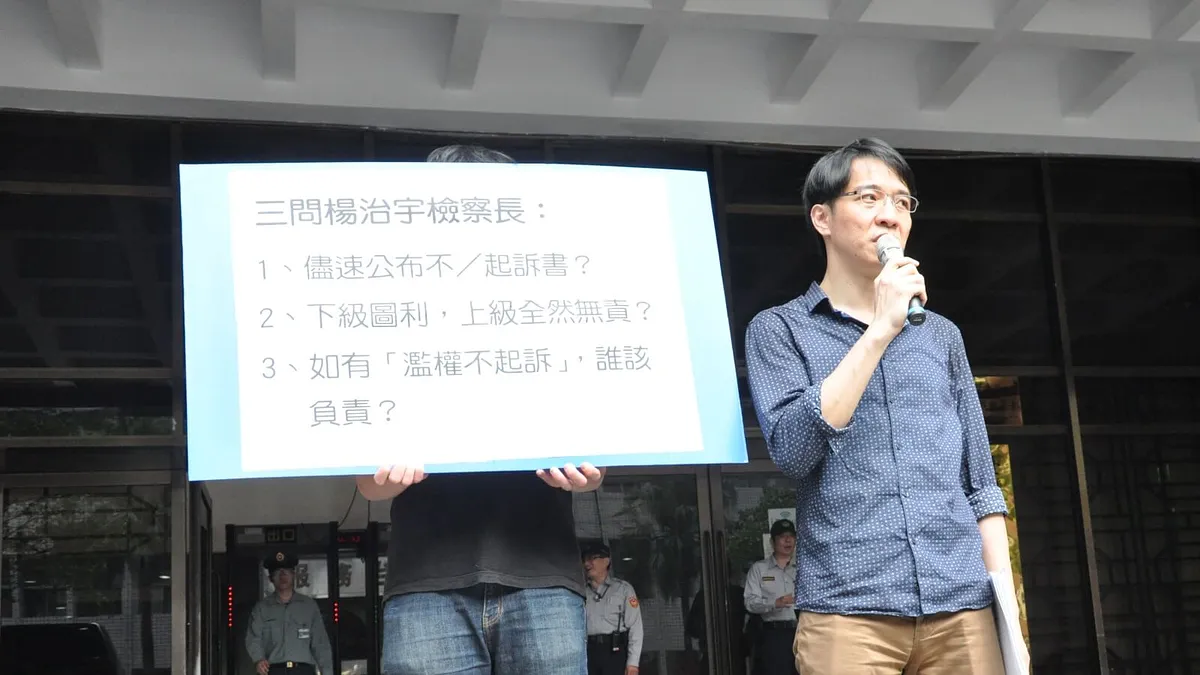
Three Questions for Chief Prosecutor Yang Chih-yu ~ Press Conference on "Did Prosecutors Abuse Their Power and Fail to Prosecute in the Taipei City Department of Transportation's 'Meilifu Case'?"
Last edited: 2026-07-27
Yesterday (the 24th), the Taipei District Prosecutors Office concluded its investigation into the MRT Hsintien Depot development project (the Meilifu scandal), indicting Kao Chia-nung, Director of the Joint Development Division of the Taipei City Department of Transportation, and Wang Ming-tsang, Section Chief, for corruption and profiteering. Both are mid-to-low-ranking civil servants.
However, in October 2012, the Control Yuan impeached former Taipei City Department of Transportation Engineering Directorate-General Chang Ch'i-te, and pointed out in its investigation report that the key figure in this case was former Deputy Mayor Lin Ch'ung-i. The prosecutors seem to have omitted any mention of this, raising suspicions?
Therefore, we have three questions for Taipei District Prosecutors Office Chief Prosecutor Yang Chih-yu:
1. Are you willing to promptly release the written indictment or non-prosecution decision?
- The Taipei District Prosecutors Office appears to have "concluded" this case; however, it has only announced the indictment of mid-to-low-ranking civil servants Kao Chia-nung and Section Chief Wang Ming-tsang, while remaining silent on the handling of other high-ranking civil servants who may have been involved, which naturally arouses suspicion.
- Therefore, we ask the Taipei District Prosecutors Office whether it is willing to promptly make public the indictment or the non-prosecution disposition to establish public credibility.
2. If subordinates commit profiteering, how can superiors bear zero responsibility?
- In particular, based on empirical rules, if subordinates are suspected of profiteering, the supervising officials who signed off on the documents can hardly be entirely free of responsibility. At first glance, the Taipei District Prosecutors Office's determination seems to defy common sense.
- Moreover, the Control Yuan previously proposed two impeachment motions against then-Deputy Mayor Lin Ch'ung-i, and directly pointed out in its investigation report that Lin Ch'ung-i was the key figure who made the final, decisive call. What on earth was the ultimate investigative conclusion of the Taipei District Prosecutors Office? If no prosecution is to be brought, or if no investigation was conducted at all, shouldn't the Taipei District Prosecutors Office provide a specific explanation of the rationale behind this?
3. If accountability for "abusive non-prosecution" is pursued in the future, who should bear the responsibility?
- Admittedly, according to media reports, the prosecutor handling this case is Prosecutor Ch'en Yun-ju, whose name should appear on the indictment bearing responsibility.
- However, we must ask: Did the Chief Prosecutor exercise the principle of "prosecutorial unity" to intervene in the investigative process? If so, if liability for "abusive non-prosecution" arises in the future, precisely who is the person that should be held responsible?
Press Contact
Attorney Kao Jung-chih 02-2523-1178
This article is an AI-generated translation of the original Chinese text. In the event of any discrepancy, the Chinese version shall prevail.