
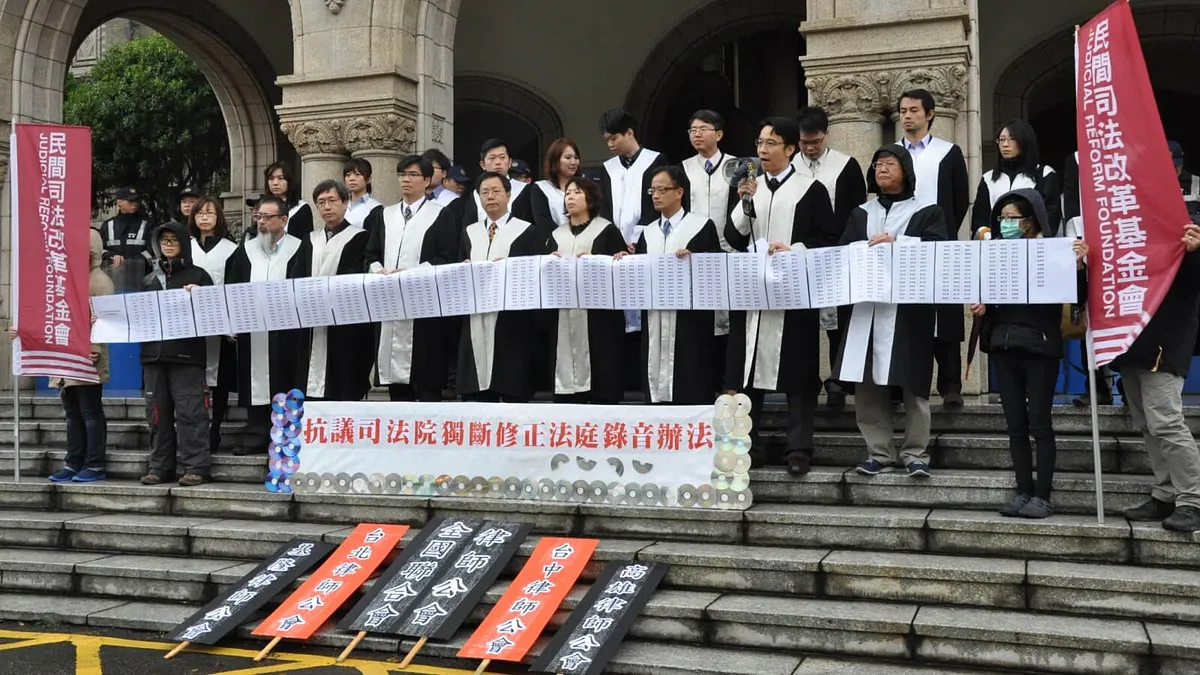
Joint Press Conference Protesting the Judicial Yuan's Arbitrary Amendment of the Regulations on Court Audio Recording
Last edited: 2026-07-27
Disregarding widespread opposition from all sectors, the Judicial Yuan promulgated the Regulations on Court Audio Recording and the Utilization and Preservation Thereof on October 25, 2013, and on December 9 of the same year, it also announced the draft Regulations on Copying Records in Civil and Administrative Litigation, strictly limiting applications for court audio recording discs to require the "written consent" of "all" declarants present at the hearing. Such policies by the Judicial Yuan risk regressing the open trial system back to the secret trials of 200 years ago, disregarding citizens' right of access to court and infringing upon lawyers' right to defense and litigation representation. We cannot sit idly by. Over 1,000 lawyers have signed a petition expressing their opposition, and on the eve of Judicial Day on January 11, we voice our most solemn protest and declare as follows:
1. Refusing to infringe upon citizens' right of access to court under the guise of personal data protection:
The Constitution guarantees citizens' right of access to court. Under the pretext of protecting the personal data of court declarants, the Judicial Yuan has nearly deprived citizens of their right to request the delivery of court audio recordings. Without evaluating how to properly protect both rights simultaneously, without considering the overall proportionality of personal data in court proceedings, and without caring that its means infringe upon citizens' right of access to court and right to be heard, the Judicial Yuan arbitrarily and strictly limited citizens' right to obtain court information. Not only does this fundamentally violate the legislative purpose of "promoting the rational utilization of personal data," but it also uses administrative orders to impose restrictions not stipulated by law, rashly infringing upon citizens' right of access to court.
2. Opposing the infringement upon the open trial system:
The judicial power is an indispensable constitutional design for the separation of powers and checks and balances, and the state must establish a fair, just, public, unbiased, and independent judicial system. In principle, trials shall be conducted publicly, and the spirit of open trials is realized through systems such as free public attendance at hearings, the presence of procedural participants, and court audio and video recording. However, the Judicial Yuan arbitrarily used the Regulations on Court Audio Recording and the Utilization and Preservation Thereof to strictly limit the acquisition of audio recordings of court proceedings, drastically reducing the openness and transparency of court proceedings and arbitrarily infringing upon the substance of the open trial system with low-level administrative orders.
3. Protesting the erosion of lawyers' right to defense and right of litigation representation:
At the symposium on the amendment of court audio recording regulations convened by the Judicial Yuan on December 25, 2012, various sectors universally raised objections to the Judicial Yuan's "strict limitations" on the delivery of court audio recordings. The legal profession, in particular, deeply recognizes the severity of flaws in the production of court transcripts in practice. The Judicial Yuan's strict limitation on parties obtaining court audio recordings will evidently place parties in even greater peril and make it harder to discover erroneous or flawed transcripts. Furthermore, parties inherently have the right to copy records, and lawyers, based on the necessity of litigation representation or the right to defense, have the right to inspect case files, which shall not be arbitrarily restricted unless explicitly provided by law. The Judicial Yuan's actions are tantamount to covertly eroding lawyers' right to defense and right of action, which is truly illegal and an abuse of power.
Based on the aforementioned reasons, we solemnly urge and demand:
- The Judicial Yuan should immediately abolish the "Regulations on Court Audio Recording and the Utilization and Preservation Thereof."
- The Judicial Yuan should respond to the needs of citizens' right of access to court, the open trial system, and lawyers' right to defense, and promptly formulate methods for the utilization and preservation of court audio recordings.
Attendees
Wu Yu-hsueh, Attorney-at-Law, Secretary-General, Taiwan Bar Association
Cheng Wen-ting, Attorney-at-Law, Chairperson, Keelung Bar Association
Li I-kuang, Attorney-at-Law, Chairperson of the Criminal Law Committee, Taipei Bar Association
Ko Shao-chen, Attorney-at-Law, Secretary-General, Taichung Bar Association
Lu Shih-chin, Attorney-at-Law, Chairperson, Kaohsiung Bar Association
Lin Yung-sung, Attorney-at-Law, Standing Board Director, Judicial Reform Foundation
Kao Jung-chih, Attorney-at-Law, CEO, Judicial Reform Foundation
Press Contact
Attorney Kao Jung-chih 02-2523-1178
This article is an AI-generated translation of the original Chinese text. In the event of any discrepancy, the Chinese version shall prevail.