
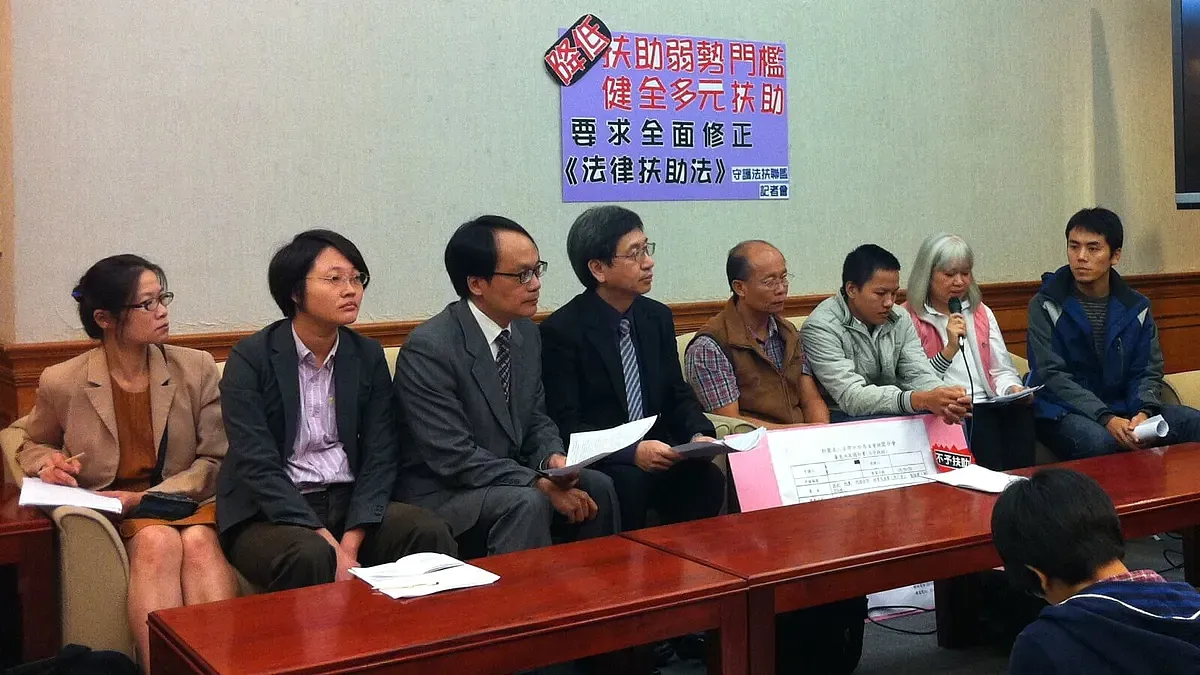
Lowering the Threshold for Vulnerable Assistance and Strengthening Diverse Support: Demanding a Comprehensive Amendment to the Legal Aid Act
Last edited: 2026-07-27
The Legal Aid Foundation was established with government funding to serve disadvantaged groups, overcome economic barriers, and lower the threshold for accessing legal resources in order to achieve substantive fairness and justice. If the Legal Aid Foundation loses or significantly weakens its function of assisting the vulnerable and degenerates into a rigid bureaucratic institution, it will forfeit the purpose and meaning of its existence.
Civil society organizations have formed the "Alliance to Safeguard Legal Aid" (hereinafter referred to as the Alliance), whose members are all civic organizations that care for and provide substantial assistance to disadvantaged groups. Since its establishment in 2009, the Alliance has closely monitored the operations of the Legal Aid Foundation, questioning its gradual loss of independence, the rapid weakening of its function to "protect the rights and interests of the vulnerable," and even the crisis of comprehensive bureaucratization:
Example 1: Mr. Tu, a Vietnamese worker, had his wages unlawfully and arbitrarily withheld and was duped into signing a payslip. In a panic, he took the agency staff's handbag and rushed out, took out the payslip and tore it up, and then immediately returned the handbag. The entire process took less than 5 minutes. The Legal Aid Foundation either had no concept of or did not care about the vulnerable status and context of foreign workers; it merely conducted a formal review determining that "he indeed forcibly took the bag" and rejected his application on the grounds that it was "manifestly devoid of grounds." Afterwards, the client went to court alone; the judge not only recognized that he had no criminal intent, but also found his conduct constituted "self-help" under Article 151 of the Civil Code, and thus acquitted him. The Legal Aid Foundation deemed it "manifestly devoid of grounds," yet the court easily found two legal grounds for the case. The difference lies entirely in whether one faces the vulnerable with sincerity and has the heart to assist them. The Legal Aid Foundation's increasingly bureaucratic and formalized review system is thus evident.
Example 2: Hermione (a pseudonym) wanted to apply to the court for debt rehabilitation, but the legal aid lawyer assigned by the Legal Aid Foundation never accompanied her to court between 2008 and 2011. Most of the petitions submitted to the court were written by the client herself, and the lawyer simply had an assistant type them up before submission, sometimes even typing the court division wrong. During a court appearance in 2009, the judicial affairs officer remarked on the spot: "Why is your lawyer so slack?" The lawyer even failed to promptly remind her to assert her rights, leading to the client's house being auctioned off by the court at a heavily discounted price, resulting in massive losses and leaving her homeless! Later, determined to change lawyers, she applied at the Taipei Branch, and her application was approved. To her dismay, she faced all sorts of obstruction from the original Taoyuan Branch, leaving a vulnerable and helpless debt-slaughtered victim with nowhere to turn for help—how heartbreaking! Fortunately, with the assistance of the "Self-Help Association of Debt Slaves," she changed to a new lawyer who was both professional and efficient, and finally received a court "discharge ruling." The lawyer proceeded step-by-step to help the client resolve her debts, and her civil rights have now been restored, giving her a chance at rebirth. This shows that the parochialism of the various branches of the Legal Aid Foundation is severe. Leaving aside the failure to act in the best interests of the client, when she decided to resort to self-help and change lawyers, she was instead harassed and hindered. The Foundation, which should have extended a helping hand, became an obstacle itself. How much genuine heart for assisting the vulnerable remains?
The Alliance asserts that the Legal Aid Act, enacted in 2004, has been in operation for nearly a decade and that it is time for a comprehensive review and amendment. Today, we explain this via a press conference, propose an amendment draft, and will subsequently visit each party caucus in the Legislative Yuan one by one to seek their support.
The key points of this amendment are:
- Empowering the Legal Aid Foundation to act as a mediator, providing more diverse alternative dispute resolution mechanisms. (Article 2 of the amended provisions)
- Incorporating "first police-prosecutor accompanied interrogation," "persons with physical and mental disabilities," "indigenous peoples," "major human rights or environmental incidents, or class actions" into the scope exempt from means-testing, thereby lowering the threshold for obtaining legal aid in such public interest cases. (Articles 3 and 14, Paragraph 1 of the amended provisions)
- Presuming low- and middle-income households, blue-collar foreign workers, vulnerable foreign spouses, families in special circumstances, the homeless, and debt-slain individuals to be without financial resources, thereby simplifying the application procedure for such citizens to receive legal aid. (Article 14, Paragraph 2 of the amended provisions)
- Explicitly stipulating sources of funding and adding donations made pursuant to deferred prosecution dispositions or negotiated judgments as one of the funding sources for the Legal Aid Foundation, so as to prevent the quality of aid from being compromised due to funding shortages. (Article 8 of the amended provisions)
- Expanding the scope of legal aid for foreigners in order to protect the right to a fair trial for foreigners who actually reside or stay in the Taiwan area, in compliance with international human rights standards. (Article 15 of the amended provisions)
- Stipulating the brackets and sharing ratios for "partial assistance" to flexibly provide legal aid to citizens nearing destitution, thereby avoiding the pitfalls of an "all-or-nothing" approach. (Article 32 of the amended provisions)
- Increasing board representation for vulnerable groups and adding employee union board representation, specifying opportunities for various sectors to express their opinions, so that the composition and operation of the board of directors better align with the needs of human rights, public interest, and the vulnerable. (Article 38 of the amended provisions)
- Stipulating that the supervisory and regulatory authority of the competent authority is limited to illegal or grossly improper matters, thereby ensuring the independent operation of the Legal Aid Foundation. (Article 59 of the amended provisions)
Attendees
Li Mo-t'ang, Specialist, Taiwan Wild Bird Society
Lin Jen-hui, Secretary-General, Environmental Jurists Association
Father Peter Nguyễn Văn Hùng, Catholic Diocese of Taipei - Migrants' Center
Lin Shih-fang, Secretary-General, Awakening Foundation
Attorneys Lin Yung-sung, Self-Help Association of Debt Slaves
Lin Feng-cheng, Executive Director, Judicial Reform Foundation
Hermione, Individual Client
Mr. Tu, Individual Client
Press Contact
Lin Feng-cheng, Executive Director, Judicial Reform Foundation 02-2523-1178
Member Organizations of the Alliance to Safeguard Legal Aid
Homeroom Education Foundation
Association of Work-Injured Victims
Catholic Diocese of Taipei - Migrants' Center
Parents' Association of Intellectual Disabilities, Taiwan
Disabled Union, Republic of China
Self-Help Association of Debt Slaves
Taiwan Association for Human Rights
Taiwan Peacemaker Foundation
Taiwan Indigenous Peoples Action Coalition
Taiwan Labour Front
Taiwan Labor and Social Policy Research Association
Taiwan Wild Bird Society
Taipei Bar Association
Taiwan Senior Citizens' Welfare Alliance
Judicial Reform Foundation
TransourceEncoding Sisters Association, Taiwan
Eden Social Welfare Foundation
Amnesty International Taiwan
Awakening Foundation
Taipei Women's Rescue Foundation
Sunshine Social Welfare Foundation
Taiwan Rural Front
Taiwan Alliance to End the Death Penalty
The Garden of Hope Foundation
Environmental Jurists Association
Lanyu Tribal Cultural Foundation
This article is an AI-generated translation of the original Chinese text. In the event of any discrepancy, the Chinese version shall prevail.