
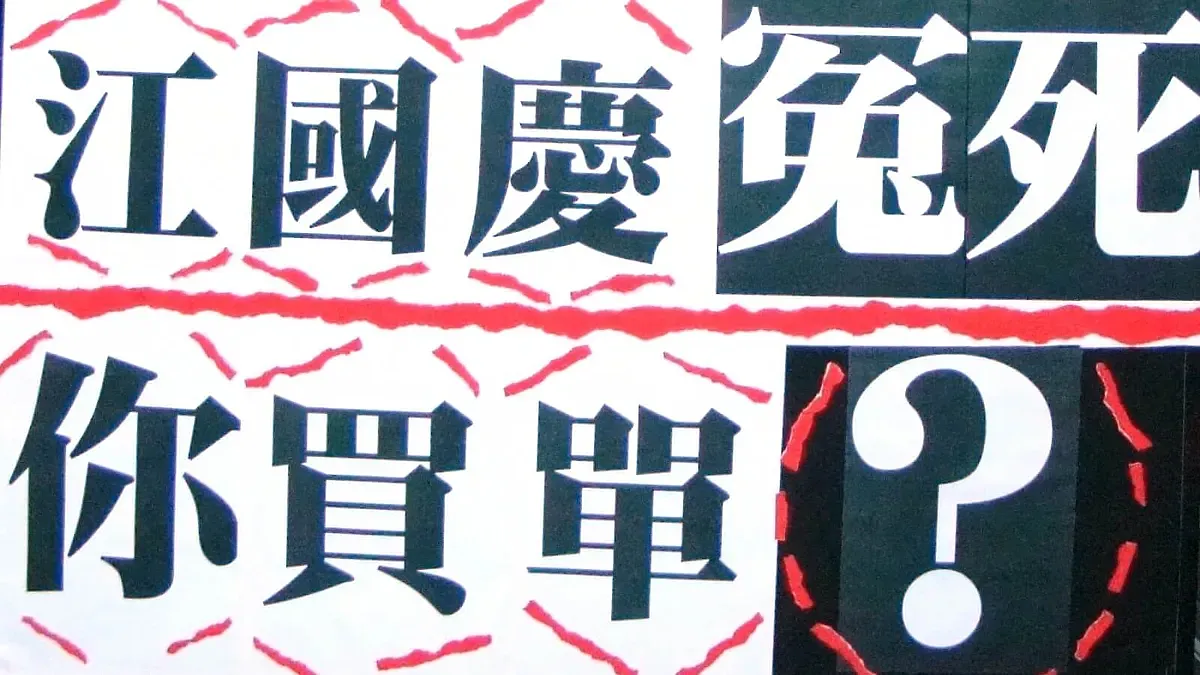
"Caring for Hung Chung-chiu, Do Not Forget Chiang Kuo-ch'ing: Ministry of National Defense, Where is the Compensation You Promised?" Press Release
Last edited: 2026-07-27
Regarding today's (August 2) 7th civil court session for the Ministry of National Defense's claim for compensation recovery from Ch'en Chao-min and others in the Chiang Kuo-ch'ing case, our foundation conducted court observation and issued the following statement:
1. Since September 24, 2012, this case has had six previous hearings (2012/9/24, 11/21, 2013/1/16, 3/13, 5/1, 6/26), and today (August 2) marks the 7th hearing. Court sessions frequently occur only after repeated demands by the judge for the Ministry of National Defense to passively respond and explain. During the hearings on March 13 and June 26 in particular, the Ministry of National Defense came completely unprepared, causing the proceedings to end hastily and lacking any substantive benefit.
2. The focus of today's hearing was to clarify both parties' opinions on the first three disputed issues, which are: 1. Has the plaintiff's right to claim compensation been extinguished by the statute of limitations? 2. Which individuals were civil servants performing official duties in accordance with the (pre-amended Military Trial Act)? 3. Did the defendants commit gross illegal acts with intent or negligence?
- The Ministry of National Defense asserts it has the right to seek compensation from the defendant military officers. However, the military officers all argue that the Chiang Kuo-ch'ing case occurred in 1997, and pursuant to the State Compensation Act, the right of claim has already been extinguished by the five-year statute of limitations; the newly implemented Criminal Compensation Act cannot be applied retroactively.
- The Ministry of National Defense asserts that all military officers were civil servants "performing official duties" under the Military Trial Act. While Huang Jui-p'eng and Ts'ao Chia-sheng cannot deny being military judicial personnel, Ch'en Chao-min and the remaining counter-intelligence officers all maintain they were merely administrative civil servants and deny being military judicial personnel.
- The Ministry of National Defense asserts that all military officers engaged in grossly illegal acts with intent or negligence. However, all the officers deny this: Ch'en Chao-min claims he never ordered torture; the counter-intelligence officers admit to torture but argue that intervening in investigations was "practical custom," that their physical abuse was not severe and amounted at most to "slight negligence" rather than gross negligence; and the two military judicial personnel, Ts'ao and Huang, also consider themselves to have merely followed orders, noting that the higher-grade military judicial authorities raised no objections and they were in no position to object.
3. Regarding the performance of the Ministry of National Defense in court: regarding disputed issue 1, the judge pointed out that the Ministry of National Defense completely failed to grasp the defendants' arguments; regarding disputed issue 2, the opinions among the Ministry's lawyers were highly inconsistent, clearly showing a lack of discussion and integration; regarding disputed issue 3, the judge rebuked the Ministry's lawyers for legal assertions that conflicted with the facts as determined by the judge. In summary, through this court observation, our foundation finds that the Ministry of National Defense remains passive, appearing at a loss when repeatedly reminded by the judge. Today's hearing was once again disappointing, and there is a fear that the public will end up footing the bill for the over 100 million NTD in compensation. The next court hearing is scheduled for September 18 at 9:30 AM.
Press Contact
JRF Executive Director Lin Feng-cheng 02-25231178
This article is an AI-generated translation of the original Chinese text. In the event of any discrepancy, the Chinese version shall prevail.