
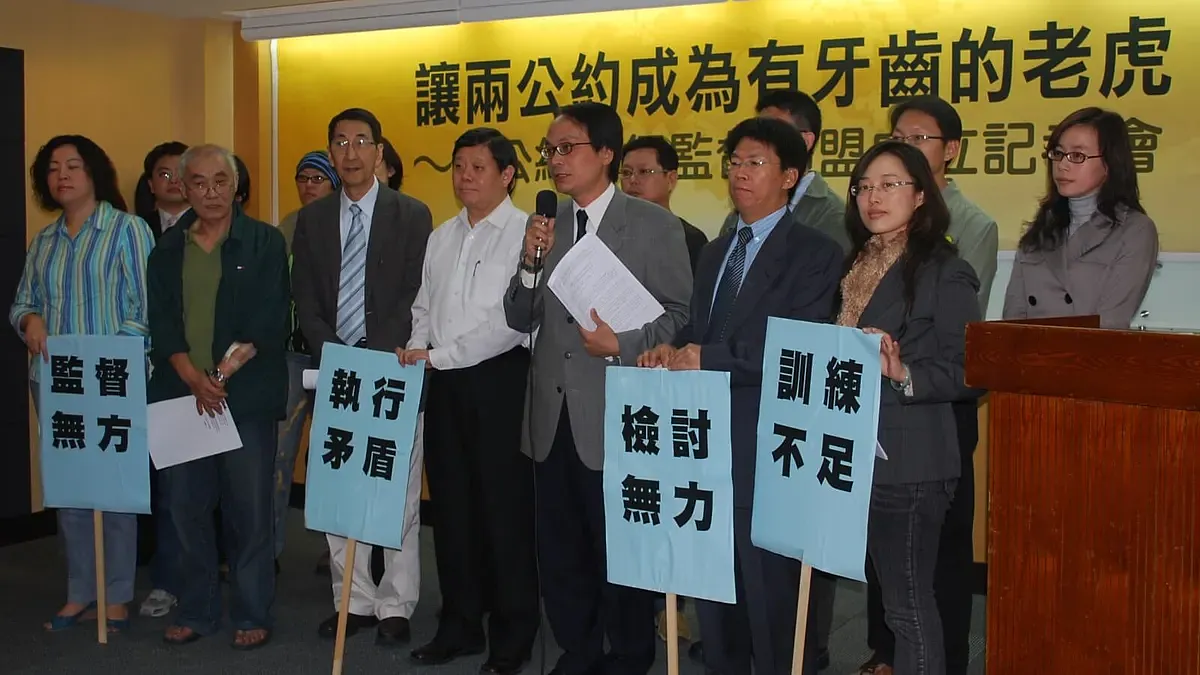
Reviewing Laws to Implement the Two Covenants is a Governmental Duty by Law ~ Civil Society Will Not Endorse a Public Hearing Designed to Shirk Responsibility Casually
Last edited: 2026-07-27
Public Statement Regarding the Ministry of Justice's Convening of the Consultative Public Hearing on "How to Accelerate the Promotion of Legislative Operations for Bills Violating the Two Human Rights Covenants"
Since 2009, this Alliance has continuously published for three years three civil society monitoring reports on the government's implementation of the Two Covenants. Furthermore, the aspect of regulatory review under Article 8 of the Enforcement Act of the Two Covenants has been virtually the focal point of review in every monitoring report. In our 2012 monitoring report, we concretely pointed out: "Since November 30, 2011, the government seems to have halted the deliberation of regulatory reviews. Regarding laws violating the Two Covenants other than the first wave of 263 provisions, there has been no sign of the government intending to carry out a second wave of regulatory review. As for how to quickly complete the legislative amendments for the more than 70 listed bills violating the Two Covenants, no positive progress by the government has been seen." After a year and a half, we finally see the government once again paying attention to regulatory reviews. Although we are still pleased that the Ministry of Justice has convened a public hearing to communicate with civil society, we are quite dissatisfied with the theme, hierarchical level, and approach of this public hearing, and even highly question the underlying motives behind it.
First, the theme of the public hearing was set as "How to Accelerate the Promotion of Legislative Operations for Bills Violating the Two Human Rights Covenants," and then many related civil society organizations were invited to offer concrete suggestions at the public hearing, with the hope of "combining the forces of civil society to jointly accelerate the review procedures for legislative operations regarding bills violating the Two Human Rights Covenants." However, we must point out that, in fact, as early as our 2012 report, this Alliance mentioned: "If we compare the urgently needed priority bills to be deliberated and passed (53 bills + 40 bills) submitted by the Executive Yuan to the Legislative Yuan in the 1st and 2nd sessions of the 8th Legislative Yuan, with the 76 bills violating the Two Covenants announced by the Ministry of Justice, only a very few of these bills became priority bills for these two sessions this year—such as only the draft amendment to some provisions of the Nationality Act in the 1st session, and only the draft amendment to the Assembly and Parade Act as well as the draft amendment to some provisions of the Broadcasting and Television Act in the 2nd session." This shows that the executive branch itself does not attach importance to the implementation of the Two Covenants, nor is it willing to conduct substantive and effective communication with the legislative branch regarding this batch of bills violating the Two Covenants from 2009. Moreover, for many bills violating the Two Covenants—including the Assembly and Parade Act, Nationality Act, Detention Act, and Code of Criminal Procedure discussed in this public hearing—civil society associations have long advocated for the passage of these bills through various channels, yet they often encounter numerous obstacles. Obstacles originating from the executive branch, and even the unwillingness to listen to the opinions of civil society while unilaterally submitting bills that violate the Two Covenants, constitute one of the primary reasons. Therefore, we truly fail to understand what substantive benefit there is for the Ministry of Justice to convene such a public hearing today.
Furthermore, we know that the Human Rights Protection Promotion Committee of the Executive Yuan is the primary unit responsible for Article 8 of the Enforcement Act of the Two Covenants, which pertains to the promotion, supervision, and listing and control of regulatory reviews. Although the secretariat of this human rights committee is established within the Department of Legal Affairs of the Ministry of Justice, we must point out that if the government intends to properly discuss the issue of regulatory review, the level of the public hearing should not be set at the Ministry of Justice; rather, it should be convened and chaired at the level of the Executive Yuan, with representatives from relevant ministries and departments who possess decision-making authority invited to attend. Otherwise, we cannot believe that the outcomes and effectiveness of this public hearing have any possibility of "accelerating" the promotion of legislative operations for bills violating the Two Human Rights Covenants.
Third, we believe that the executive branch has long been unwilling to establish a foundation of mutual trust with civil society, nor has it listened to the suggestions of civil society regarding the human rights compliance of these bills at the many press conferences initiated by civil society. Convening a public hearing in the current manner—merely listing the unpassed bills and hoping to "combine the forces of civil society"—is a quite irresponsible approach and not a fundamental solution. In fact, the most serious problem at present is not accelerating the passage of this messy backlog of unpassed bills from 2009. We are all very clear that, given the current ecology of the Legislative Yuan, no matter how many such public hearings are held, the bills still cannot be passed; it would merely waste everyone's time and administrative resources. Rather than this, it would be better to ponder how to establish a mechanism for the executive branch to draft bills that comply with the Two Covenants.
Finally, we believe that regarding this batch of bills violating the Two Covenants from 2009, because the government failed to conduct solid preparatory work before and after ratifying the Covenants, various agencies hastily compiled this list of regulatory reviews without understanding the contents of the Covenants or referencing general comments. However, the laws, regulations, and administrative measures violating the Two Covenants are numerous; they cannot possibly be limited to these 219 provisions plus the 44 provisions added by civil society. If the public hearing only deals with the related bills that have not yet passed, we believe the meeting will completely fail to focus and will not produce any substantive resolutions. In fact, the current issue lies with the Legislative Yuan, not with the "government sector joining forces with civil society."
In summary of the above opinions, our 20 civil society organizations propose the following four recommendations:
- The executive branch itself can undertake many concrete actions. For example, President Ma Ying-jeou once publicly stated that laws inconsistent with the Two Covenants should be directly governed by the Two Covenants. Therefore, it is recommended that the Executive Yuan also issue an administrative order commanding all ministries and departments to handle matters in accordance with the Two Covenants and the Enforcement Act of the Two Covenants.
- It is recommended that during the legislative amendment process of the Executive Yuan, a mechanism for prior consultation and communication with civil society organizations should be established.
- The Executive Yuan should establish a regulatory review committee to systematically and continuously review laws, regulations, and administrative orders that violate international covenants.
- Draft amendments and policy drafts of all administrative agencies must complete a human rights impact assessment and attach a "Human Rights Checklist" explaining whether they comply with the norms of international covenants before they can be submitted to the Legislative Yuan.
Co-signing Organizations
Taiwan Association for Human Rights, Alliance for Civil Society Supervision of the Two Covenants, Taiwan Association for Prisoners' Rights, Judicial Reform Foundation, Taiwan Association for Innocence, Environmental Jurists Association, National Federation of Teachers Unions, OURs: Urban Reform Organization, Social Housing Advocacy Consortium, Taiwan Alliance to End the Death Penalty, Airport MRT A7 Station Self-Help Association, Taiwan Vagabond Association, Shaoxing Rights Promotion Association, Huaguang Community Self-Help Association, Huaguang Community Fact-Finding Team, Taiwan International Workers Association, Taiwan Indigenous Peoples Policy Association, Taiwan Labour Front, Taiwan Association for Children and Families' Rights, Association of Taiwan Journalists
Press Contact
Shih I-hsiang, Executive Secretary of the Alliance for Civil Society Supervision of the Two Covenants: 02-2596-9525
This article is an AI-generated translation of the original Chinese text. In the event of any discrepancy, the Chinese version shall prevail.