
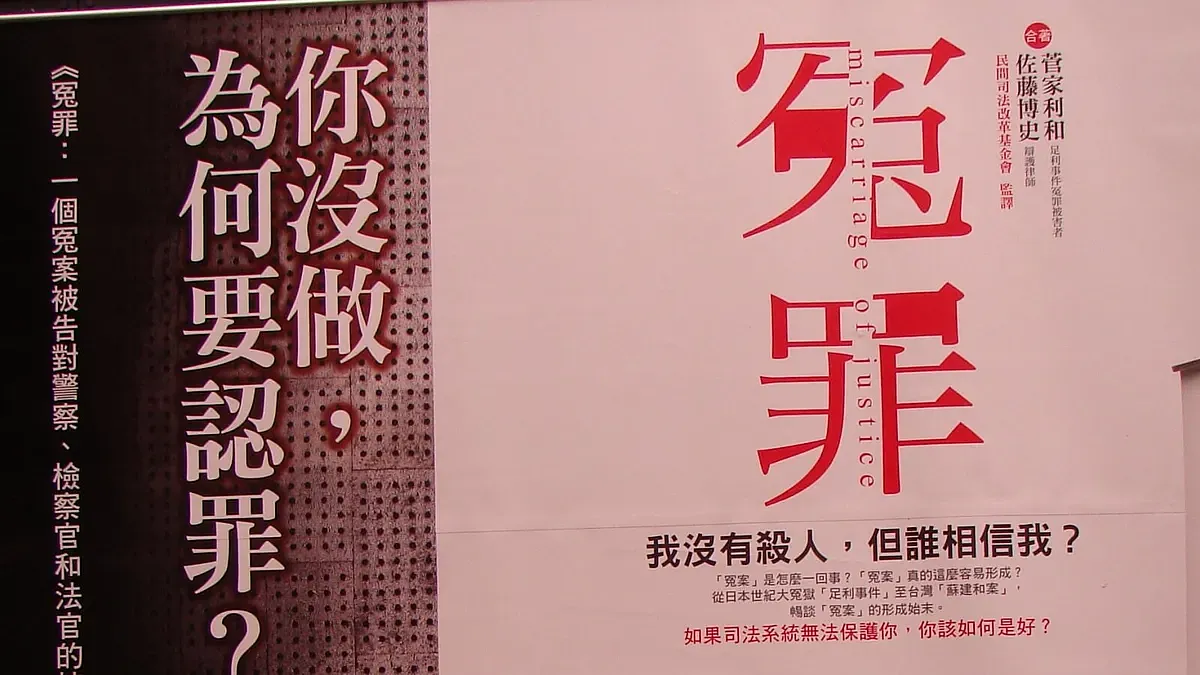
Wrongful Conviction: An Accused Person's Indictment of Police, Prosecutors, and Judges
Last edited: 2026-07-27
This is an accused person's indictment of the police, prosecutors, and judges.
On March 26, 2010, Presiding Judge Satô Masanobu of the Utsunomiya District Court in Japan declared the defendant Sugaya Toshikazu innocent. The three judges of the panel stood up, bowed, and apologized to Mr. Sugaya, stating: "We truly regret that we failed to listen to the voice of truth and deprived you of 17 and a half years of your freedom." These brief 30 seconds summarized Sugaya's 20 years of painful ordeal. Sugaya wept tears of joy. Afterward, he walked out of the courthouse, raising both hands in triumph amid cheers, his excitement palpable as supporters held up banners reading "Totally Innocent" and "Presiding Judge, Apologize." Japanese refer to this case as the "Ashikaga Event."
Stepping back 20 years: "The police first came to my house about a little over a year before I was arrested, in November 1990, which was half a year after little Matsuda Mami was murdered. On May 12, 1990, little Mami (then four years old) went with her father to a pachinko parlor in Ashikaga City, Tochigi Prefecture, and went missing that same day. The next morning, her body was discovered near the embankment of the Watarase River close to the pachinko parlor. ... At the time of the incident, I was 43, single, and had almost no contact with neighbors. When not at work, I would often go to the pachinko parlor or stay cooped up in my rented room, which was about a 15-minute bicycle ride from my parents' home. I suppose that is why I was treated as a suspect." (Quoted from page 24 of this book)
From Life Imprisonment to a Reversed Acquittal: Re-testing DNA
One of the book's authors, Sugaya Toshikazu, was accused of murdering little Matsuda Mami. Based on a coerced confession and a DNA test report, Sugaya was prosecuted shortly after his arrest. Following the Utsunomiya District Court's first-instance judgment of life imprisonment in 1993 (defense counsel Satô Hiroshi was retained only after this), the Tokyo High Court's dismissal of the appeal in 1996, and the Supreme Court's dismissal ruling in 2000, the sentence of life imprisonment was finalized. In October of that same year, Sugaya was transferred from the Tokyo Detention House to the Chiba Prison.
Satô Hiroshi never gave up. In 2002, Satô petitioned the Utsunomiya District Court for a retrial. On February 13, 2008, the petition was dismissed. On February 18, Satô filed an immediate appeal with the Tokyo High Court. Subsequently, they proposed a tripartite agreement among the court, prosecution, and defense, and renewed the request for DNA re-testing. On Christmas Eve of that same year, they received the most precious Christmas gift—a court ruling granting a retrial and ordering a DNA re-test. Half a year later, the test report was released, concluding that the DNA test report relied upon in the original judgment was erroneous, that Sugaya was not the true perpetrator, and he was released in June 2009. In 2010, the case was ruled an acquittal!
This book is co-authored by the defendant Sugaya Toshikazu and his defense attorney Satô Hiroshi, detailing the judicial miscarriage and emotional journey Sugaya endured over these long 20 years—forced false confessions, altered eyewitness testimonies, misleading psychological evaluations, and flawed DNA testing and interpretation...
Shared "Wrongful Conviction" Experiences in Japan and Taiwan: The Ashikaga Event V.S. The Su Chien-ho Case and the Chiang Kuo-ching Case
Beyond providing an in-depth analysis of Japan's century-old wrongful conviction, the "Ashikaga Event," and exposing the heavy shroud of darkness throughout the investigation, prosecution, and trial processes, we also lead readers back to examine Taiwan's own "wrongful conviction" experiences. On the morning of August 31, 2012, at 10:00 AM, the Taiwan High Court acquitted the three defendants in the Xizhi murder case (also known as the "Su Chien-ho case"), Su Chien-ho, Liu Bing-lang, and Chuang Lin-xun. Going back slightly further, on the morning of September 13, 2011, at 9:00 AM, the Northern Regional Military Court ordered a retrial in accordance with the law and acquitted Air Force serviceman Chiang Kuo-ching of charges related to the murder of a young girl.
The Su case spanned 21 years and the Chiang case 15 years before finally achieving reversed acquittals. Across these different cases, we can observe the same criminal justice problems: the coerced confessions in the Su Chien-ho case and the erroneous DNA testing in the Chiang Kuo-ching case are experiences shared by Mr. Sugaya Toshikazu. Therefore, in translating and publishing this book in Taiwan, we have also internalized Taiwan's wrongful conviction experiences. We invited Su Chien-ho case participant Su Chien-ho, Aletheia University Department of Law Associate Professor Wu Ching-chin, and Judicial Reform Foundation member and Chiang/Su defense team lawyer Eugene Yu (Yu Po-hsiang) to write special recommendation essays. Not only do these essays prompt us to re-examine whether "the accused is a bad person" and reflect on whether being "cleared of wrongdoing is a blessing or a misfortune," but they also provide readers with a brilliant analysis of the "perfect formula for manufacturing wrongful convictions."
Justice is not flawless, and Taiwan's society continues to drive reform; the battle against miscarriages of justice will likewise never truly end. We hope that through the publication of this book, Taiwanese readers will be guided to understand the true appearance of a "criminal defendant / bad person" from different perspectives. Beyond obtaining acquittal and exoneration through judicial procedures, we hope to strip away society's discriminatory labels and restore their "innocence"—a "truly recognized" innocence!
Publication Information
Title: Wrongful Conviction: An Accused Person's Indictment of Police, Prosecutors, and Judges (訊問の罠ー足利事件の真実)
Authors: Sugaya Toshikazu, Satô Hiroshi
Translator: Judicial Reform Foundation
Publisher: Taiwan Kadokawa Shoten Co., Ltd.
Publication Date: July 6, 2013
ISBN/ISSN: 9789863251286
List Price: NT$240
Press Contacts
Taiwan Kadokawa Shoten Audrey Chang │ 02-2748-9481 ext. 562 │ chang.audrey@kadokawa.com.tw
Judicial Reform Foundation Chiu Li-ling │ 02-2523-1178 ext. 12 │ liling@jrf.org.tw
This article is an AI-generated translation of the original Chinese text. In the event of any discrepancy, the Chinese version shall prevail.