
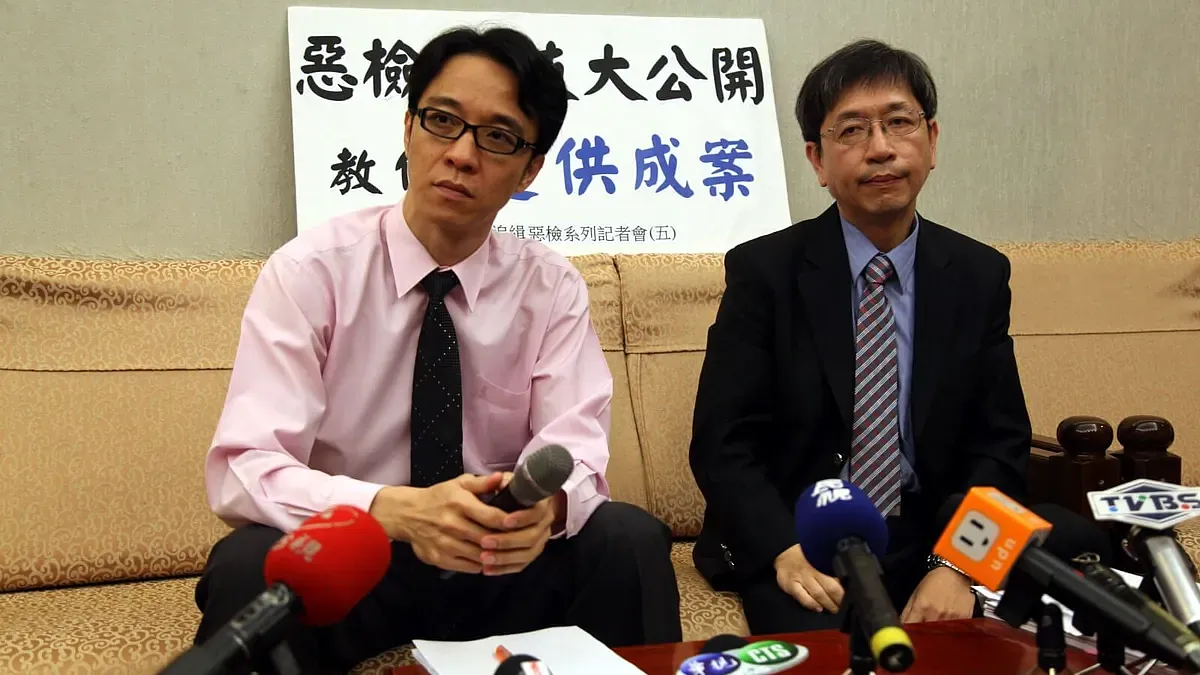
Exposing Corrupt Prosecutors' Secret Techniques? Teaching You How to Coerce Confessions to Build a Case—"Hunting Corrupt Prosecutors" Press Conference Series (V)
Last edited: 2026-07-27
We can understand prosecutors' abhorrence of evil, but it is impossible for prosecutors to make absolutely correct judgments regarding good and evil at the very first instance every time. When investigating cases, if "the defendant is definitely guilty" is adopted as the sole "preconceived stance" and "guidance," it violates the principles of the rule of law, making abuses of power, wrongful accusations, and miscarriages of justice inevitable.
Article 2 of the Code of Criminal Procedure requires prosecutors to "pay equal attention to circumstances both favorable and unfavorable to the defendant"; Article 9 of the Prosecutorial Ethics Norms also continually reminds that: "When handling criminal cases, prosecutors shall strictly observe the principles of statutory punishment and the presumption of innocence, and shall not make convicting the defendant their sole purpose. Evidence favorable and unfavorable to the defendant shall be thoroughly gathered, investigated, and deliberated."
This press conference is based on three cases. The first involves suspected vote-buying, the second involves a police officer suspected of sheltering arcade gambling operators, and the third involves a police officer suspected of accepting bribes. All three cases were handled by former Hualien District Prosecutors Office prosecutor Wu Wen-cheng (currently serving at the New Taipei District Prosecutors Office). While the specific details of his alleged illegalities and dereliction of duty vary, his methods of exploiting procedures and abusing prosecutorial power are identical. Now, after the court acquitted these defendants due to extremely weak evidence, the prosecutors did not even dare to appeal.
Prosecutor Wu's methods sometimes skirt the edges of the law and sometimes adopt overtly illegal tactics.
Examples of the former include:
- Inducing witnesses or making an example of someone to instill fear in witnesses so they utter criminal scenarios matching the prosecutor's imagination; or
- Conducting aggressive searches of civil servant defendants' residences and workplaces, creating social pressure and conducting trial by media amidst heavy media broadcast, forcing defendants to "fall in line."
Examples of the latter include:
- Insulting or coercing interrogated witnesses or defendants during questioning to make them submit to the prosecutor's will and utter statements pleasing to the prosecutor;
- Mismatched evidence that is clearly unrelated to the criminal facts, yet still far-fetchedly and forcibly used to bring an indictment;
- Even violating the constitutional guarantee that "restrictions on personal liberty shall not exceed 24 hours" by detaining the defendant and applying for custodial detention to force the defendant to confess and yield.
Through these methods, prosecutors seem to completely forget that a defendant prior to trial is merely a "suspect" protected by the presumption of innocence. Instead, making the conviction of the defendant their sole purpose, they use their official powers by any means necessary to "hunt down" the people. The modern state governed by the rule of law requires prosecutors to strictly observe the principles of statutory punishment and the presumption of innocence precisely to remind prosecutors that the state has bestowed upon them such immense power, which should be used with caution and care. Otherwise, prosecutors who ought to promote the rule of law and justice can carelessly turn around and inflict severe harm upon the people. Taking these police officers whose acquittals have been finalized as examples: they were indicted, detained, suspended from duties, and stigmatized. In the end, even though they obtained acquittals, received criminal compensation from the state, and were successively reinstated, the agony of falling to the status of prisoners, the potential limitations on career advancement, and the damage to their reputations can never be recovered. Moreover, the public only remembers that these people were once indicted and seemed to be corrupt; now that they have been acquitted, how many people still care or know? These are things that an acquittal cannot remedy. It also deeply makes one feel how much harm prosecutors can inflict upon the people if they abuse their power. Those who hold power should truly maintain a sense of awe and caution at all times.
Today, this Foundation is making public the individual cases involving Prosecutor Wu Wen-cheng and broadcasting courtroom audio and video as supplementary explanation, exposing the prosecutor's abusive investigative methods to the sunlight for public scrutiny. Immediately thereafter, this Foundation will also submit these individual cases to the Prosecutor Evaluation Commission of the Ministry of Justice, formally requesting an individual case evaluation against Prosecutor Wu Wen-cheng.
Attendees
Atty. Lin Yung-sung, Executive Committee Member, Judicial Reform Foundation
Atty. Kao Jung-chih, Office Director, Judicial Reform Foundation
Press Contact
Atty. Kao Jung-chih 02-2523-1178
This article is an AI-generated translation of the original Chinese text. In the event of any discrepancy, the Chinese version shall prevail.
