
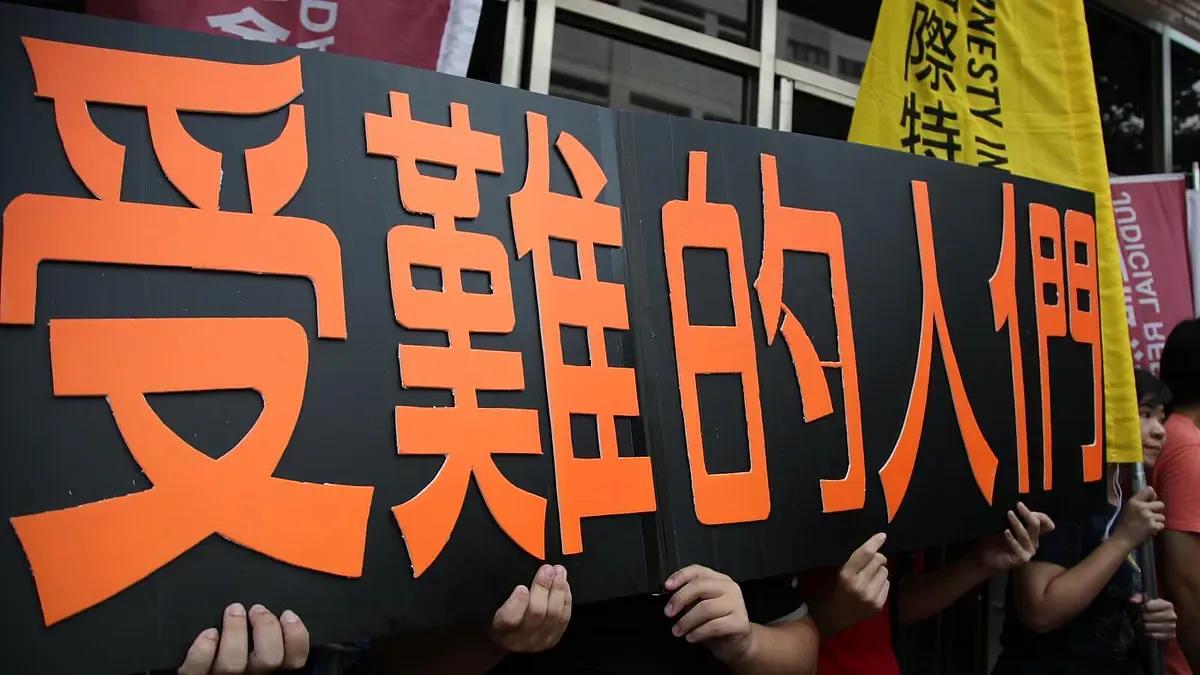
Joint Statement Regarding the Criminal Compensation Ruling in the Su Case
Last edited: 2026-07-27
Regarding today's (10th) High Court Ruling 101-Xing-Pu-Zi No. 36 concerning the petition for criminal compensation filed by Liu Bing-lang, Chuang Lin-xun, and Su Chien-ho, we issue the following statement:
I. The ruling's determination of facts contradicts the previous final acquittal judgment by the High Court (100-Chu-Tsai-Keng-(San)-Zi No. 1)
-
The determination regarding whether torture occurred is erroneous:
Based on the evidence, the original final judgment determined that Su Chien-ho's confession was obtained through torture and excluded its use. This ruling claims that the original judgment 'did not determine that the three individuals were indeed tortured by the police,' which is already erroneous.
-
The interpretation of the so-called 'voluntariness of confession' is sophistry:
This ruling vaguely claims that the original final judgment 'expressed doubts about the voluntariness of the confession and excluded its admissibility upon examination under the strict evidence rule, but did not determine that the three claimants were indeed tortured by the police.' However, 'issues with the voluntariness of a confession' mean that the confession was not a statement made of the defendant's own free will. According to common sense, statements not made of one's own free will generally stem from threats, inducement, intimidation, coercion, and torture.
Since the original final judgment already confirmed that 'there are issues with the voluntariness of the confession,' it evidently determined that the investigation by prosecutors and police at the time was indeed unlawful. Even if the specific forms of police and prosecutorial illegality were left unaddressed, it was because the specific methods of illegality had no bearing on the conviction in the original judgment; as long as the degree of illegality reached the threshold of excluding the confession, the confession could not be adopted as evidence. This ruling's strained interpretation is sheer sophistry.
II. The application of the law in this ruling violates the Code of Criminal Procedure and the Two Covenants
-
It reverses the state's burden of proof:
This ruling repeatedly emphasizes that 'the original final judgment did not state that there was torture, nor are the victims able to prove they were tortured,' which reverses the state's burden of proof. The burden of proof regarding whether torture occurred lies with the state—specifically, the prosecutor representing the state—as is self-evident from Article 156, Paragraph 3 of the Code of Criminal Procedure. Furthermore, paragraph 41 of General Comment No. 32 of the International Covenant on Civil and Political Rights specifies that when there is doubt regarding a violation of Article 7 prohibiting torture, 'the burden is upon the State to prove that the statement was made voluntarily.' Therefore, this ruling cannot use the victims' inability to prove that they 'were not tortured' as a ground to determine that the victims bear attributable responsibility and thereby reduce their compensation.
-
It violates Articles 7 and 14(6) of the International Covenant on Civil and Political Rights:
Article 7 of the ICCPR 'unconditionally and absolutely' prohibits torture and cruel treatment, and Article 14, Paragraph 6 stipulates that victims of miscarriages of justice have the right to compensation. Moreover, paragraph 18 of General Comment No. 13 of the ICCPR issues a warning that 'many States have often failed to observe this right or to provide adequate guarantees.' This ruling 'fragments' the 'confession' from the 'causes leading to the confession,' seemingly taking the stance that once a 'defendant confesses' and is detained, they bear 'attributable responsibility,' thereby ignoring the underlying reason for the confession: that it was the result of threats, inducement, intimidation, coercion, and torture. Consequently, this ruling not only violates the principles of empirical logic and reasoning, but also runs counter to the spirit of Articles 7 and 14(6) of the ICCPR mentioned above, thereby shirking the state's responsibility and being stingy in providing adequate guarantees to the people.
III. Su Chien-ho and the other two individuals, upon receiving the ruling and consulting with their legal defense team, will file a motion for review with the Criminal Compensation Tribunal of the Judicial Yuan.
Joint Statement by: Association for the Vindication of Su Chien-ho's Case, The Homemaker Education Foundation, Taiwan Association for Human Rights, Taiwan Association for Innocence, Judicial Reform Foundation, Covenants Watch, Taiwan Alliance to End the Death Penalty
This article is an AI-generated translation of the original Chinese text. In the event of any discrepancy, the Chinese version shall prevail.