
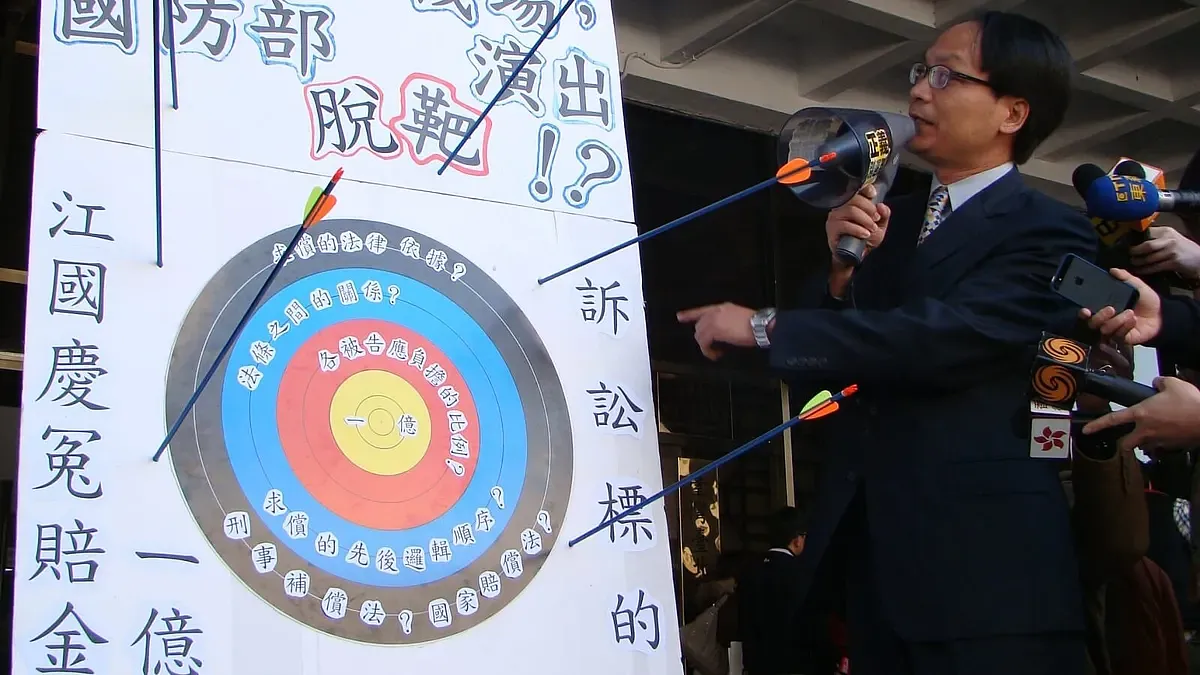
Ministry of National Defense's Claim for Damages Against Ch'en Chao-min and Others Continues to "Miss the Target"
Last edited: 2026-07-27
Regarding today's (the 16th) civil court hearing on the Ministry of National Defense's claim for damages against Ch'en Chao-min and others regarding the compensation for the Chiang Kuo-ching case, our Foundation conducted courtroom observation and issues the following statement:
1. Since the first court hearing of this case on September 24, 2012, the judge questioned the Ministry of National Defense's inadequate preparation. The second hearing took place on November 21 of the same year, and today marks the third hearing. However, the Ministry remains unclear about its statement of claims and the underlying legal relationships, clearly revealing the judge's frustration. Over three hearings, the Ministry has still failed to clarify the legal relationships, delivering yet another "off-target" performance.
2. Following the High Prosecutors Office's public announcement on December 9, 2012, to set aside the Taipei District Prosecutors Office's non-prosecution disposition for Ch'en Chao-min and others, the defendants' defense arguments can generally be divided into three categories:
- Ch'en Chao-min claims: (1) All resolutions were "discussed" and passed "without objection" by the task force, so he should not be held solely responsible; (2) Ch'en also noted "everything shall comply with the law," so the responsibility for torture cannot be pinned on him; (3) He was unaware of the solitary confinement disposition.
- Military prosecutors claim: (1) Special task force meetings convened by a lieutenant general are not something subordinate personnel can interfere with; (2) They did not participate in nor were they aware of the torture; (3) The solitary confinement disposition had long been decided and was not imposed for the purpose of torturing Chiang Kuo-ching.
- As for the Counter-Intelligence Investigation Team, who carried out the physical acts: (1) They do not deny that torture took place, but (2) they were merely following orders.
3. From the defendants' defense arguments, it is evident that whether the Taipei District Prosecutors Office files an indictment is linked to the Ministry of National Defense's civil claim for damages. If even an indictment is this difficult, civil claims for damages are likely to be deeply pessimistic. Furthermore, "a courtroom is a battlefield," and entering court should be treated as combat. Strategic objectives, execution tactics, sand table exercises, logistical support, and repetitive simulations are all indispensable. After three hearings, the Ministry cannot even clearly articulate the legal relationships, failing to show any actions or resolve matching the Minister of National Defense's solemn pledge to "win at all costs."
4. Therefore, the conclusion of today's courtroom observation remains: given the Ministry of National Defense's current level of litigation preparation, no possibility of winning the lawsuit can be discerned. If the situation is allowed to develop unchecked, the outcome where the 100 million NTD wrongful compensation initially paid by the Ministry is ultimately borne by the general public will likely be unavoidable.
This article is an AI-generated translation of the original Chinese text. In the event of any discrepancy, the Chinese version shall prevail.