
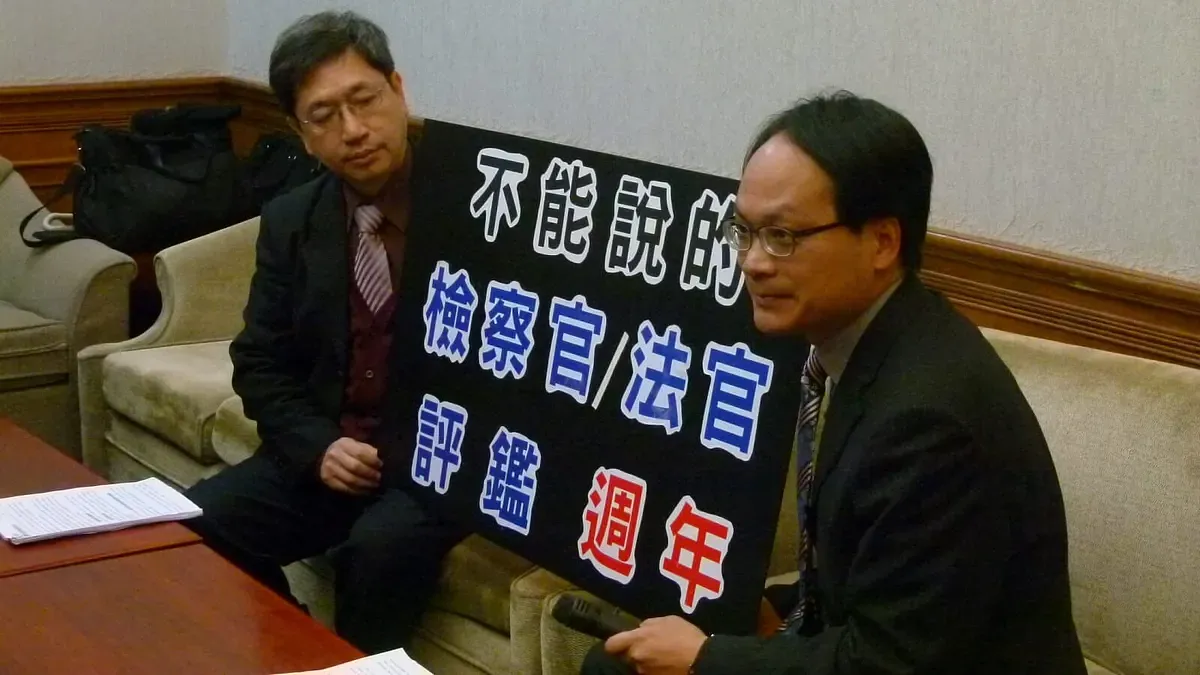
The Unmentionable Anniversary of "Prosecutor/Judge Evaluation"?!
Last edited: 2026-07-27
On January 6, 2012, the prosecutor and judge evaluation systems officially took effect, and the Ministry of Justice and the Judicial Yuan established their respective Prosecutor Evaluation Commission and Judge Evaluation Commission. High-ranking officials from both agencies held a grand press conference at the time, unveiling the plaques with great fanfare amidst thunderous applause. In his speech, the Minister of Justice even made a solemn vow, claiming that "several problematic prosecutors have already been identified," projecting a ready-to-act stance aimed at eliminating incompetent prosecutors through this evaluation system.
Disappointingly, the Prosecutor and Judge Evaluation Commissions have proven ineffective. Looking at the case load, the Judge Evaluation Commission handled merely three cases, while the Prosecutor Evaluation Commission pathetically handled only one—which was proactively transferred by the Taitung District Prosecutors Office, with zero public complaints processed. The Prosecutor Evaluation Commission looks less like a grievance channel for the people and more like an official "housecleaning" organ. Judging by the outcomes, no one was eliminated. With such dismal results and an awkward first anniversary, it is no wonder that the Ministry of Justice and the Judicial Yuan did not hold grand press conferences as the evaluation system reached its one-year mark on the eve of Judicial Day (January 11). The reason is simple: there are too many "unmentionable truths" within. Since the authorities refuse to speak of them, we will:
-
Conservative institutional design shuts the public out
Citizens cannot file complaints directly, and the organizations filing on their behalf lack access to data. Unable to obtain documents to accuse officials, and with civil society organizations legally empowered to report also struggling to take action, grievances are inherently doomed to remain unredressed.
-
The Prosecutor Evaluation Commission is hollowed out
Compared to the Judicial Yuan's Judge Evaluation Commission, the Prosecutor Evaluation Commission has taken it upon itself to restrict its own investigative powers. Unable to initiate investigations proactively, it can only passively wait for reports? Furthermore, investigations into reported cases are restricted solely to the specific individual case reported and cannot extend to systemic issues? Even more absurdly, evaluation commissioners are not necessarily able to review case files or audio/video records of court sessions even for reported cases? One truly wonders what kind of justice commissioners with such crippled investigative powers can uphold for the public, or what kind of incompetent prosecutors (judges) they can eliminate.
Therefore, the foreseeable conclusion is that if the Prosecutor and Judge Evaluation Commissions continue to operate this way, they are destined to be a sham.
To see the big picture from a small detail, let us take an individual case as an example. Following public complaints, our Foundation held press conferences on April 17 and May 3, 2012, respectively, to report Prosecutor Lin Kuan-yu (林冠佑) of the Taipei District Prosecutors Office for his extremely poor courtroom attitude. Yet, nine months have passed, and the Prosecutor Evaluation Commission has yet to take any action. As it turns out, under the pressure of widespread media reports and criticism, the Ministry of Justice actually "approved" his departure abroad?
Dressed up as "studying abroad," a prosecutor's advanced studies inevitably involve case handling and human resources allocation. Beyond meeting relevant criteria, it ordinarily requires a considerable connection to one's work and must be approved by the Ministry of Justice. What raises suspicion is that the timing of the Ministry of Justice's approval for him to go abroad is far too "coincidental"? If this is taking "leave without pay" to "dodge the spotlight," the Ministry of Justice is essentially spearheading illegal and arbitrary actions while interfering with the investigation of the Prosecutor Evaluation Commission—which is utterly improper! With a Ministry of Justice like this, even ten Prosecutor Evaluation Commissions would be in vain!
Today, our Foundation is making public yet another case reported by a citizen against Prosecutor Lin Kuan-yu, and will play the audio recording as evidence, laying bare Prosecutor Lin Kuan-yu's arrogance, overbearingness, authoritarianism, and lawlessness in court for public scrutiny. At the same time, we must ask the Ministry of Justice: could it be that permitting a reported prosecutor to go abroad for advanced studies at a sensitive moment of investigation is your way of responding to public grievances regarding the judiciary? With the previous case unsettled and a new one arriving, just how far is the Ministry of Justice willing to protect its own before facing reality? Is there truly any determination to let the Prosecutor Evaluation Commission function to its full potential?
Attendees
Jên Yung-sung, Esq., Executive Committee Member, Judicial Reform Foundation
Lin Feng-cheng, Esq., CEO, Judicial Reform Foundation
Press Contact
Lin Feng-cheng, Esq. 02-2523-1178
This article is an AI-generated translation of the original Chinese text. In the event of any discrepancy, the Chinese version shall prevail.