
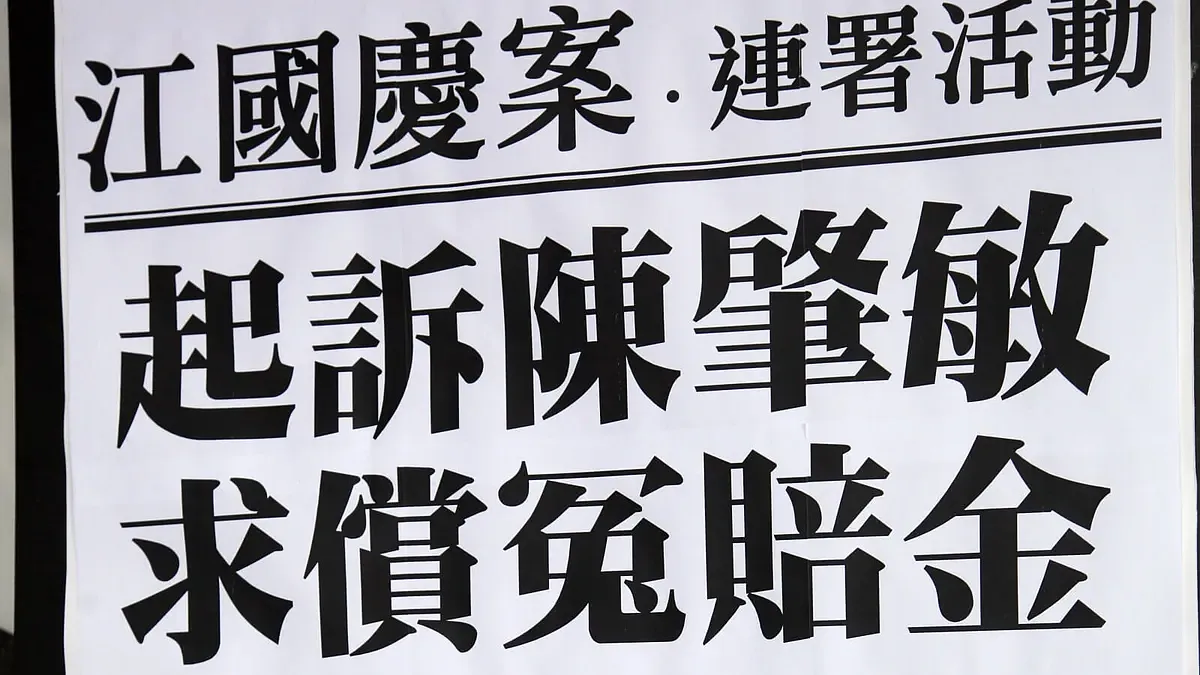
Who Should Pay for the Wrongful Execution of Chiang Kuo-Ch'ing? Ministry of National Defense's Civil Recourse Action Against Ch'en Chao-min: Post-Court Observation Statement
Last edited: 2026-07-27
The Foundation's statement following court observation of the Ministry of National Defense's civil recourse action for compensation in the Chiang Kuo-Ch'ing case against Ch'en Chao-min et al. on September 24 is as follows:
1. The Taipei District Prosecutors Office's Decision Not to Prosecute Has Indeed Created Difficulties for the Ministry of National Defense's Recourse Action
- Almost all defendants, including Ch'en Chao-min, cited the non-prosecution disposition by the Taipei District Prosecutors Office to argue that they bore no "intent" or "negligence" whatsoever. This completely confirms our previous suspicion: prosecutors whitewashing criminal liability will ultimately lead to the exemption of compensation liability, making it difficult for the national treasury to seek recourse from illegal and derelict public servants, leaving the public to foot the bill.
- Regardless of whether civil recourse liability must be predicated on the existence of criminal liability, everyone should closely monitor the litigation strategy of the Ministry of National Defense and examine how it argues the legal principles of civil recourse—especially regarding the legal constitutive requirements of "intent or gross negligence" and how it refutes the unreasonable defenses raised by the defendant Ch'en Chao-min and others.
2. The Chiang Kuo-Ch'ing Case Is a Classic Example of "State-Institutionalized Murder"; If Responsibility Is Segmented Overall, No One Will Be Held Accountable
- Continuing the spirit of the prosecutor's non-prosecution disposition in fragmenting responsibility, the defendants in the civil court have indeed begun to distance themselves from one another's responsibilities.
- Subordinates claimed: They were merely "following orders," and even pleaded to the court that if soldiers failed to obey, they would face criminal liability for "insubordination."
- However, commander Ch'en Chao-min stated: Although he deployed subordinates from the "Counter-Intelligence Unit," specifically tasked with dealing with "spies and traitors," to "interrogate," he also instructed that "everything must be lawful." How could the torture and coerced confessions by his subordinates be blamed on him?
- If their arguments hold water and the conclusion that "no one needs to be held responsible" looms large, can we really accept this?
3. Concerned About the Ministry of National Defense's Lack of Vigor in "Collecting the Debt," We Are Considering "Intervention in Litigation":
- Regarding whether the Ministry of National Defense has done its utmost to guard the people's purses, we have previously raised four questions (please refer to this morning's press release).
- After observing the court proceedings, the judge appropriately clarified the legal opinions, holding that: (1) The Ministry of National Defense's explanation of the constitutive requirements in the complaint was overly simplistic; (2) Because the responsibilities of each defendant differ, the Ministry failed to individually discuss the legal basis, underlying facts, and legal requirements corresponding to each defendant; resulting in (3) Defendants being unable to respond and defend themselves, and the Ministry facing the risk of losing the lawsuit due to insufficient evidence. Regarding the factual aspect, the judge also questioned: (4) Who should have originally investigated the Chiang Kuo-Ch'ing case? Why did Ch'en Chao-min have the "Counter-Intelligence Unit" form a special task force to investigate? The explanations provided by the Ministry of National Defense remain utterly unclear.
- The various issues raised by the court are precisely our concerns. The prosecutor's non-prosecution decision is almost tantamount to drafting a statement of defense for the defendants. If the Ministry of National Defense fails to actively enrich the legal relations and factual testimonies, it may lead to the dismissal of the lawsuit, preventing the national treasury from ever recovering this debt, leaving taxpayers to suffer the consequences.
- Therefore, in addition to organizing a series of activities such as solidarity rallies, petition signatures, and human-formation character displays to urge everyone to actively care about the Chiang Kuo-Ch'ing case, we are also considering filing an application for "intervention in litigation" with the court regarding the civil proceedings.
Press Contact
Attorney Lin Feng-cheng, Executive Director, Taiwan Association for Human Rights / Judicial Reform Foundation 02-2523-1178
This article is an AI-generated translation of the original Chinese text. In the event of any discrepancy, the Chinese version shall prevail.