
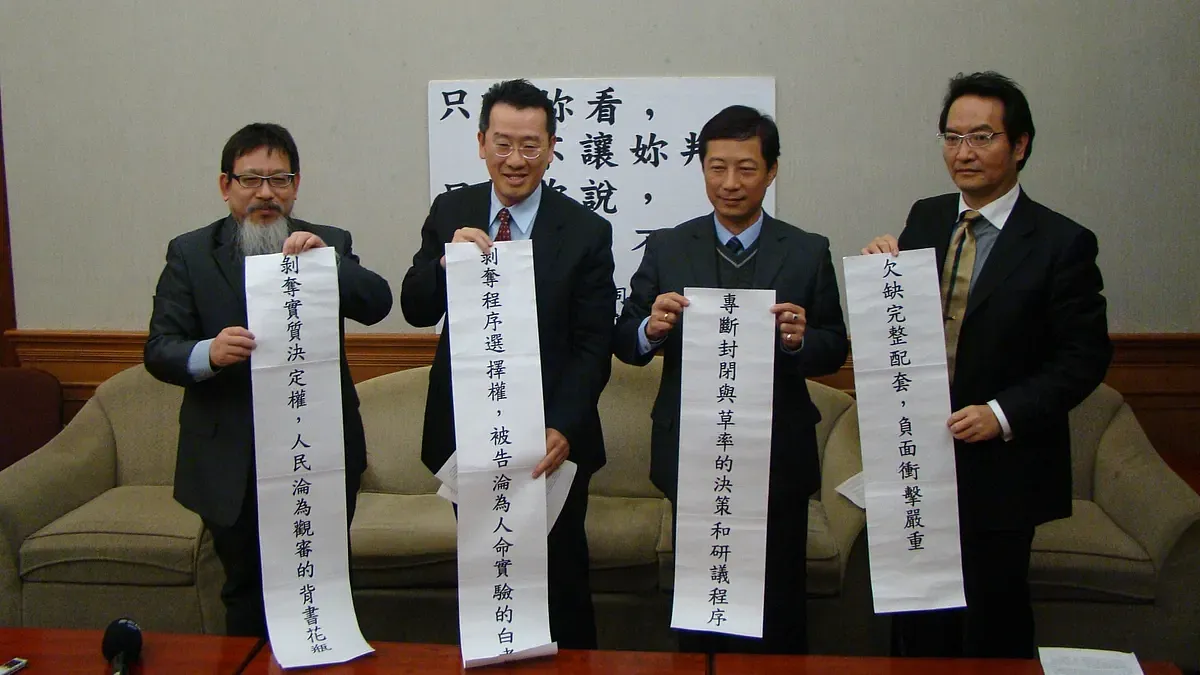
Allowed to Watch, but Not to Judge? Allowed to Speak, but Your Voice Doesn't Count?!—Civil Society Organizations' Statement on the Judicial Yuan's Draft "Provisional Statute for Lay Assessor Trials"
Last edited: 2026-07-27
After the Judicial Yuan officially announced to the public in July 2011 its judicial reform policy to promote the "lay assessor system," it proposed the Draft Provisional Statute for Lay Assessor Trials in less than half a year, despite triggering numerous doubts. According to the Judicial Yuan's established plan, this draft would be submitted to the new legislature in the spring of 2012 to complete the three readings of the legislative process, with the Shihlin and Chiayi District Courts selected for "pilot implementation."
Grounded in the ideal of judicial democratization, we support the introduction of a system for "lay participation in trials" so that the judicial power is no longer exercised solely by professional judges, thereby enhancing democratic legitimacy. However, faced with this systemic reform—arguably the most drastic in our nation's judicial history and with the most far-reaching impact—we are deeply concerned that the Judicial Yuan's overly "conservative mindset," "hasty deliberations," and subsequent "arbitrary decision-making," rushed into implementation under conditions of manifest inadequacy, may lead to a comprehensive failure of "lay participation in trials." This would further cause the public to completely lose faith in the system, wasting both public funds and labor while pointlessly squandering the opportunity to deepen judicial democracy.
Therefore, the "Alliance for Lay Participation in Trials," formed by civil society organizations, not only (1) specifically points out four major flaws in the Judicial Yuan's version of the Draft Provisional Statute for Lay Assessor Trials, but also (2) insists that the core spirit of "lay participation in trials" lies in holding a "substantial voting right" regarding judgments and exerting a "binding force" on professional judges, and (3) under thorough evaluation, analysis, and supporting preparation, expresses strong support for "comprehensively" implementing the system of "lay participation in trials."
The Four Major Flaws of the Judicial Yuan's Draft Provisional Statute for Lay Assessor Trials:
-
Deprivation of Substantial Decision-Making Power, Reducing the Public to Mere Window Dressing for Lay Assessor Endorsements
The institutional core of citizen participation in trials is to incorporate the "rules of experience and perceptions of justice" of "cross-disciplinary representatives" into the "fact-finding" and "legal subsumption" of judicial judgments, thereby reducing the risks that may arise when professional judges monopolize judicial power. Precisely for this reason, almost all countries that adopt systems of lay participation in trials grant citizens the "power to actually participate in decisions." However, the Judicial Yuan has acted in reverse, stipulating in the draft that the majority opinion of lay assessors shall merely serve as a reference for judges and shall not be binding. This completely violates the institutional spirit of citizen participation in trials, reducing the public to mere window dressing for judicial endorsements.
-
Deprivation of the Right to Choose Procedures, Reducing Defendants to Guinea Pigs in Human Experiments
On the one hand, the Judicial Yuan's draft limits the scope of application of the lay assessor system to serious criminal cases "involving the death penalty or life imprisonment"; on the other hand, it refuses to grant defendants the right to choose whether or not to adopt the lay assessor system. The direct effect of combining these two designs is that, before the system has been equipped with a complete evaluation and supporting design based on empirical evidence, it not only forces "criminal defendants in certain regions" to pay with their "lives and lifelong freedom," reducing them to guinea pigs in judicial experiments, but also deprives defendants of the right to say "no." Such an institutional design not only triggers constitutional controversies regarding the right to equality in litigation, but also involves grave violations of human rights.
Regarding this extremely unreasonable institutional design, a judge who participated in the formulation of the system for the Judicial Yuan once frankly and publicly stated that the reason was: "If defendants are allowed to choose, what if the majority of defendants choose not to adopt the lay assessor system? The Judicial Yuan would lack sufficient experimental samples?!" Can any government claiming to value judicial human rights use such a horrifying reason to force criminal defendants to participate in an extremely costly experiment? Is this not a supreme irony after the implementation of the two international human rights covenants?
-
Arbitrary, Closed, and Hasty Decision-Making and Deliberation Procedures
The "lay assessor system" was proposed by current Judicial Yuan President Lai Hao-min and Vice President Su Yong-chin when they took office in November 2010. Since the establishment of the "Lay Assessor System Deliberation Committee" in January 2011, criticisms that "the Judicial Yuan has a predetermined stance" and that "the committee has been reduced to window dressing" have continuously emerged. The deliberation committee, originally scheduled to last for a year, was hastily ended and dissolved after six months without meaningful discussions on substantive issues. The "Research and Formulation Committee for the Provisional Statute for Lay Assessor Trials," subsequently organized by the Judicial Yuan in August 2011, not only continued to adopt a closed decision-making model but further prohibited participating representatives from questioning the fundamental institutional stance on "lay assessment." How could such a decision-making process fail to be questioned as arbitrary?
What is even more serious is that, despite continuous calls from all sectors not to rush things, the Judicial Yuan disregarded the reality of severe under-preparedness and insisted on hurriedly completing the drafting of the bill by the end of 2011. Referring to Japan's process and experience in promoting citizen participation in trials, its "lay judge system (saiban-in seido)," which began operation in May 2009, not only underwent four years of gestation but also underwent five years of solid preparation. Participants included not only the legal professional community of judges, prosecutors, defense attorneys, and academics, but extended to various cabinet ministries and civil society organizations and groups. Furthermore, during the five-year preparation period, 630 mock trials and 290 mock lay judge selection procedures were conducted, and the results of the simulations were fully made public to accept suggestions and public comment from society. By comparison, the hastiness of the Judicial Yuan's decision-making and deliberations goes without saying.
-
Lack of Comprehensive Supporting Measures, Causing Severe Negative Impacts
The operation of a system of citizen participation in trials requires comprehensive supporting institutional measures. To date, there is no sign whatsoever of the Judicial Yuan planning and preparing the necessary supporting measures. Setting aside "out-of-court" institutional supporting measures (such as the impact on the lives and physical and mental well-being of citizens participating in trials), even looking solely at the supporting measures related to criminal litigation—such as the single-charge-sheet system, pre-trial preparation, centralized trials, rules of evidence, and appeals—necessary reforms must be completed in advance; otherwise, not only will it be impossible to realize any of the values of citizen participation in trials, but it will also inflict severe negative impacts on the criminal justice system, making all procedural participants and stakeholders victims of the Judicial Yuan's rash experimentation.
Finally, we must once again call for and emphasize:
- The core spirit of "lay participation in trials" lies in citizens holding a "substantial voting right" regarding judgments and exerting a "binding force" on professional judges. Only in this way can judicial democratization be realized and effectively respond to the public's dissatisfaction with and expectations of the judiciary.
- Under thorough evaluation, analysis, and supporting preparation, the system of "lay participation in trials" should also be implemented "comprehensively" rather than arbitrarily selected regions for pilot testing. Aside from turning citizens into guinea pigs for judicial experiments, this would also cause courts to act on their own and lead to schizophrenia for those participating in criminal litigation procedures.
In short, the system of citizen participation in trials is a major engineering project for our nation's judicial reform; it must never be approached hastily, arbitrarily, or with closed doors. It must be steady and solid, expanding participatory dialogue and formulating supporting measures. Otherwise, rushing into implementation will not only squander public funds and waste resources, but also sacrifice the rights and interests of the broad masses of the people, dash the golden opportunity for our country to introduce a sound and complete mechanism for citizen participation in trials, and shackle the infinite potential for conducting future judicial reforms.
Attendees
Attorneys Ch'en Po-hsiang (Representative of the Taipei Bar Association)
Attorney Chang Ching (Representative of the Hualien Bar Association)
Attorney Ku Li-hsiung (Convener of the Alliance for Lay Participation in Trials and Representative of the Taiwan Bar Association)
Attorney Lai Mi-ting (Representative of the Taoyuan Bar Association)
Attorney Lo Ping-ch'eng (Representative of the Hsinchu Bar Association)
Attorney Lin Feng-cheng (Executive Director of the Judicial Reform Foundation)
Co-initiating Organizations
The "Alliance for Lay Participation in Trials" is jointly formed by organizations including the Taiwan Bar Association, Keelung Bar Association, Taipei Bar Association, Taoyuan Bar Association, Hsinchu Bar Association, Hualien Bar Association, Chiayi Bar Association, Tainan Bar Association, and the Judicial Reform Foundation.
Press Contact
Attorney Lin Feng-cheng, Executive Director, Judicial Reform Foundation 02-25231178
Official Responses
This article is an AI-generated translation of the original Chinese text. In the event of any discrepancy, the Chinese version shall prevail.