
The Hsu Tzu-chiang Case: "Judges Sent Someone to Fix the Prison Sentence"
Last edited: 2026-07-27
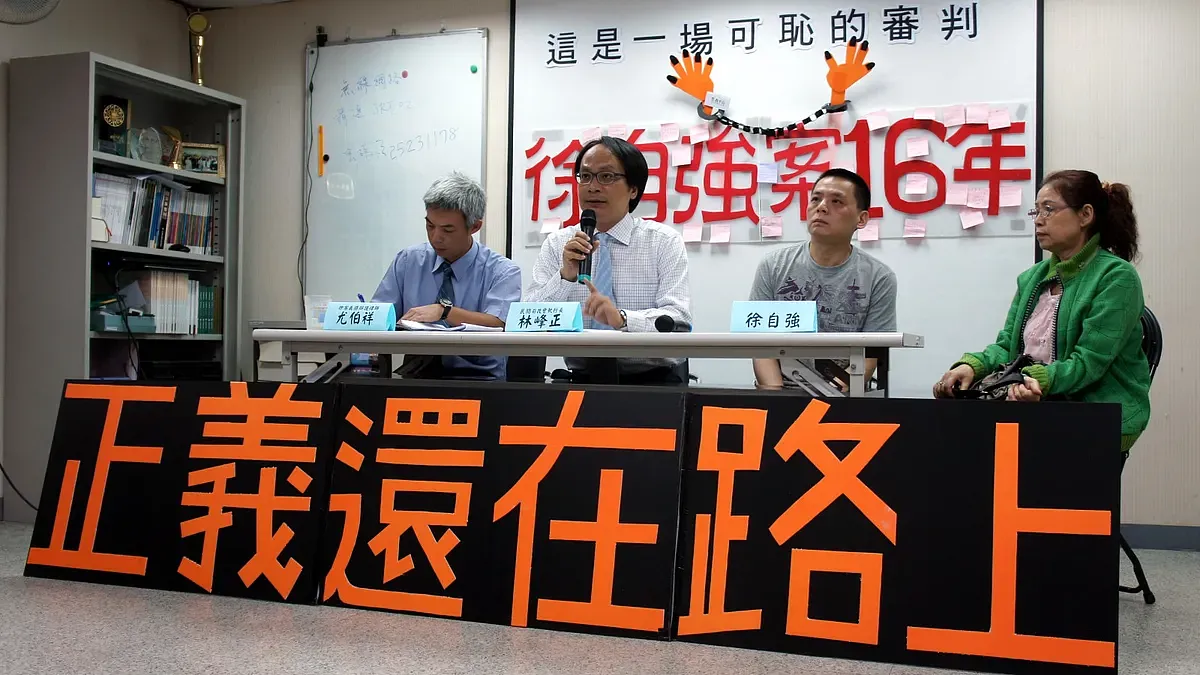
Regarding the report "Judges Sent Someone to Fix the Prison Sentence" published in Next Magazine today (May 24), Hsu Tzu-chiang and JRF held a press conference this afternoon to explain the actual situation and raise several questions for the High Court:
Hsu Tzu-chiang Guarantees: Bravely Facing Judicial Trial, Absolutely No Flight!
- Having voluntarily surrendered himself sixteen years ago, Hsu Tzu-chiang has already demonstrated his determination to bravely face the judiciary. Had he intended to flee, there would have been no need to surrender himself in the first place.
- According to the provisions of the Act for the Speedy Trial, as long as Hsu Tzu-chiang is willing to plead guilty, his life sentence can be commuted to a fixed-term imprisonment. Coupled with having been detained for nearly 16 years, he could almost be released immediately. Rejecting this option is precisely to prove that he has indeed been wrongfully accused, in the hope of one day walking out of prison with a clean slate.
- Therefore, Hsu Tzu-chiang and his legal team will surely continue to appeal until the day justice is manifested.
At the request of the public, the sequence of events regarding "Judges Sent Someone to Fix the Prison Sentence" is briefly described as follows:
Hsu Tzu-chiang stated: On Monday, April 30 at 10:00 AM, two male public defenders came for a legal visit, bringing the police department's reply and some case files. They first said, "We only reviewed the files last Friday (April 27); a few days ago the judge told us to take over the arguments" and "The judge asked us to come because the case must be concluded before May 19." Pointing to the police department's reply, they said, "Your defense attorneys have not reviewed the files; the judge thinks the three lawyers might not want to argue and intend to delay the litigation." The public defenders further stated, "Your case cannot possibly result in the death penalty. You have been locked up for a very long time; if you plead guilty using the Act for the Speedy Trial, your sentence can be commuted." I replied, "I cannot possibly use the Act for the Speedy Trial, because using it requires pleading guilty. I have not done what is alleged, and I cannot possibly plead guilty. What I want is the truth, the facts, and my innocence." The conversation lasted only about 10 minutes before they left.
Judicial Reform Foundation's Questions Regarding the High Court's Press Release:
- The pro bono defense attorneys have never been absent and have overcome all difficulties to fully cooperate under the court's demand for intensive hearings. Did the prerequisite for appointing a public defender even exist in the first place?
- The High Court's press release claims that a public defender was appointed for the defendant "previously." However, searching through the case files, there seemingly appears to be no relevant documentation to serve as proof?
- Furthermore, since the defendant already had defense counsel, would it not be illegal for the court to appoint an additional public defender (according to what the public defender stated inside the detention center, the date was April 27)?
- When interviewed by Next Magazine, the public defender clearly admitted to being dispatched by the judge. However, the High Court's press release seemingly denies that the panel of judges instructed the public defender to go to the detention center. What is the actual truth?
Synthesizing the above questions, we believe that in the current eighth retrial proceedings by the High Court's panel of judges, their sole focus is simply to rush to "conclude the case as soon as possible and avoid releasing the prisoner" before the implementation of the Act for the Speedy Trial on May 19! In other words, a "guilty" mindset had already been predetermined in their minds. This explains why they turned a deaf ear and turned a blind eye to the alibis, the requests for on-site inspection and reconstruction, and the applications for evidence investigation submitted by the defense team. The people's right to a fair trial by a court has been utterly lost; although Hsu Tzu-chiang has undergone trial in form, in reality, an entire trial instance has been completely wasted!
Press Contact
Lin Feng-cheng 02-25231178
Taiwan High Court Press Release
Release Date: May 23, 2012
Releasing Unit: Administrative Presiding Judge's Office
Contact Person: Hung Kuang-ts'an
Contact Number: 02-23713261#8007
No.: 101-003
Regarding the 574th issue of Next Magazine published on May 24, 2012, which featured the article "Exclusive Interview with Hsu Tzu-chiang: Judges Sent Someone to Fix the Prison Sentence," the contents described therein do not match the facts. To prevent outside misunderstandings, this Court hereby explains as follows:
Pursuant to Article 31, Paragraph 1 of the Code of Criminal Procedure, which stipulates that "For cases where the minimum prescribed punishment is imprisonment for 3 years or more, cases of the first instance over which the High Court has jurisdiction, or cases where the defendant is unable to make a complete statement due to mental disability, if the appointed defense counsel is absent on the trial date without justifiable reason, the presiding judge may designate a public defender," although Paragraph 4 of the same Article provides that "After a defense counsel is designated, if counsel is retained by the defendant, the designation of defense counsel may be revoked," because this case, pursuant to Article 5, Paragraph 1 of the Act for the Speedy Trial, must be prioritized and handled through intensive and concentrated trials, a public defender was accordingly designated for the defendant upon receipt of the case. Once the defendant retains defense counsel, should a situation arise where counsel is absent as provided in Article 31, Paragraph 2 of the Code of Criminal Procedure, substantive defense can be immediately conducted for the defendant to safeguard the defendant's procedural rights. Pursuant to Article 8 of the Public Defender Management Rules, the public defender of this Court visited the defendant in the correctional institution to fulfill the duty of safeguarding the defendant's rights and to make preliminary preparations for oral arguments. This falls within the independent statutory powers of the public defender and does not require instructions or reports to the panel of judges, nor is it something the panel of judges may interfere with. Furthermore, until the conclusion of arguments, the defendant's defense counsel in this case were never absent under the aforementioned provisions of law, and the panel of judges did not order the designated public defender to appear in court to execute duties; thus, the exercise of defense counsel's duties and the defendant's rights were not hindered in any way. Moreover, the public defenders of this Court have also stated that they did not engage in any so-called insinuations prompting the defendant to plead guilty. In addition, pursuant to Article 7 of the Act for the Speedy Trial, a defendant may apply for a discretionary reduction of sentence, and if the defendant does not know to apply, the court shall inform them thereof; thus, there was no need to dispatch anyone to make insinuations.
This article is an AI-generated translation of the original Chinese text. In the event of any discrepancy, the Chinese version shall prevail.
