
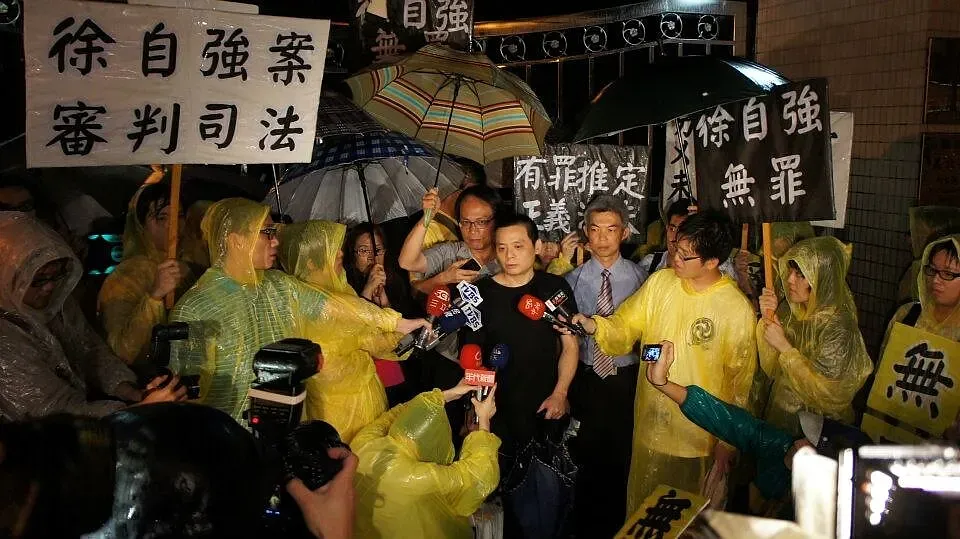
Released Due to Violation of the "Right to a Speedy Trial"—We Will Continue to Fight for Hsu Tzu-ch'iang's Innocence
Last edited: 2026-11-03
Hsu Tzu-ch'iang's release is based on the requirements of the International Covenant on Civil and Political Rights and the Criminal Speedy Trial Act, as 16 years of protracted litigation has infringed upon the people's "right to a speedy trial."
Article 14, Paragraph 3, Subparagraph 3 of the International Covenant on Civil and Political Rights provides: "In the determination of any criminal charge against him, everyone shall be entitled to the following minimum guarantees, in full equality: (c) To be tried without undue delay." On May 19, 2010, the Criminal Speedy Trial Act was promulgated, with Article 5, Paragraph 3 stipulating: "The cumulative duration of detention during trial shall not exceed eight years."
If properly implemented, the spirit of a speedy trial not only prevents the excessive infringement of personal liberty, but also prevents the loss or weakening of evidence, reduces case backlogs that lead to public distrust in the criminal justice system, and serves the dual purposes of "protecting human rights" and advancing "public interest."
If Taiwan aspires to become a genuine democratic society governed by the rule of law, the state has the obligation and responsibility to conclude criminal proceedings and render a judgment within an appropriate and reasonable timeframe. Otherwise, protracted judicial procedures will make it increasingly difficult to uncover the truth, waste judicial resources, and merely deepen public distrust in the judiciary. Furthermore, it subjects defendants and their families who wander through the courts to relentless torment, thereby infringing upon the fundamental right of the people to a fair trial guaranteed by the Constitution.
Today, Hsu Tzu-ch'iang's release is merely belated procedural justice. Having been detained for nearly 16 years without a final judgment, this case has created a lose-lose-lose scenario for the defendant, the victim, and the judiciary alike.
As for outside concerns regarding whether Hsu Tzu-ch'iang might abscond, such fears are entirely unwarranted. Since Hsu had the courage to turn himself in 16 years ago, it demonstrates his courage and determination to face the justice system. Naturally, he will continue to appeal to the Supreme Court and fight to the very end for his innocence!
Press Contact
Attorney Lin Feng-cheng, Executive Director, Judicial Reform Foundation 02-2523-1178
The Criminal Speedy Trial Act was promulgated on May 19, 2010. The provisions concerning detention in Paragraphs 2 to 4 of Article 5 took effect two years after promulgation, on May 19, 2012.
Article 5 of the Criminal Speedy Trial Act:
Courts shall prioritize and intensively consolidate the trial of cases in which the defendant is detained.
During trial, extensions of detention for offenses carrying a maximum statutory punishment of the death penalty, life imprisonment, or imprisonment for more than ten years shall be limited to six times in the first and second instances, and once in the third instance. The cumulative duration of detention during trial shall not exceed eight years.
If the aforementioned detention period has expired and no final judgment has yet been rendered, the detention shall be deemed revoked, and the court shall release the defendant.
This article is an AI-generated translation of the original Chinese text. In the event of any discrepancy, the Chinese version shall prevail.