
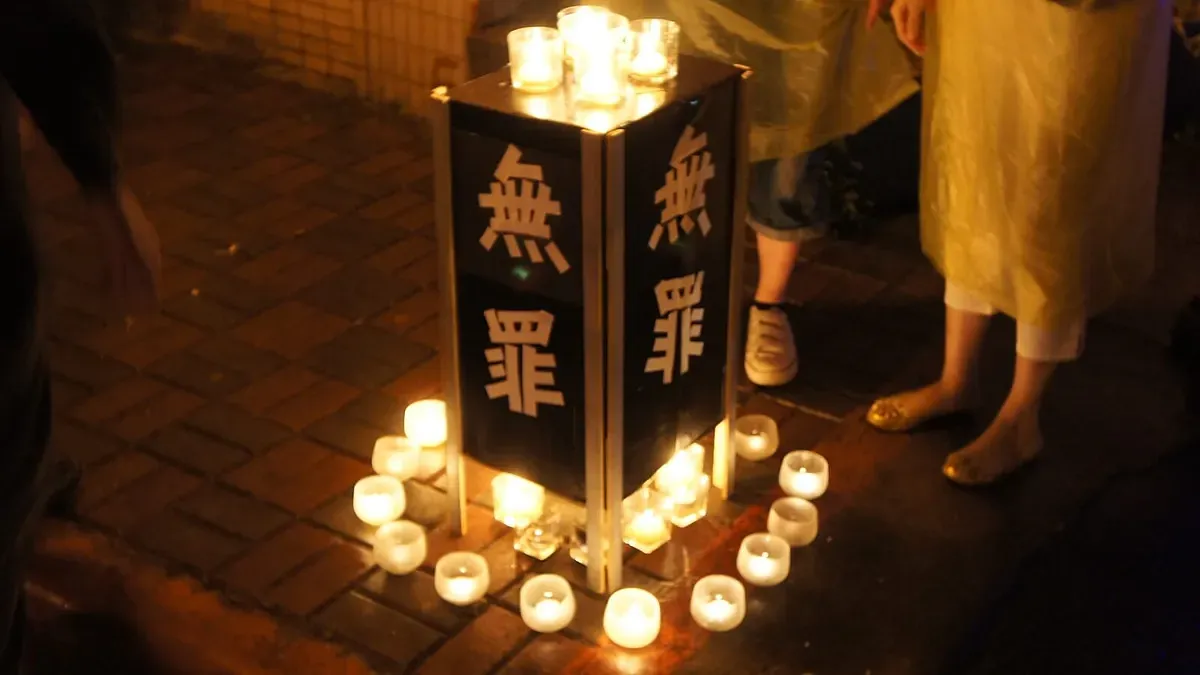
The "Right to be Tried Without Undue Delay" Has Been Seriously Violated, Justice Is Still on the Way—Statement on the Guilty Verdict in the Hsuch Tzu-chiang Case
Last edited: 2026-11-03
We continue to feel deeply grieved and regretful over the verdict finding Hsuch Tzu-chiang guilty. What grieves us is that the people's "right to a speedy trial" has long been severely violated; what we regret is when the judiciary will finally cease being "apathetic" to the expectations and suffering of the people.
Article 14, Paragraph 3, Subparagraph 3 of the International Covenant on Civil and Political Rights stipulates: "In the determination of any criminal charge against him, everyone shall be entitled to the following minimum guarantees, in full equality: … (c) To be tried without undue delay." According to Article 5, Paragraph 3 of the Criminal Speedy Trial Act promulgated on May 19, 2010: "The cumulative duration of detention during trial shall not exceed eight years." A speedy trial not only prevents the excessive violation of personal liberty, but also avoids the loss or weakening of evidence, reducing the distrust in criminal justice caused by case backlogs, thus serving to protect both human rights and the public interest.
This case has dragged on for 16 years, inflicting prolonged torment on the defendant, his family, and the victims, while violating the people's "right to a speedy trial." Putting aside the fact that no evidence has ever been found to convict Hsuch Tzu-chiang, over the past 16 years the evidence has become weak and fragmented; repeated retrials are truly a severe waste of judicial resources. The Prosecutor-General has filed extraordinary appeals for Hsuch Tzu-chiang five times; the Control Yuan issued an investigative report in 2001 criticizing the proceedings; and the Grand Justices rendered Interpretation No. 582 in 2004, all concluding that the case has major flaws and a very high probability of a wrongful conviction. The verdict of the eighth remand simply maintained an indefensible view, upholding the life imprisonment sentence from the seventh remand. Evidently, toward the public protests against unfair court trials, the demands of basic human rights, the principles of criminal substantive and procedural laws, explicit legal requirements, and rectifications from other government agencies, the court has remained completely indifferent, like "dogs barking at a passing train."
The case originated from the kidnapping and murder of a real estate developer in Tachih in 1995. In September 1995, the police arrested suspect Huang Chun-ch'i in Chungli, who claimed there were two accomplices, Hsuch Tzu-chiang and Ch'en I-lung (arrested in October). In June of the following year, fearing that the co-defendant would be sentenced to death and executed, leaving no one alive to testify and clear his name, Hsuch Tzu-chiang surrendered to the authorities accompanied by his lawyer on June 24, 1996. At the time, he chose to entrust his life to the judiciary and refused to flee precisely because he believed in the fairness of the justice system; today, that choice appears absurd and ironic.
The proceedings for this eighth remand began on March 26 of this year and were completed in less than two months. During this time, many problematic pieces of evidence—such as the investigation process and meeting records of the police task force at the time—were completely absent. Defense counsel repeatedly requested an on-site inspection of the ransom-collection locations at the Taoyuan and Neili train stations, which would have ruled out Hsuch Tzu-chiang's involvement, but the judges deemed it unnecessary. For a case involving the death penalty or life imprisonment, during oral argument, the judge actually instructed defense counsel to "just briefly summarize"! Furthermore, before the conclusion of oral arguments in the entire case, the judge allegedly privately instructed the public defender to visit Hsuch Tzu-chiang in detention and urge him to plead guilty under the Criminal Speedy Trial Act. Such conduct was highly improper and clearly violated the requirements of the principle of an "impartial court." Compared with the more than four years spent on the sixth remand and the one year and eight months spent on the seventh remand, one cannot help but question whether the judges had already prejudged the case as guilty given that this verdict was produced in less than two months, rendering the trial procedure merely a formality. As expected, today's verdict once again finds him guilty, ignoring the arguments and evidence presented in the proceedings, and completely failing to convince the general public.
Grand Justices Interpretation No. 582 explicitly pointed out that the confession of a co-defendant must be subjected to cross-examination procedures (confrontation) to possess evidentiary competence. Moreover, a confession cannot serve as the sole evidence for a conviction; other necessary evidence must still be investigated to determine whether it aligns with the facts. Furthermore, the probative force of a confession is not inherently "stronger" than other evidence being "weaker"; they must still be mutually corroborated and comprehensively assessed to reach a level of conviction. In the present trial, although co-defendant Ch'en I-lung was cross-examined under oath as a witness, whenever defense counsel asked questions concerning the facts of the case, he evaded them more than 30 times with responses such as "I don't know how to answer," "I forgot," and "I don't know." Although formally testifying, substantively he concealed much regarding the case and minimized his involvement. Another co-defendant, Huang Chun-ch'i, once again refused to testify under oath at this hearing, failing even to complete the testimony procedure. Yet the judges still proceeded to find Hsuch Tzu-chiang guilty. Surprisingly, the court 16 years later still disregards the presumption of innocence, ignores strict rules of proof, requires no other evidence, and disregards the Control Yuan's investigative report. Confined to established dogmas, the court adopted the flawed confessions of the two co-defendants, Huang and Ch'en, continuing to use them as the sole evidence to convict Hsuch Tzu-chiang; moreover, it turned a blind eye to the other evidence painstakingly presented by defense counsel that sufficiently disproves Hsuch's involvement. In the end, it remains a case of "presumption of guilt, better to wrongfully convict than let slip, Tseng Ts'an's mother doubting her son, and three men making a tiger," daring not to return a clean slate to Hsuch Tzu-chiang!
All civic groups concerned with this case have gathered here today to express our anger and impatience with an incompetent judiciary, and to declare to the general public that we will exhaust all our efforts and pool all our strength to rescue Hsuch Tzu-chiang until a verdict meeting the standards of fairness and justice is obtained!
Press Contact
JRF Executive Director, Attorney Lin Feng-cheng 02-2523-1178
This article is an AI-generated translation of the original Chinese text. In the event of any discrepancy, the Chinese version shall prevail.