
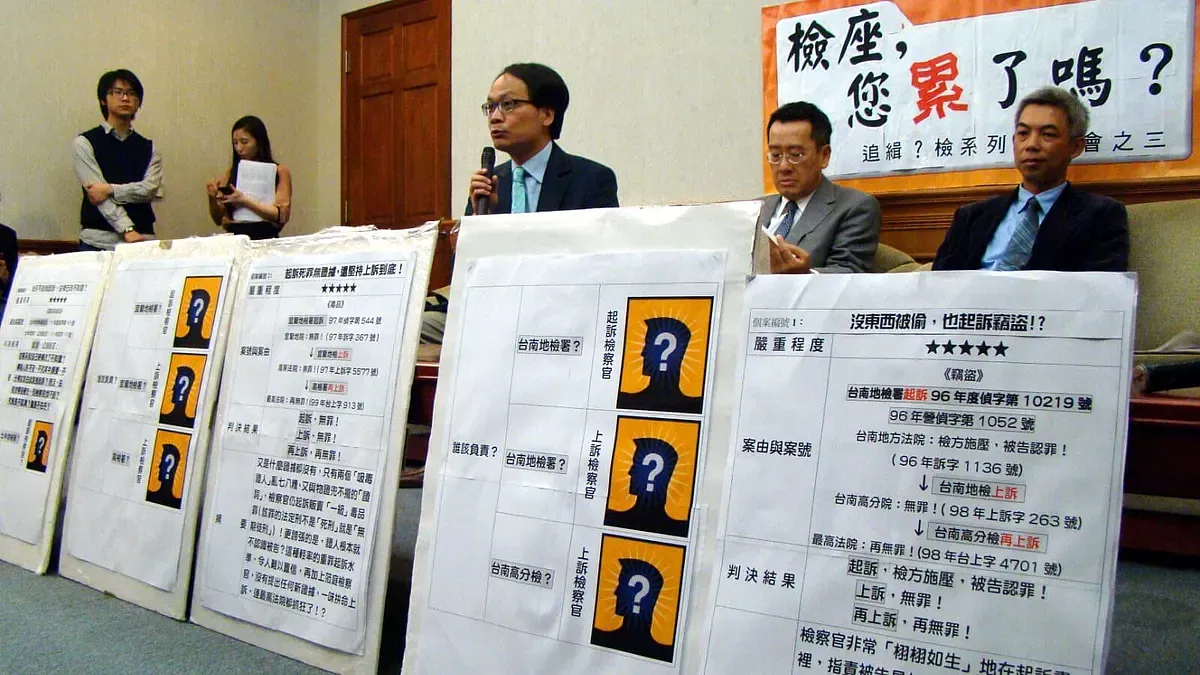
Prosecutor, Are You Exhausted? Press Conference Series on "Chasing Rogue Prosecutors" (III) – Response Press Release to the Ministry of Justice
Last edited: 2026-07-27
The Foundation expresses its appreciation for the Ministry of Justice's prompt response to the March 29 press conference. However, we believe that questions still remain regarding the establishment of general review and accountability mechanisms as well as the preliminary explanations of individual cases. Therefore, we hereby respond as follows:
1. What on earth are the "general" review and accountability mechanisms?
- In successive press conferences, the Foundation has repeatedly emphasized that exposing individual cases is not intended to target minor, accidental oversights by handling prosecutors, nor have we investigated or published the personal names of the handling prosecutors. What the public cares about is precisely what preventive, review, and accountability mechanisms the Ministry of Justice, as the policymaking unit, has in place regarding hasty indictments and abusive appeals.
- If the Ministry of Justice can boldly shoulder its responsibilities and actively establish such a mechanism, it would be a blessing for the people. Judging from this press release, it seems to mention that "discussions are underway." We wonder what the specific content and timeline are, and this truly awaits explanation from the Ministry of Justice.
2. Still no word on the investigation results of the first six cases?
The Ministry of Justice has repeatedly stated that it would officially request the Taiwan High Prosecutor's Office to promptly form an investigative team to conduct an in-depth investigation and understanding. Yet, four or five months have suddenly passed, and we still do not know what the investigation results are, or when they will be made public to the outside world.
3. When judicial credibility plummets, do not just blame grass-roots prosecutors; abusive appeals must also be held accountable!
- In the case of "No items stolen, yet charged with theft!?", no later than the second instance, the court had already ascertained that no cables were stolen at the location indicated in the indictment. Why did the Tainan Branch of the Taiwan High Prosecutor's Office still persist in appealing?
- In the case of "Indicted for a capital offense without evidence, yet persisting with the appeal to the end!", since the court had already ascertained that the witness's identification was entirely erroneous, and the prosecutors of the Yilan District Prosecutors Office and the High Prosecutors Office possessed no supplementary evidence whatsoever, was persisting with the appeal to the Supreme Court not an abuse of appeal?
4. Regarding "No items stolen, yet charged with theft!?"
- Out of 5 theft offenses indicted, 4 resulted in acquittals. May we ask whether such indictment quality is already a matter of concern?
- If the Ministry of Justice's statement that "so long as something was stolen, an indictment can be brought" can be deemed rational, may we ask if a thief were to steal from the Minister's neighbor, could a prosecutor indict the thief for stealing the Minister's belongings? And why must the court deliver an acquittal?
5. Regarding "Indicted for a capital offense without evidence, yet persisting with the appeal to the end!"
- How could a case indicting the death penalty or life imprisonment be conducted without cross-examination, relying solely on a single photographic identification? Was an investigative process of this kind truly completely free of any flaws?
- As for other supplementary evidence being exceptionally weak, which courts across various instances found harrowing to even review upon thorough examination, was persisting with the appeal truly not an abuse?
- If the Yilan District Prosecutors Office and the High Prosecutors Office still feel aggrieved, how should they respond to the severe reprimand from the Supreme Court?
6. Regarding "Inducted for reserve service upon failing to report, yet unaware the law has been amended?"
- May we ask, among apprehension, wanted listing, and indictment, which is the means that least infringes upon the rights and interests of the people? While prosecutors indeed possess the discretion to independently assess and decide when investigating cases, what is curious is: what were the considerations when the prosecutor "independently assessed"?
- Just as the court pointed out, the impact of a reservist call-up is minor, and under normal circumstances, ordinary people would not risk criminal punishment by failing to report. Therefore, if the prosecutor made a determination of "subjective intent to evade call-up processing" without affording the defendant a proper opportunity to explain, could this already be suspected of haste? This is precisely similar to how the indictment still cited Article 11 of the Statute Governing Punishment for Offenses Against Military Duty as the legal basis for prosecution (which had in fact long been amended to Article 10). Can the public not comprehensively judge that the prosecutor subjectively had no idea at all that the law had been amended?
Press Contacts
To-hsin Lin, Attorney-at-Law, Executive Director, JRF 02-25231178
Jung-chih Kao, Attorney-at-Law, Office Director, JRF 02-25231178
Explanation by the Ministry of Justice Regarding the "Concrete Flaws" in Prosecutors' Case Handling Pointed Out by the Judicial Reform Foundation
Ministry of Justice Press Release
Release Date: March 29, 2012
Issuing Unit: Department of Prosecutorial Affairs, Ministry of Justice
Contact Person: Tsai Wei-yi
Contact Number: 23884894 No.: 00-024
Regarding the "concrete flaws" in prosecutors' case handling pointed out at the press conference held today (the 29th) by the Judicial Reform Foundation, the Ministry of Justice explains as follows:
I. Regarding the contents of the aforesaid press conference, the Ministry has requested the relevant district prosecutors offices to examine the aforementioned cases, and the preliminary investigation findings are as follows:
1. Regarding the portion concerning "No items stolen, yet charged with theft!?", as preliminarily investigated by the Taiwan Tainan District Prosecutors Office, the prosecutor in that case indicted the defendant for allegedly committing 5 counts of theft. The court of the first instance delivered a guilty verdict on all indicted criminal facts based on the defendant's confession. The second instance and the Supreme Court, however, only delivered guilty verdicts concerning the criminal facts of the first count of the indictment, while issuing acquittals for the remaining 4 theft offenses. As for the parts finalized with acquittals, although public prosecution was instituted, the first instance court had previously found them guilty because the defendant, in addition to confessing to the offense during police questioning and investigation, led the police to the Chiayi area to point out the location where he committed the theft, which was corroborated by seized stolen goods and evidence; it was not fabricated out of thin air by the police. Although the second instance court issued an official letter to the Taiwan Power Company stating roughly that no cables were reported stolen at the location identified by the defendant, Linyi Engineering Co., Ltd. (hereinafter referred to as Linyi Company), which contracted the company's project, did have a record of reporting a theft to the police, and the location of the theft was near the HSR Chiayi Station (though on a different road section) as the location of the theft identified by the defendant. Therefore, there was indeed the fact that Linyi Company's cables were stolen, but a discrepancy existed between the stolen location and the location where the defendant confessed to committing the theft. This discrepancy may have arisen because of errors in the defendant's memory or intentional misleading, thereby affecting the truthfulness of his confession, which falls under the issue of evidence weighing. Hence, the press conference's assertion that "no items stolen, yet charged with theft!?" and similar claims are subject to misunderstanding.
2. Regarding the portion concerning "Indicted for a capital offense without evidence, yet persisting with the appeal to the end!", as preliminarily investigated by the Taiwan Yilan District Prosecutors Office, because witnesses Wu O-liang and Liu O-qing in that case both explicitly stated during police questioning and interrogations that the defendant transferred and sold drugs, which was corroborated by communication surveillance transcripts, and both witnesses stated during police questioning and interrogations that they knew the defendant, clearly stated that the defendant was of Chinese nationality, his relevant activity locations (the residences of the defendant's relatives and friends), and his work content (buying and selling fish cargo), which matched the defendant's true background. Thus, the prosecutor instituting a public prosecution based on this was not inappropriate. Although that case resulted in an acquittal finalized by the court because the witnesses subsequently recanted their previous statements, this is an issue of evidence collection and adoption, and is not a case of the prosecutor indicting the defendant for drug trafficking without any evidence.
3. Regarding the portion concerning "Inducted for reserve service upon failing to report, yet unaware the law has been amended?": As preliminarily investigated by the Taiwan Shilin District Prosecutors Office, when the Statute Governing Punishment for Offenses Against Military Duty was amended in 2002, the subjective element of "intent to evade call-up processing" was added to Paragraph 1 of Article 10. In that case, the prosecutor had already investigated the defendant's entry and exit records (showing no entry or exit records) and possessed the report from the defendant's mother when personnel dispatched by the referring agency conducted a visit (the defendant's mother stated that the defendant had not been in contact with family members for a long time). The prosecutor further retrieved the defendant's household registration data, summoned the defendant to appear according to the address but the defendant failed to appear, and the subpoena was returned to the Office (bearing a note left by the homeowner stating that the recipient did not reside at this address and requesting that related mail not be sent to this address). Therefore, the handling prosecutor had already ascertained that the defendant did not actually reside at the registered household address and that no other residence could be found; only after the defendant failed to appear upon summons did the prosecutor comprehensively judge and determine, based on other evidentiary data obtained during the investigation, that the defendant already possessed the "subjective intent to evade call-up processing," rather than simply failing to report the relocation of his household registration in accordance with regulations, and accordingly instituted public prosecution. Furthermore, there was no such thing as being "unaware the law has been amended." Moreover, after the defendant failed to appear upon summons in that case, whether it was necessary to further execute an apprehension based on the defendant's household registration address and subsequently issue a wanted warrant falls well within the discretion of the prosecutor to independently assess and decide when investigating a case. Furthermore, after public prosecution was instituted in this case, the defendant only appeared after being issued a wanted warrant by the court. Therefore, the aforementioned criticism that "the judge could find the defendant, but the prosecutor could not?" is subject to misunderstanding.
II. The Ministry will officially request the Taiwan High Prosecutors Office (hereinafter referred to as the High Prosecutors Office) to promptly form an investigative team to pull the case files and conduct an in-depth understanding regarding the above three cases. If it is found that the handling prosecutors indeed committed oversights, they shall be disciplined depending on the circumstances in accordance with the provisions of the Reward and Punishment Standards Table for Personnel of Prosecutorial Agencies under the Ministry, and the investigative results deemed to involve oversights will be officially communicated to the prosecutors of the subordinate prosecutorial agencies to pay heed and prevent similar situations from recurring.
III. In addition, to enhance the quality of prosecutors' indictments, aside from arranging courses analyzing the causes of acquittals across various crime types in the various on-the-job training courses for prosecutors held annually, the Ministry has also commenced studying the feasibility of establishing a mechanism through the proper screening of various acquittals, understanding from the reasoning of judgments whether prosecutors made errors, omissions, or improper maneuvers in indictments or appeals during the investigation of relevant individual cases, and should doubts be discovered, officially requesting the High Prosecutors Office to pull the files and investigate.
This article is an AI-generated translation of the original Chinese text. In the event of any discrepancy, the Chinese version shall prevail.