
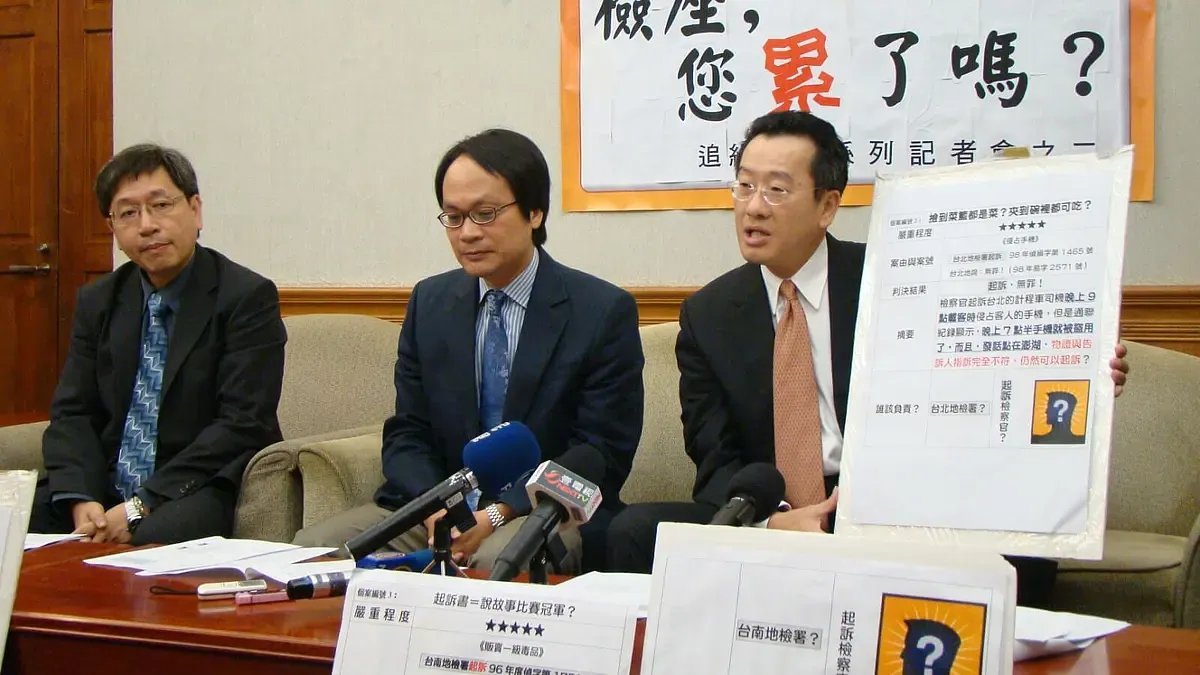
Prosecutor, Are You Tired? "Hunting Down Bad Prosecutors" Press Conference Series (II) - Response Press Release to the Ministry of Justice
Last edited: 2026-07-27
The Foundation deeply affirms the Ministry of Justice's prompt response once again regarding the individual cases published during the December 8 press conference. However, considering that the preliminary explanations of the cases still leave room for doubt, we hereby respectfully reply as follows:
1. Regarding the case "Reporting to Your Honor: Everything is Contained in the Appendix!":
Yesterday afternoon's statement clearly pointed out that this Foundation referred to the Supreme Court's reprimand of the Taiwan High Prosecutors Office. Based on the said Supreme Court judgment, we concluded that the prosecutor "did not offer a single word pointing out how the original judgment violated laws and regulations," rendering the appeal completely unlawful. The Supreme Court should have a clear obligation to explain this.
2. Regarding the case "Whatever You Pick in the Vegetable Basket is Edible? Whatever You Clip Into Your Bowl Can Be Eaten?":
- Not only is the collection of evidence crucial, but the subsequent evaluation of collected evidence is also the very purpose for which the prosecutor system exists. If there is no need to judge or weigh evidence, does this not mean that everything picked up and put in the vegetable basket is edible?
- In this case, call logs can be said to be ironclad physical evidence. What good would it do for the prosecutor to summon another 100 people? Is our country's indictment standard truly "rumors of a tiger can make people believe there is a tiger in the market"? If even such solid physical evidence can be ignored, are indictments really decided solely by the prosecutor's say-so?
3. Regarding the case "Indictment = Winner of a Storytelling Contest?":
- The focus of this Foundation's concern lies in whether prosecutors hastily indict and indiscriminately appeal, let alone in cases involving the death penalty or life imprisonment—shouldn't such cases be handled with even greater caution?
- This case obviously involved merely the "one-sided statements" of two drug users, without any other evidence. In plain terms, isn't this just two people "telling a story"?
4. In addition, the Ministry of Justice also presented numerous statistical data in its statement to corroborate that prosecutors do not engage in indiscriminate indictments or hasty appeals. However:
- It remains unknown how the presented statistics were compiled. We await the Ministry of Justice's explanation of the statistical and calculation formulas, as well as their sources and origins, in order to command public credibility.
- Regardless, the 6 cases presented this time and last time all target the unlawful or improper conduct of individual prosecutors, and the Ministry of Justice should still concretely investigate and respond to the individual cases first.
5. Finally, what is the Ministry of Justice's "general" accountability mechanism after all?
The Ministry of Justice should also inform the general public what its "general" accountability mechanism actually is, rather than merely responding passively and defensively to outside criticism. While explanations of individual cases are certainly important, systemic solutions are the fundamental way to effectively overcome the problems of prosecutors' hasty indictments and indiscriminate appeals.
Press Contacts
JRF Executive Director, Attorney Lin Feng-cheng
JRF Office Director, Attorney Kao Jung-chih
Explanation by the Ministry of Justice Regarding the "Specific Flaws" in Prosecutors' Handling of Cases Pointed Out by the Judicial Reform Foundation
Ministry of Justice Press Release
Release Date: December 8, 2011
Issuing Unit: Department of Prosecutorial Affairs, Ministry of Justice
Contact Person: Tsai Wei-i
Contact Number: 23884894 No.: 00-106
Regarding the "specific flaws" in prosecutors' handling of cases pointed out by the Judicial Reform Foundation today (8th), this Ministry explains as follows:
I. Regarding the contents of the aforementioned press conference, this Ministry has requested the relevant prosecutors offices to review the aforementioned cases, and the preliminary investigation findings are as follows:
- Regarding the part concerning "Reporting to Your Honor: Everything is Contained in the Appendix!", per the preliminary investigation by the Taiwan High Prosecutors Office, the prosecutor handling the case filed the statement of appeal in their own name, rather than merely citing a "document" or attaching a "document" as a substitute. Furthermore, the prosecutor converted the informant's petition intent into part of the reasons for appeal, and the reasons for appeal repeatedly pointed out that the original judgment clearly did not conform to empirical and logical rules, containing errors of law non-applicable and misapplication of law, lacking the omission of legal application alleged by the Foundation. Moreover, after the prosecutor handling the appeal submitted the statement of appeal for the Foundation's reference, the Foundation made 4 responses, of which the 3rd point explicitly specified that "the statement of appeal submitted by the handling prosecutor totals 6 pages, explicitly pointing out at least 4 times that the original judgment violated empirical rules or logical rules, or contained errors of law non-applicable and misapplication of law, and specifically pointed out the origin and source of the questioned evidence," thereby clarifying the matter.
- Regarding the part concerning "Whatever You Pick in the Vegetable Basket is Edible? Whatever You Clip Into Your Bowl Can Be Eaten?", per the preliminary investigation by the Taipei District Prosecutors Office, in addition to retrieving relevant mobile phone call logs, the prosecutor handling the case also questioned the informant, the defendant, and witnesses, and retrieved surveillance footage before concluding that the informant's accusations matched the witness testimonies. Naturally, this is not a situation where whether to indict is decided solely by the prosecutor's say-so, as questioned by the Foundation.
- Regarding the part concerning "Indictment = Winner of a Storytelling Contest?", per the preliminary investigation by the Tainan District Prosecutors Office, this case was referred by the Third Precinct of the Tainan City Police Department. Because two witnesses who had used category 1 drugs both stated during police interviews that they purchased the drugs from the defendant, and one of the witnesses pointed out that the defendant used a mobile phone to conduct the drug transactions, the police retrieved call logs that indeed corresponded to the stated call logs. During the investigation, the handling prosecutor questioned the two witnesses separately under oath, and they still correctly pointed out that the defendant engaged in drug trafficking, whereupon the investigation was concluded and an indictment was filed. During the trial, the Tainan District Court once again summoned the two witnesses to appear in court for cross-examination and confrontation with the defendant, and they repeatedly pointed out the defendant's drug trafficking without error. Therefore, the prosecutor did not indict the defendant without evidence. However, after the trial, the Tainan District Court held that convictions cannot be based solely on the unilateral testimony of drug purchasers, and thus acquitted the defendant. After receiving the judgment, the public prosecutor appealed to the Taiwan High Court Tainan Branch Court. However, that court rendered an acquittal without summoning witnesses to appear in court again. Subsequently, the prosecutor of the Taiwan High Prosecutors Office Tainan Branch Office filed an appeal on the grounds that the original court failed to thoroughly examine the witnesses' inability to clearly account for details and rendered an acquittal without stating reasons, thereby violating the law due to incomplete investigation and inadequate reasoning. Nonetheless, the appeal was dismissed by the Supreme Court and the case became final. Thus, the prosecutor's indictment was indeed based on evidence, and was not a storytelling scenario as alleged by the Foundation.
II. Recently, this Ministry has advocated for "exquisite investigation," emphasizing that prosecutors should strengthen the collection of criminal evidence when handling cases, carefully evaluate all evidence obtained during the investigation, and ensure there is a high probability of securing a guilty verdict from the court before filing an indictment, thereby reducing the acquittal rate and preventing innocent people from suffering the ordeal of litigation. According to statistics, the conviction rate for cases indicted by prosecutors from 2007 to 2009 reached 95.6%, and the conviction rate from January to September 2011 even reached 96.2%. Nonetheless, there remains room for improvement in certain cases. This Ministry emphasizes that prosecutors must still conduct more meticulous evidence collection and file appropriate indictments to protect the human rights of criminal defendants.
III. Regarding appeals, this Ministry also issued Letter No. Fa-Chien-Chueh-Tzu-0980800866 on March 4, 2009, requiring prosecutors to exercise caution when filing appeals in order to conserve judicial resources and protect human rights. Furthermore, paragraphs 19 and 20 of the "Guidelines for Prosecutorial Agencies to Expeditiously Handle Criminal Cases," promulgated by this Ministry on May 28, 2010, stipulate: When prosecutors review acquittals rendered in the first and second instances and determine that the determination of facts and application of law are indeed free of error and that there is no necessity for appeal, they shall record their reasons or opinions and submit them to the Chief Prosecutor for approval, after which no appeal shall be filed. Regarding requests for appeal filed by informants or victims, prosecutors shall conscientiously review them, and if such requests are groundless, they shall dismiss them. According to this Ministry's statistics over the past 5 years, the rate at which prosecutors appealed acquittals rendered by courts of first instance was 58.15%, and the rate of appealing acquittals rendered by courts of second instance was 12.8%, which can be considered a reasonable rate of appeal.
IV. Regarding the above three cases, this Ministry has requested the Taiwan High Prosecutors Office to expeditiously establish an investigative team to pull the case files and conduct an in-depth review. If it is discovered that the handling prosecutors indeed committed negligence, they will be disciplined in accordance with the provisions of the Reward and Punishment Standards Table for Personnel of Prosecutorial Agencies under this Ministry based on the circumstances. Furthermore, if the investigation results identify any negligence, a letter will be sent to the prosecutors of the subordinate prosecutorial agencies urging their attention to prevent similar incidents from recurring, thereby safeguarding defendants' human rights. As for cases where prosecutors handle matters and there is sufficient factual evidence to establish that intentional acts or gross negligence led to obvious and major errors that infringed upon people's rights, such matters will constitute grounds for individual case evaluation in the future after the implementation of the Judges Act.
This article is an AI-generated translation of the original Chinese text. In the event of any discrepancy, the Chinese version shall prevail.