
Discounted Justice? ~ Guilty Verdict in the Hsu Tzu-chiang Case: Life Imprisonment
Last edited: 2026-11-03
Regarding the guilty verdict still handed down against Hsu Tzu-chiang, we continue to feel regret and grief, and helplessly ask: until when will the judiciary remain 'insensitive' to the expectations and suffering of the people?
This case has been tied up in litigation for over 16 years. Even a newborn baby would now have reached the age of 'sweet sixteen.' The Prosecutor-General has filed extraordinary appeals on behalf of Hsu Tzu-chiang a total of 5 times; the Control Yuan also issued an investigative report in 2001 criticizing the court; and the Grand Justices of the Judicial Yuan even issued Judicial Yuan Interpretation No. 582 in 2004. All of these demonstrate that major flaws existed in the trial process of this case, and the probability of a miscarriage of justice resulting in Hsu being given a heavy sentence is extremely high. Although this seventh remand trial changed Hsu Tzu-chiang's sentence to life imprisonment, it generally maintained the perspective held over the past 16 years: the presumption of guilt, and the requirement for the defendant to prove their own innocence. Facing past mistakes remains an unbearable burden for the courts.
Discounted Justice: (Death Penalty + Acquittal) ÷ 2 = Life Imprisonment!?
Can judges, mired in the judicial cesspool, truly find it impossible to move forward and be left with no choice but to walk a safer path?
The three judges presiding over this trial were undoubtedly proactive and conscientious in their procedures; on the merits, in order to spare Hsu Tzu-chiang from the death penalty, they also spent a great deal of space explaining that he lacked the intent and act of committing murder. However, the judges still considered Hsu Tzu-chiang guilty of kidnapping for ransom, and the judgment chose a relatively 'safer' path. Obviously, the people still cannot rely solely on the wavering professional conscience of professional judges to resist a judicial bureaucratic culture that is not centered on the people. Putting hope in institutional reforms brought about by lay participation or lay adjudication is what the people ought to pursue.
In 1995, a real estate developer in Tachih was kidnapped and murdered. On September 25, 1995, the police arrested suspect Huang Chun-ch'i in Chungli, who claimed there were two accomplices, Hsu Tzu-chiang and Ch'en I-lung (arrested in October). In June of the following year, Hsu Tzu-chiang surrendered to the Shihlin District Court accompanied by a lawyer, and was sentenced to death.
There are numerous doubts as to whether Hsu Tzu-chiang was truly implicated in this case: First, the prosecution lacked concrete evidence of Hsu's involvement, yet the court still permitted up to 15 years of pre-trial detention. Aside from subjecting Hsu Tzu-chiang to the torment of judicial procedures, this also indirectly lowered the judges' willingness to hand down an acquittal, while increasing the social cost and price of an acquittal. Furthermore, ever since the case entered the High Court for trial in December 1996, it has bounced back and forth between the Supreme Court and the High Court. The main reason is that the court relied almost exclusively on the confessions of co-defendants Huang Chun-ch'i and Ch'en I-lung to determine Hsu Tzu-chiang's involvement, with virtually no other evidence. Moreover, the court's reasons for dismissing evidence favorable to Hsu Tzu-chiang were far-fetched, and the facts pieced together from various transcripts were highly unreasonable, leaving the entire case full of suspicious points. In particular, the judgment failed to conduct a detailed investigation and corroboration of the facts established through the 'confessions' of the co-defendants. After the retrial resulting in the fifth remand was finalized in 2000, an investigative report released by the Control Yuan in 2001 also directly pointed out flaws in the Hsu Tzu-chiang case, such as the questionable voluntariness of the police interrogation confessions of Huang and Ch'en, the court's superficiality, and its failure to exhaust investigative efforts.
If Hsu Tzu-chiang were a judge's son, would such 'corroborating' evidence also make one feel overwhelmingly grateful and thank the heavens for escaping death!?
This seventh remand trial took 1 year and 8 months of proceedings; and ever since Hsu Tzu-chiang voluntarily surrendered and was detained in 1996, more than 15 years have passed. Back then, Hsu surrendered on June 24, 1996, accompanied by a lawyer, out of fear that if the co-defendant were sentenced to and executed by the death penalty, there would be 'no living witness' left to clear his name. He trusted and entrusted his life to the judiciary. Today, that appears to have been so absurd. Sixteen years later, the court still does not care whether there are 'witnesses' and requires no other evidence; it can render a guilty verdict based solely on the records of co-defendants whose interests conflict with one another. One must ask: if Hsu Tzu-chiang were a judge's son, would such 'corroborating' evidence warrant feeling overwhelmingly grateful to have escaped death with a life sentence and thanking the heavens!?
According to the intent of Judicial Yuan Interpretation No. 582, the confessions of co-defendants must undergo cross-examination procedures (confrontation) before they possess evidentiary capability. Furthermore, the Grand Justices clearly pointed out that a confession cannot be used as the sole evidence for establishing guilt, and other necessary evidence must still be investigated to determine whether it conforms to the facts. Moreover, the probative force of a confession is not naturally 'stronger' while other evidence is 'weaker'; they must still be mutually corroborated and comprehensively judged to reach a degree that generates firm conviction.
The flawed confessions of co-defendants remain the sole evidence of Hsu's guilt; the court turns a deaf ear to Grand Justices' Interpretation No. 582
This case first saw the investigative report from the Control Yuan, followed by Interpretation No. 582, both of which directly or indirectly determined the flaws in the trial procedures of this case. Why did the High Court in this remand trial still treat these two as non-existent and fail to break out of the rut of previous judgments? It even used the testimony of Huang and Ch'en—who refused to answer when the defense team requested cross-examination—as the basis for Hsu's guilty verdict! Why does the court not dare to return clarity and innocence to Hsu based on the spirit of the presumption of innocence prescribed by the Code of Criminal Procedure?
The Criminal Speedy Trial Act will only let the Hsu Tzu-chiang case fizzle out in a muddled compromise
Claiming to comply with the provisions of the International Covenant on Civil and Political Rights, the Judicial Yuan passed the Criminal Speedy Trial Act in 2010. Recently, this already resulted in Chiou Ho-shun being 'swiftly' sentenced to a finalized death penalty under 'un-speedy' circumstances. The people can once again experience the power of a 'limitless judiciary'—forever detained and never released, trials that never end. To dodge the stigma of 'protracted trials,' the possibility that the Supreme Court will dismiss the appeal and finalize the sentence is quite high, and the Hsu Tzu-chiang case may thus be quietly brushed under the rug. A speedy trial act incapable of restoring innocence to defendants of miscarriages of justice will only result in the hasty clearance of a backlog of cases dragged out for over a decade, so that the courts no longer need to face this case. Such a speedy trial act is evidently nothing more than a 'rapid clearance sale method' for the courts; it is neither 'speedy' nor does it align with the good intentions of the International Covenant on Civil and Political Rights in guaranteeing the people's 'right to a timely trial'!
From Su Chien-ho and Chiou Ho-shun to Hsu Tzu-chiang, what we see is that defendants who insist on their innocence during trial proceedings due to crudeness in the investigative stage can only continue to sink and float in a procedural vortex with no end in sight, while judges and prosecutors simply look on coldly. How can a judiciary that fails to understand the hardships of the people gain the trust of the people!
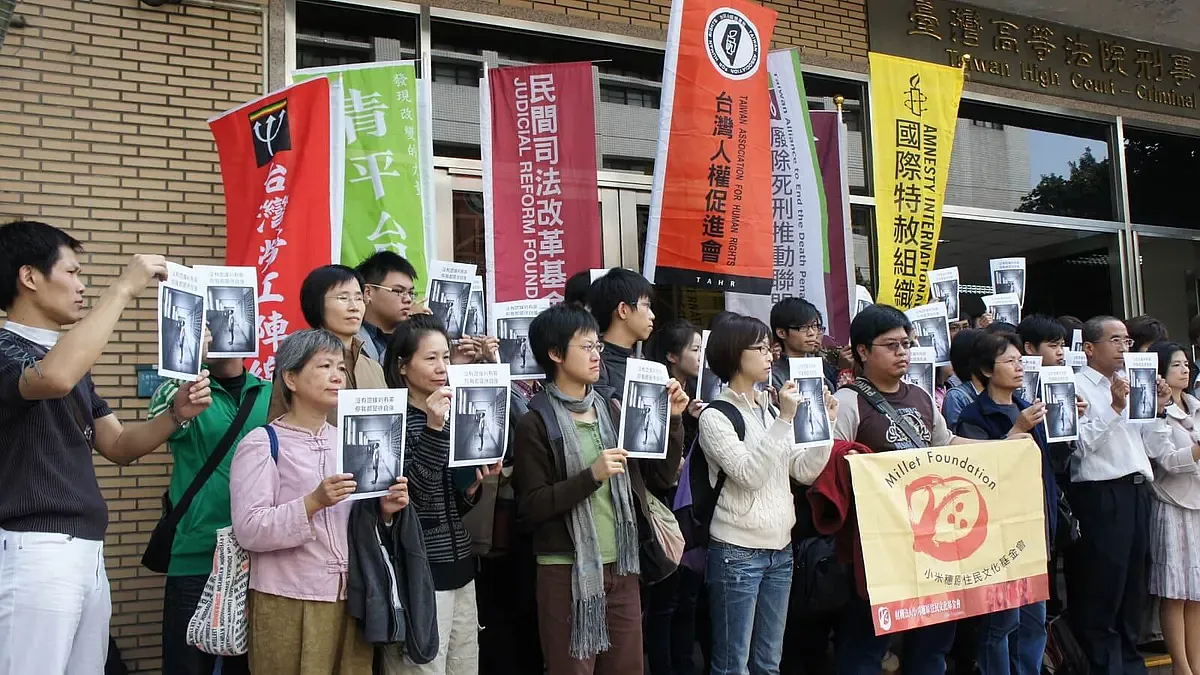
All civic groups concerned about this case have gathered here today not only to express their helplessness and dissatisfaction with the 'judicial culture of choosing the safe path,' but also to declare to the general public that we will do our utmost, pooling all forces to continue rescuing the Hsu Tzu-chiang case, and promote institutional reform for substantive public participation in trials, until the judicial system can produce judgments that accord with fairness and justice!
Attachments
2011/11/25 Taiwan High Court Press Release
Press Contact
Attorney Lin Feng-cheng, Executive Director, Judicial Reform Foundation 02-25231178
Joint Supporters
Huang Fu-te Education Foundation, Pisai Indigenous Foundation, Taiwan Association for Human Rights, Taiwan Labor Front, Environmental Jurists Association, Taiwan Association to End the Death Penalty, Green Citizens' Action Alliance (note: translation uses standard form for Ch'ing Platform/Green Platform context or common name), Amnesty International Taiwan Section
This article is an AI-generated translation of the original Chinese text. In the event of any discrepancy, the Chinese version shall prevail.