
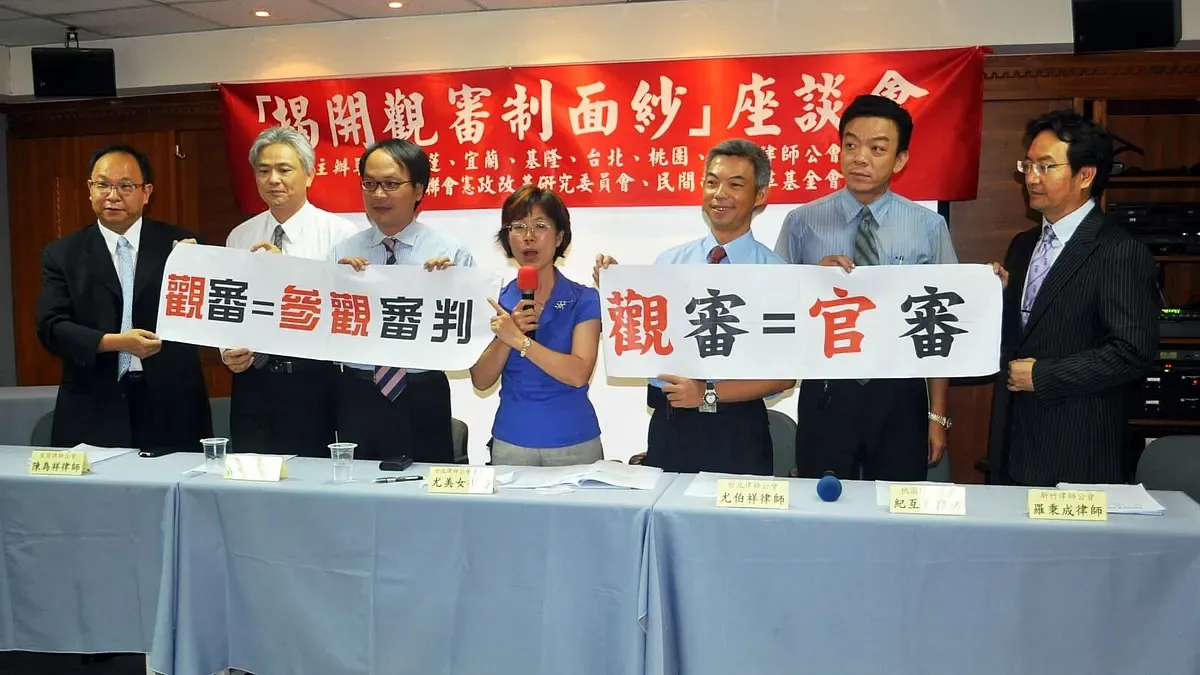
Please Lay Down the Arrogance of Power, Judicial Yuan: Truly Listen to the People's Voice
Last edited: 2026-07-27
From the gates of home, school, and government offices into the closed judicial bureaucratic system, professional judges—who are almost locked away in ivory towers for their entire lives—possess exquisite professional skills, yet their out-of-touch words and deeds are heard from time to time; most are immensely clever, but not necessarily equipped with both virtue and wisdom so as to be trusted by litigants; occupying high positions and looking down upon the common people below, while they may reap objective advantages, expecting them to hold empathy for all living beings is often too much to ask; true, they frequently toil from dawn to dusk and maintain personal integrity, but priding themselves on official purity and acting arbitrarily, they shut off avenues of speech in the courtroom, willfully insult and manipulate litigants, and even shout in open court—all of which are never uncommon. Even when they pour their heart and blood into drafting a judgment, their courtroom conduct is insufficient to convince others, and the content of their judgment remains alienated from public sentiment. Consequently, not only do litigants find it difficult to accept willingly, but it also regularly fails to earn the public's trust. In short, the professional arrogance and communication barriers of professional judges, which stem from a resulting lack of respect for litigants, are the root of the public's suffering during the litigation process. Once the content of a judgment deviates from common sense and social experience, the suffering felt by litigants throughout the lengthy litigation process is bound to be ignited into furious discontent against the court. The evolution of professional arrogance into the arrogance of power is the primary reason for the public's enduring dissatisfaction with the judiciary.
Due to judicial independence, holding professional judges accountable is difficult, making professional arrogance a chronic and deep-seated ailment among them. Therefore, since the Enlightenment, people have realized that the judicial power—originating from popular sovereignty—should not be entrusted entirely to professional judges; the public must participate in trials in order to check and supplement the shortcomings of professional judges. Following more than two centuries of development, public participation in trials, exercising judicial power jointly with professional judges, has now become the global mainstream. Whether through the Anglo-American jury system or the Continental European lay-judge system, the purpose is invariably to check the arbitrariness and arrogance of professional judges, such that the participating public must be able to stand on an equal footing with professional judges and hold decision-making power over the trial outcome equal to that of professional judges, at the very least. For a long time, domestic calls based on this understanding to allow public participation in trials and to check professional judges have never ceased.
Ever since President Lai and Vice President Su of the Judicial Yuan accepted the presidential nomination last year, they publicly announced their intention to promote public lay-participation (kuan-shen). Although the Judicial Yuan heavily promoted this after they took office, what exactly lay-participation entails was never clearly explained by the Judicial Yuan, leaving all sectors suspicious of how lay-participation differed from merely observing court hearings. Although the Judicial Yuan established the "Deliberation Committee on the Public Lay-Participation System" early this year—inviting scholars and attorneys to participate—and repeatedly stated that officials had no preconceived notions, after holding a few meetings and inviting scholars from Japan, South Korea, and Germany to introduce their respective public participation systems, the committee ceased operations. Shortly thereafter, the Judicial Yuan announced that it would select the Chiayi and Shilin District Courts to pilot a lay-participation system of "expressing opinions without voting rights," and subsequently established the "Committee for Research and Formulation of the Provisional Regulations on Public Lay-Participation." At this point, all sectors finally realized that after hedging and hiding for more than half a year, the official predetermined notion had all along been "expressing opinions without voting rights." The external scholars and attorneys who participated in the "Deliberation Committee on纽 the Public Lay-Participation System" had expressed opinions without voting, thus becoming the earliest "experimental lay participants" to experience the effects of lay-participation.
Such a crude and heavy-handed decision-making process still nakedly exposes the professional arrogance of professional judges, once again replicating a lack of respect and trust toward the people. Lay participants who express opinions without voting do not stand on an equal footing with professional judges—how can they possibly check professional judges? Allowing professional judges and diminished lay participants to jointly try cases and deliberate under conditions of extreme information asymmetry provides professional judges with a prime opportunity to sway the opinions of the lay participants. Therefore, a lay-participation system of expressing opinions without voting does not allow the people participating in trials to check professional judges; rather, it allows professional judges to educate "ignorant" lay participants. Afterward, they can still invoke the name of the people to let judgments actually dominated by professional judges evade outside criticism. Under this legislative mindset, lay participants are effectively tools to endorse professional judges. The lay participants remain the people, while professional judges remain the masters; the people continue to be manipulated by the masters. Could it be that judicial reform has reached the end of its rope? Otherwise, why would the Judicial Yuan, instead of seeking to cure the problem at its root, mistakenly believe that the endorsement of lay participants can restore the reputation of professional judges?
Furthermore, evidence investigation and deliberation both lie at the core of judicial power. Lay participants—who lack voting rights and are not judges—nevertheless participate in trials alongside professional judges, engaging not only in evidence investigation but also deliberating together. Does this not raise constitutional concerns regarding the exercise of judicial power by non-judges? Judicial power originates from the people, and letting the people determine trial outcomes raises no constitutional questions whatsoever. Yet, confined by its professional arrogance, the Judicial Yuan is unwilling to return judicial power to the people, while attempting to use lay-participation to deflect the public's demand for public participation in trials, thereby producing an unconstitutional creature of "expressing opinions without voting rights."
Moreover, our current criminal procedure system is conceived and shaped around trials conducted by professional judges. The structures of investigation, first instance, and even appellate review are all fundamentally incompatible with the philosophy of public participation in trials. For example, can an indictment presently containing dozens of co-defendants and numerous criminal facts be tried to completion within a few days to accommodate lay-participation, in line with the Judicial Yuan's ideals? If we do not adopt the principle of a single indictment and instead stubbornly cling to the old practice of dossier transfer, how can lay participants—faced with an extreme information asymmetry vis-à-vis professional judges—avoid being swayed by them? If lay participants routinely dance to the tune of the professional judges' will, how can the lay-participation system avoid becoming a hollow shell? If an appellate court can easily overturn the factual findings of a lay-participation court based on dossier materials, what is the meaning of lay-participation? Such complementary measures within the criminal procedure system are all crucial to whether public participation in trials can be effectively implemented, and they require long-term, comprehensive planning. Since the Judicial Yuan intends to "pilot" the lay-participation system, if any reference value is to be gained from the pilot results, the experiment must be conducted under sound conditions to be meaningful.
Public participation in trials is not only a milestone for judicial reform, but also for democratization. As a necessary goal for our nation to pursue, it naturally demands careful handling. However, throughout the policy-formulation process for the lay-participation system, the Judicial Yuan has fully displayed an arrogant posture of self-importance. Rushing through the process without considering comprehensive complementary legislation, it has ignored everything. As members of the unofficial bar bearing the mission to promote democracy and the rule of law, attorneys cannot sit idly by and watch the ideal of public participation in trials vanish into thin air—or even breed catastrophe—due to the Judicial Yuan's crude lay-participation system. We jointly issue this statement to appeal: judicial reform has not yet reached a dead end, nor does the Judicial Yuan bear the burden of urgently fulfilling the President's policy commitments; hasty legislation must be avoided. We urge the Judicial Yuan to lay down the arrogance of power, truly listen to the voice of the people, incorporate diverse opinions, and broadly accept wise counsel for this foundational project of a century.
This article is an AI-generated translation of the original Chinese text. In the event of any discrepancy, the Chinese version shall prevail.