
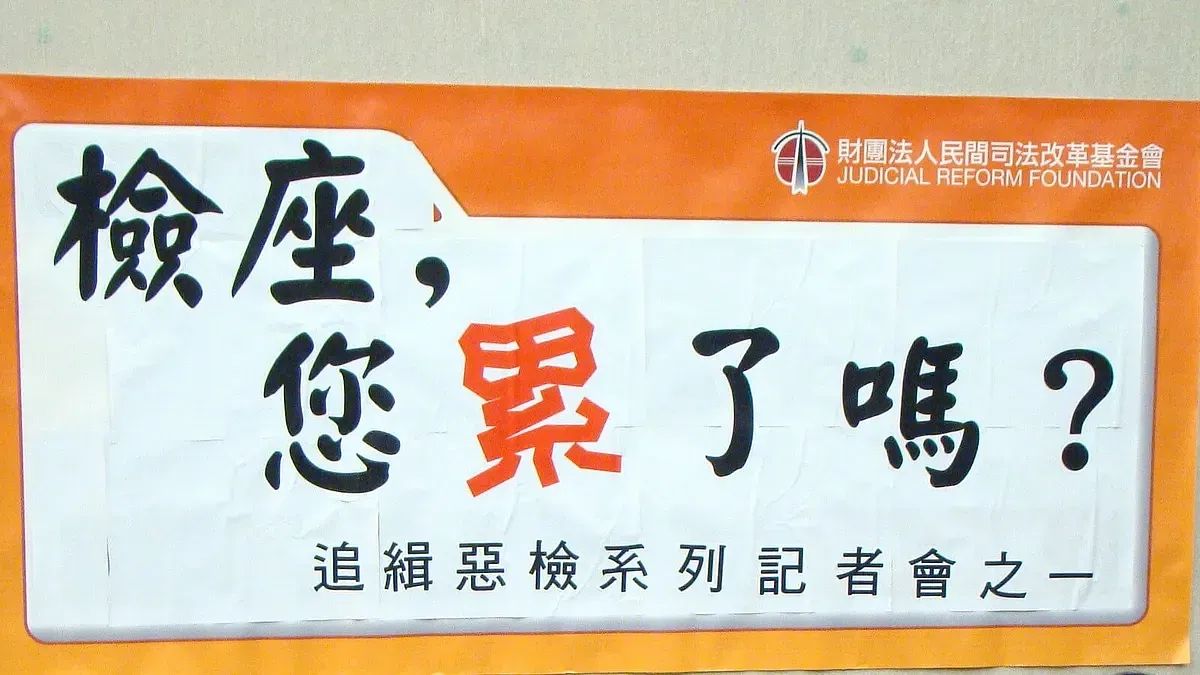
Refusing to Admit Mistakes? Not Realizing the Mistake? Or Not Knowing Where the Mistake Lies? ~ Response to the Ministry of Justice's Case Investigation Reports Regarding the Press Conference Series on Tracking Down "Bad Prosecutors" (Parts I, II, and III)
Last edited: 2026-07-27
To make it convenient for readers to review the cases presented by the Judicial Reform Foundation (JRF) and the responses from the Ministry of Justice (MOJ), we have compiled the following tables for reference and public evaluation.
November 29, 2011 │ Prosecutor, Are You Tired?! Press Conference Series on Tracking Down "Bad Prosecutors" (Part I)
-
Case 1 Made Public: Supreme Court 98 Tai-Shang No. 532 - Violation of the Controlling Guns, Ammunition and Knives Act
JRF Response on November 30, 2011 MOJ Investigation Results and Handling on May 31, 2012 JRF Response on June 11, 2012 - The focus of our Foundation's concern is whether the prosecutor made a hasty indictment and filed abusive appeals in this case. Given that the defendant retracted their statement and that physical evidence such as text messages and communication records were on file, did this already constitute a hasty indictment?
- Why was there still an abusive appeal after the district court had clarified the facts and delivered an acquittal?
- Moreover, the Taichung Branch of the Taiwan High Prosecutor's Office appealed to the Supreme Court once again—could this not also be considered an abusive appeal?
- Furthermore, while convicting the defendant of taking the blame for another was a remedial measure, we wonder if the prosecutor pursued any further investigation or investigative actions regarding the potentially swapped drug offense case? Is the truth not important after all?
- The defendant in this case was apprehended by the police for possessing a modified firearm with lethality and was escorted to the prosecutor. The defendant confessed to the offense during the interrogation by the duty prosecutor. After the prosecutor applied for and was granted a detention warrant by the court, the defendant subsequently claimed to be taking the blame for Shih OO, etc.
- Upon learning of the defendant's defense, the handling prosecutor not only summoned the handling police officer to testify under oath that the defendant was indeed caught on the spot possessing the modified firearm, but also actively retrieved and compared two-way communication records, and summoned the witness Shih OO via double-registered mail. However, because the witness failed to appear on time, and the prosecutor further ascertained from previous case files that Shih OO had already been sentenced by the court to a fixed term of imprisonment of 1 year and 2 months for a drug offense and had not entered prison to serve the sentence upon summons, making it clearly impossible for him to appear in court, the prosecutor concluded that the defendant's defense was a mere empty assertion and thus initiated a prosecution. Therefore, the prosecutor exhausted all investigative efforts regarding the defendant's defense, fulfilled their duties, and indicted in accordance with the law. There was no such situation where the prosecutor "deliberately ignored evidence favorable to the defendant, thereby acting as an accomplice to abusive police officers." The prosecutor's handling of this case involved no negligence.
- Since this Foundation selected cases merely from acquittal judgments without reviewing all case files and evidence, it was naturally difficult to understand the relevant investigative actions taken by the prosecutor during the case processing, and it was evidently inappropriate to hastily draw the conclusion that "the prosecutor deliberately ignored evidence favorable to the defendant, thereby acting as an accomplice to abusive police officers."
1. Doubts regarding the MOJ's response: - While it is true that "Shih OO... failed to enter prison to serve the sentence upon summons, making it clearly impossible for him to appear in court," can it be "concluded that the defendant's defense is a mere empty assertion" based solely on this? What is the logic behind such an inference?
- The information available to our Foundation is limited, but police abuse of power is indeed a fact. Even if the initial investigating prosecutor cannot be blamed, we must ask: What subsequent actions did the prosecution take regarding those deceived by such abuse? If they remained passive, ignored the matter, and slighted their own duties and responsibilities, how is it inappropriate to call them an "accomplice"?
- Why was there still an abusive appeal after the district court had clarified the facts and delivered an acquittal? Were the first-instance public prosecutor and the second-instance public prosecutor not at risk of making abusive appeals?
- Prosecutors have always readily brandished the banner of "discovering the truth," vowing to pursue every case until the truth comes to light. Yet the ultimate remedial measure in this case turned out to be nothing more than prosecuting the original defendant once again for the crime of taking the blame for another?
-
Case 2 Made Public: Kaohsiung District Court 94 Su Zi No. 2245 - Forgery of Documents
JRF Response on November 30, 2011 MOJ Investigation Results and Handling on May 31, 2012 JRF Response on June 11, 2012 - The lack of "critical physical evidence" of the "'document' in the crime of forgery of documents" was the specific criticism in the Kaohsiung District Court's ruling. We believe the court's criticism was not contrary to the facts.
- As the court bluntly pointed out in its ruling: during the preparatory proceeding on July 19, 2005, the public prosecutor was orally instructed to supplement the documents, and on August 17, 2005, an official document was issued again requesting supplementation to no avail; the court had no choice but to issue a formal ruling on November 4 ordering supplementation, and finally formally dismissed the prosecution by ruling on December 12. The court waited for the prosecutor for nearly half a year, causing the people to suffer the disaster of unwarranted litigation. Can the prosecutor truly be said to have no negligence whatsoever?
- If, as reported in the news, the Kaohsiung District Prosecutors Office blamed the court, claiming that the appeal was filed late because the court "served the documents improperly" to the prosecutors office—given that the court and the district prosecutors office are located right next to each other, what difficulty could there possibly be in service? Exactly how was it improper?
- The prosecutor in this case initiated the prosecution on June 13, 2005. The court issued a ruling ordering the prosecutor to supplement the forged mutual aid association ("hui") bidding slips and the specific time, location, and content of the defendant's fraudulent bidding. However, according to social experience, mutual aid association bidding slips are naturally discarded and cease to exist after members place their bids. As for the specific facts of the fraudulent bidding, because the defendant in this case was suspected of fraudulent bidding across 6 mutual aid association groups spanning from January 1998 to October 2000, the case inherently made it difficult to confirm the specific criminal facts, and the defendant also admitted to using bidding slips, etc. Moreover, after Prosecutor Ching, who indicted the case, was reassigned due to a job transfer, when the court issued the ruling on November 4, 2005 ordering supplementation, Prosecutor Li, who took over the case at the office, could only supplement the record using the original mutual aid association contracts and the roster of members who had already fulfilled their obligations.
- After the Taiwan Kaohsiung District Court dismissed the prosecution on December 12, 2005, it served the ruling on Prosecutor Ching, who originally indicted the case. Since Prosecutor Ching had already been transferred to the Public Prosecution Division, he neither filed an appeal against the ruling upon receiving it nor submitted it for review in accordance with regulations, which violated the rules (whether disciplinary action should be taken will be handled through separate personnel administrative procedures).
- As for the filing of the appeal in this case, because Prosecutor Li—who took over the case—received case file No. 95-Bo-Zhen-Zi-No. 1 in February 2006 (which was newly docketed after the aforementioned case was dismissed with finality) and discovered that the court's procedure for serving the ruling did not conform to customary practices, and that the ruling was contrary to common social experience, he filed an appeal on February 29 of the same year. Although the court dismissed the appeal as untimely, there were legal grounds for filing the appeal, and it is difficult to deem Prosecutor Li's handling as negligent.
1. Doubts regarding the MOJ's response: - Prosecution relies on evidence. Insisting on prosecuting the "crime of forgery of documents" without evidence of a "document"—is this not too far-fetched?
- "Job transfers" are internal affairs of the MOJ or the district prosecutors office; what do they have to do with the quality of case handling? How can they be used to rationalize negligence in handling a case?
- The phrase "the court's procedure for serving the ruling did not conform to customary practices" is vague and lacks detail. What does it actually mean?
- Counting from the court's oral request during the preparatory proceeding on July 19, 2005, ordering the public prosecutor to make supplementation, to the formal issuance of the ruling on December 12, the court waited for the prosecutor for nearly half a year. Due to a failure in operational succession, who should ultimately be held responsible?
- Since it has been acknowledged that Prosecutor Ching violated regulations, what is the related disciplinary action? When will it be made public?
-
Case 3 Made Public: Taipei District Court 99 Jin-Su Zi No. 45 - Violation of the Banking Act
JRF Response on November 30, 2011 MOJ Investigation Results and Handling on May 31, 2012 JRF Response on June 11, 2012 - "Slips of the pen" may perhaps be unavoidable in the process of document processing, and omissions or errors can hardly be prevented in complex cases with numerous defendants.
- However, from the perspective of the people, a defendant listed in an indictment is not merely a "name" in "Kai-Ti font, size 16"; it may involve an individual or a family. Therefore, when an "erroneously listed" defendant occurs as a mistake, and the prosecutor is unwilling to withdraw the indictment but instead waits for the court to issue a ruling of dismissal, is there truly no negligence or hastiness involved?
- Although the indictment in Taipei District Prosecutors Office 99-year-Zhen-Zi No. 2186 listed "Wu Li-ling" in the defendant identification column (there was also a defendant named Wu Ya-ling), neither the facts nor the reasoning columns of the indictment specified any criminal facts or evidence regarding "Wu Li-ling." Therefore, the court rendered a judgment of dismissal of prosecution regarding the defendant "Wu Li-ling" on the grounds that the indictment failed to state criminal facts.
- After the aforementioned judgment of dismissal of prosecution was served on the public prosecutor, it became final without an appeal being filed. Meanwhile, the defendants Wu Ya-ling and others were convicted by the court.
- Subsequently, when the Enforcement Division of the Taipei District Prosecutors Office handled the execution of the aforesaid judgment of dismissal regarding defendant "Wu Li-ling," it docketed case No. 101-Ta-Zi No. 391 to continue the investigation regarding the prosecutor's failure to state criminal facts in the indictment (currently not yet concluded).
- The original prosecuting prosecutor in this case did not erroneously list the defendant "Wu Li-ling," nor did they mistakenly type "Wu Ya-ling" as the defendant "Wu Li-ling." However, the prosecutor omitted the criminal facts of the defendant "Wu Li-ling" in the indictment, which upon review indeed constituted negligence (whether disciplinary action should be taken will be handled through separate personnel administrative procedures).
1. Doubts regarding the MOJ's response: - If "Wu Li-ling" was indeed involved and the criminal facts were "merely" omitted, why did the public prosecutor fail to supplement them? Shifting responsibilities to protect turf—can this truly be said to involve no negligence?
- If "Wu Li-ling" was "not" involved at all, why was the public prosecutor unwilling to withdraw the indictment? Would this not subject the citizen to unwarranted and unnecessary litigation burdens?
- Does a person named "Wu Li-ling" actually exist? Was she involved in this case?
- If "Wu Li-ling" was not involved in the case at all yet was indicted, is that not the height of absurdity? Aside from disciplining the prosecutor, shouldn't an apology be issued to the public?
- If "Wu Li-ling" was indeed involved in the case, for the Taipei District Prosecutors Office to wait until the "enforcement" stage to "mend the fold after the sheep have escaped"—was this done for the sake of fairness and justice, or to save face? Restarting the investigation by docketing a new case as late as 2012—when will the citizen's torment of suffering through litigation trials ever end?
December 8, 2011 │ Prosecutor, Are You Tired?! Press Conference Series on Tracking Down "Bad Prosecutors" (Part II)
-
Case 1 Made Public: Supreme Court 99 Tai-Shang No. 3700 - Forgery of Documents
JRF Response on December 9, 2011 MOJ Investigation Results and Handling on May 31, 2012 JRF Response on June 11, 2012 Yesterday afternoon's statement already clearly pointed out that this Foundation referenced the Supreme Court's criticism of the Taiwan High Prosecutor's Office. Based on the Supreme Court's judgment, we believed that the prosecutor "did not utter a single word pointing out how the original judgment violated laws," and therefore the appeal was completely unlawful. The Supreme Court should have a clear obligation to explain this. - The handling prosecutor in this case filed the appeal brief under their own name, without quoting "documents" or attaching "documents" as substitutes. The appeal brief was as long as 6 pages and explicitly pointed out at least 4 times that the original judgment violated the rules of experience and logic, or contained instances where laws were not applied or were misapplied. It also specifically pointed out the origin and source of the evidence in question. There was no such situation as alleged by the Foundation.
- The report in this press conference was clearly erroneous. Upon receiving the appeal brief filed by the prosecutor on the same day, the Foundation issued a statement of clarification on its website.
1. Doubts regarding the MOJ's response: - While our Foundation clarified that the handling prosecutor did not completely "utter not a single word" in the appeal brief as claimed by the Supreme Court, we also wonder whether the MOJ actually understands the background and reasons behind this.
- Upon examination, there are no small number of similar cases where the Supreme Court explicitly requires prosecutors of the High Prosecutor's Office to draft their own appeal briefs, prohibiting them from merely citing the private prosecutor's or complainant's briefs, or attaching them as appendices. We must ask: What is the MOJ's opinion on this view held by the Supreme Court?
- The MOJ evidently believes that our Foundation, by relying on the Supreme Court's judgment to criticize the prosecutor for "making a mistake," ran the risk of gloating. However, regarding the turf war and animosity between the Supreme Court and the prosecutors of the High Prosecutor's Office, what handling strategy does the MOJ have in response?
- Furthermore, if a complainant's request for appeal is drafted "too perfectly," leading the prosecutor to "extensively quote" it, only to have the appeal dismissed by the Supreme Court, doesn't the MOJ need to appropriately regulate or penalize the bad habit of prosecutors "extensively quoting"?
-
Case 2 Made Public: Taipei District Court 98 Yi Zi No. 2571 - Embezzlement of Mobile Phone
JRF Response on December 9, 2011 MOJ Investigation Results and Handling on May 31, 2012 JRF Response on June 11, 2012 - Not only is the collection of evidence of utmost importance, but the evaluation of evidence after collection is also the very purpose for which the prosecutor system exists. If evidence does not need to be judged and weighed, does that not mean whatever falls into the vegetable basket is considered a vegetable?
- In this case, communication records could be said to be ironclad physical evidence. What does it matter if the prosecutor summons 100 more people? Is our country's standard for indictment really based on "three people making a tiger" (rumors becoming accepted as facts)? If even such solid physical evidence can be ignored, is an indictment really whatever the prosecutor says it is?
- During the investigation, the prosecutor in this case requested communication records for the mobile phone's serial number from the telecommunications company based on the serial number proactively provided by the victim. According to the communication records, mobile number 13510072847 from mainland China indeed received signals in Penghu at 7:33 PM on the day the victim lost the phone (i.e., January 31, 2009). Additionally, mobile number 0953716022 used the aforementioned phone from June 9 to June 14, 2009. Because the handling prosecutor believed that Hung OO—the applicant for mobile number 0953716022—might have acquired the victim's lost phone through purchasing stolen goods or other illegal means, the prosecutor summoned Hung OO to appear as a witness. However, Hung OO's testimony could not fully explain the retrieved communication records. Consequently, the prosecutor deemed that the communication records obtained through the mobile phone serial number were difficult to rely upon and inconsistent with other evidence in the case file, and thus did not list them as evidence for the indictment. Instead, the prosecutor indicted the defendant using other evidence (the victim's testimony, communication logs for numbers provided by the victim, and burned discs of surveillance footage, etc.).
- Following the press conference, the Taipei District Prosecutors Office recognized that contradictions indeed existed in the evidentiary facts, and proactively docketed case No. 100-Ta-Zi No. 11408 for investigation (currently not yet concluded). Upon investigation, it was discovered that the serial number of the phone lost by the victim was different from the serial number proactively provided by the victim during the original investigation. Therefore, in reality, the phone lost by the victim had never made calls from the Penghu area at 7:33 PM on January 31, 2009. The trial judge had rendered an acquittal based on the erroneous communication records for the phone serial number provided by the victim during the investigation, without examining other evidence.
1. Doubts regarding the MOJ's response: - What exactly was the testimony of "Hung OO"? Did it eliminate the possibility of the taxi driver's involvement? If so, what was the basis and logic for the prosecutor to ignore and reject it?
- The "erroneous" mobile phone serial number referred to by the MOJ was evidence investigated and adopted by the investigating prosecutor, which the court subsequently followed. If the court made a misjudgment, did the prosecutor truly make no misjudgment at all?
- A witness's testimony is often biased due to unclear memory or subjective misrecognition, which is common sense. It is not as certain and credible as "physical evidence" like communication records. If the prosecutor had already discovered contradictions during the investigation yet chose "testimony" over "physical evidence," can they truly justify themselves?
- The statement by the Taipei District Prosecutors Office during its subsequent investigation that "the serial number of the phone lost by the victim differed from the serial number proactively provided during the original investigation" is treated too casually, as if treating previous litigation procedures—which exhausted people and resources and wasted national judicial resources—as child's play. Is there truly no one who should be held responsible?
-
Case 3 Made Public: Supreme Court 99 Tai-Shang No. 3559 - Drug Offense
JRF Response on December 9, 2011 MOJ Investigation Results and Handling on May 31, 2012 JRF Response on June 11, 2012 The focus of our Foundation's concern is whether the prosecutor made a hasty indictment and filed an abusive appeal. Especially in cases involving the death penalty or life imprisonment, shouldn't greater caution be exercised?
This case obviously relied solely on the "one-sided statements" of two drug users without any other evidence. In plain terms, isn't this just two people "telling a story"?
- This case was prosecuted because two witnesses explicitly stated in police interviews and interrogations that they purchased drugs from the defendant, which was corroborated by communication records retrieved by the police. It was not without basis. Furthermore, during cross-examination in the Taiwan Tainan District Court, these two witnesses repeatedly testified that the defendant indeed sold drugs. Although the first- and second-instance courts both ruled after trial that individuals cannot be convicted solely on the unilateral allegations of drug purchasers and therefore delivered acquittals, the first- and second-instance public prosecutors, upon receiving the judgments, filed appeals on the grounds that the court failed to evaluate the probative force of the witnesses' testimony and should not have acquitted the defendant merely because the witnesses' testimonies showed inconsistencies. These appeals were not without reason. Therefore, the prosecutor's indictment and lawful appeal were well-founded and involved no negligence; it was not a case where the indictment was merely "telling a story" as alleged by the Foundation.
- The handling prosecutor's indictment of the defendant for the offense of selling Category 1 drugs was not without basis. Although the defendant was subsequently acquitted with finality by the court, this should be a matter of discretionary judgment in prosecution and the court's weighing of evidence. However, the schedule attached to the indictment in this case, which described the types, frequencies, and prices of the drugs sold by the defendant as "Heroin, approximately 50 times, with each transaction priced between NT$500 and NT$2,000," was clearly lacking in concrete specificity. This runs counter to the Ministry's policy in recent years advocating for "exquisite investigation," which emphasizes that prosecutors should strengthen the collection of criminal evidence and exercise caution in indicting to reduce the acquittal rate. This matter has been communicated via official letter to all prosecutorial agencies, instructing them to inform their subordinate prosecutors that when concluding investigations and initiating prosecutions, they should state the concrete facts constituting the crime and their time, location, and methods as clearly as possible, and use an evidence list to specifically point out each item of evidence and its relevance to the criminal facts.
1. Doubts regarding the MOJ's response: - In its response, the MOJ emphasizes "exquisite investigation" while simultaneously claiming this case is completely free of negligence—how can these two stances be reconciled?
- So-called "communication records" cannot prove anything at all. Aside from the statements of drug users, what other evidence was there? Is this truly the standard of indictment acceptable in a modern state under the rule of law?
- The core focus of this case is that the prosecutor indicted and appealed a "very serious crime carrying the death penalty or life imprisonment." Shouldn't greater caution be exercised?
- Let alone serious crimes, even for minor offenses, can a hasty indictment and abusive appeal be launched on such weak evidence? Can the judiciary truly win the trust of the people this way?
March 29, 2012 │ Prosecutor, Are You Tired?! Press Conference Series on Tracking Down "Bad Prosecutors" (Part III)
-
Case 1 Made Public: Supreme Court 98 Tai-Shang No. 4701 - Theft Offense
JRF Response on March 20, 2012 MOJ Investigation Results and Handling on May 31, 2012 JRF Response on June 11, 2012 - Out of 5 theft acts prosecuted, 4 resulted in acquittals. We must ask: Is such indictment quality not a cause for serious concern?
- If the MOJ's claim that "if something was stolen, an indictment can be brought" makes logical sense, we ask: If the Minister's neighbor has their house burglarized, can a prosecutor indict a thief for stealing things from the Minister's house? Why must the court deliver an acquittal?
- The prosecutor in this case indicted the defendant on 5 counts of theft. Based on the defendant's confession, the first-instance court found the defendant guilty of all indicted criminal facts. The second-instance and Supreme Court, however, found the defendant guilty of only the first count of the indicted facts, while delivering acquittals for the remaining 4 counts of theft.
- Regarding the acquittals that became final, although a prosecution was initiated, the first-instance court had previously found guilt because the defendant, in addition to confessing during police interviews and investigations, led the police to Chiayi to point out the locations where he committed the thefts, which was corroborated by seized stolen goods and evidence. It was not something fabricated out of thin air by the police.
- Although the second-instance court wrote to Taiwan Power Company stating that no electric cables were reported stolen at the location pointed out by the defendant, Linyi Engineering Co., Ltd. (hereinafter Linyi Co.), which contracted projects for the company, had a record of reporting stolen goods to the police, and the location of the theft was near the HSR Chiayi Station (though on a different road section). Therefore, the fact that Linyi Co.'s electric cables were stolen did occur; it was merely that the location of the theft differed from the location pointed out in the defendant's confession. This discrepancy might have arisen because the defendant's memory was faulty, or because the defendant intentionally misled authorities, which affected the credibility of his confession and falls under the issue of weighing evidence. Hence, the claim made in the press conference that "indicting for theft even when nothing was stolen!?" involves a misunderstanding.
- The appeal filed by the Taiwan High Prosecutor's Office Tainan Branch against the second-instance acquittal was made after the prosecutor reviewed the case files and specifically pointed out that the original judgment violated the provisions of Articles 378, 379(10), and 379(14) of the Code of Criminal Procedure, and was lawfully filed without impropriety.
- The Tainan District Prosecutors Office has requested prosecutors in prosecutorial meetings to collect evidence rigorously, and has required chief prosecutors reviewing case closing documents to strictly examine whether the criminal facts listed in indictments are supported by precise human and physical evidence.
1. Doubts regarding the MOJ's response: - As long as there is a confession from the defendant, does all other evidence collection become unimportant?
- So the MOJ's so-called "handling result" merely refers to "requesting prosecutors in prosecutorial meetings"?
- Out of 5 counts indicted, 4 resulted in acquittals—is this an indictment standard acceptable to the MOJ?
- When even the most basic criminal facts such as the "location of the theft" get messed up, how can the public trust the quality of prosecutors' case handling?
-
Case 2 Made Public: Supreme Court 99 Tai-Shang No. 913 - Drug Offense
JRF Response on March 20, 2012 MOJ Investigation Results and Handling on May 31, 2012 JRF Response on June 11, 2012 - In a case where the death penalty or life imprisonment is sought, an indictment could be brought without cross-examination and relying solely on a single photographic identification? Can such an investigation process truly be said to involve no negligence whatsoever?
- As for other corroborating evidence being extremely weak, upon review by successive courts, it was truly too painful to watch. Was insisting on an appeal not abusive?
- If the Yilan District Prosecutors Office and the High Prosecutor's Office still feel aggrieved, how should they respond to the severe criticism from the Supreme Court?
- Because witnesses Wu O-liang and Liu O-ching explicitly accused the defendant during police interviews and interrogations of transferring and selling drugs to them, and this was supported by communication surveillance transcripts, and both witnesses stated during police interviews and interrogations that they knew the defendant and provided clear descriptions of the defendant's Chinese nationality, related activity locations (residences of the defendant's relatives and friends), and work content (buying and selling fish products) which matched the defendant's true background, the prosecutor's initiation of prosecution based on this was not improper.
- Because the witnesses changed their previous accounts during the trial, the court delivered a final acquittal. The appeals filed by the first- and second-instance prosecutors against the acquittal were exercises of their official powers and were well-founded; it is difficult to deem them negligent.
1. Doubts regarding the MOJ's response: - As long as there is witness testimony pointing to the defendant, does all other evidence collection become unimportant?
- The contents of the "transcripts" prove nothing at all. Couldn't witnesses casually fabricate "activity residences" and "work content"? Is this the standard of our country's prosecutors?
- Without having witnesses identify the defendant or conducting cross-examination between the parties, an indictment was brought for crimes carrying the death penalty or life imprisonment. Later, the court discovered that the witnesses had entirely misidentified the defendant. With such case handling, can the prosecutor truly be said to have no negligence?
- Furthermore, the core focus of this case is that the prosecutor indicted and appealed a "very serious crime carrying the death penalty or life imprisonment." Shouldn't greater caution be exercised?
- Let alone serious crimes, even for minor offenses, can a hasty indictment and abusive appeal be launched on such weak evidence? Can the judiciary truly win the trust of the people this way? Moreover, this case was made completely clear no later than the second-instance trial—did the second-instance prosecutor really commit no error or negligence in insisting on appealing?
-
Case 3 Made Public: Shilin District Court 93 Yi No. 174 - Violation of the Military Service Act
JRF Response on March 20, 2012 MOJ Investigation Results and Handling on May 31, 2012 JRF Response on June 11, 2012 - Among bringing someone in for questioning, issuing a warrant, and filing an indictment, which is the method that least infringes upon citizens' rights and interests? While prosecutors have the discretion to weigh and decide when investigating cases, we are curious: what are the underlying considerations when a prosecutor exercises "discretion"?
- Just as the court pointed out, recall training has a minor impact, and under normal circumstances, ordinary people would not risk criminal punishment by failing to appear. Therefore, if a prosecutor concludes that there was a "subjective intent to evade draft mobilization processing" without appropriate explanation from the defendant, wouldn't that already be suspected of being hasty? This is just like the indictment still citing Article 11 of the Offenses Against Military Duty Act (which was actually amended to Article 10 long ago). Can the public comprehensively deduce from this that the prosecutor subjectively had no idea the law had been amended?
- When the Offenses Against Military Duty Act was amended in 2002, the subjective element of "intent to evade draft mobilization processing" was added to Article 10, Paragraph 1. During the investigation of this case, the prosecutor had already checked the defendant's entry and exit records (showing no entry or exit records), and possessed a report from a home visit conducted by the referring agency's personnel (the defendant's mother stated that the defendant had not been in contact with the family for a long time). The prosecutor further retrieved the defendant's household registration records, summoned the defendant to the address to no avail, and the subpoena was returned to the prosecutors office (with a note left by the homeowner stating that the recipient did not live at that address and requesting that related mail not be sent there). Thus, the handling prosecutor ascertained that the defendant did not actually live at the registered household address and that no other residence could be found. Only after the defendant failed to appear upon summons did the prosecutor determine that there was no necessity to issue a warrant to bring the defendant in based on the registered household address. Furthermore, whether it is necessary to issue a warrant based on the defendant's household registration address after failing to appear upon summons, and subsequently issue a wanted warrant, falls within the discretionary authority of a prosecutor when investigating a case. Moreover, after the prosecution was initiated in this case, the defendant only appeared after being issued a wanted warrant by the court; thus, it was not as the press conference claimed that "the judge could find the defendant, but the prosecutor couldn't."
- According to Articles 251(1) and 251(2) of the Code of Criminal Procedure, if the evidence obtained from an investigation is sufficient to recognize that there is suspected criminal conduct by a defendant, an indictment shall be initiated. If the whereabouts of the defendant are unknown, an indictment shall likewise be initiated. In this case, the prosecutor made a comprehensive judgment based on other evidentiary data obtained during the investigation, concluding that the defendant possessed the subjective intent to "evade draft mobilization processing," rather than simply failing to report a change of household registration as prescribed, and initiated the prosecution. This subjective intent was explicitly stated in the factual column of the indictment, so there was no such situation as "not knowing the law had been amended."
- This case should merely be a difference in legal interpretation between the prosecutor and the court regarding how to determine the defendant's subjective intent. The prosecutor's indictment involved no negligence, nor was there any situation of "being careless or not caring." Additionally, the handling prosecutor graduated from the 21st class of the judicial training program and retired on August 31, 2011, which is noted here for the record.
1. Doubts regarding the MOJ's response: - Does the MOJ seem to imply that since the prosecutor has retired, there is no longer any need to pursue accountability?
- Since the judge was able to find the defendant through a wanted warrant, why didn't the prosecutor do the same?
- Among bringing someone in for questioning, issuing a warrant, and filing an indictment, which is the method that least infringes upon citizens' rights and interests? While prosecutors have the discretion to weigh and decide when investigating cases, we are curious: what are the underlying "considerations" when a prosecutor exercises "discretion"?
- Recall training has a minor impact, and under normal circumstances, ordinary people would not risk criminal punishment by failing to appear. Therefore, if a prosecutor concludes that there was a "subjective intent to evade draft mobilization processing" without appropriate explanation from the defendant, wouldn't that already be suspected of being hasty?
This article is an AI-generated translation of the original Chinese text. In the event of any discrepancy, the Chinese version shall prevail.
