
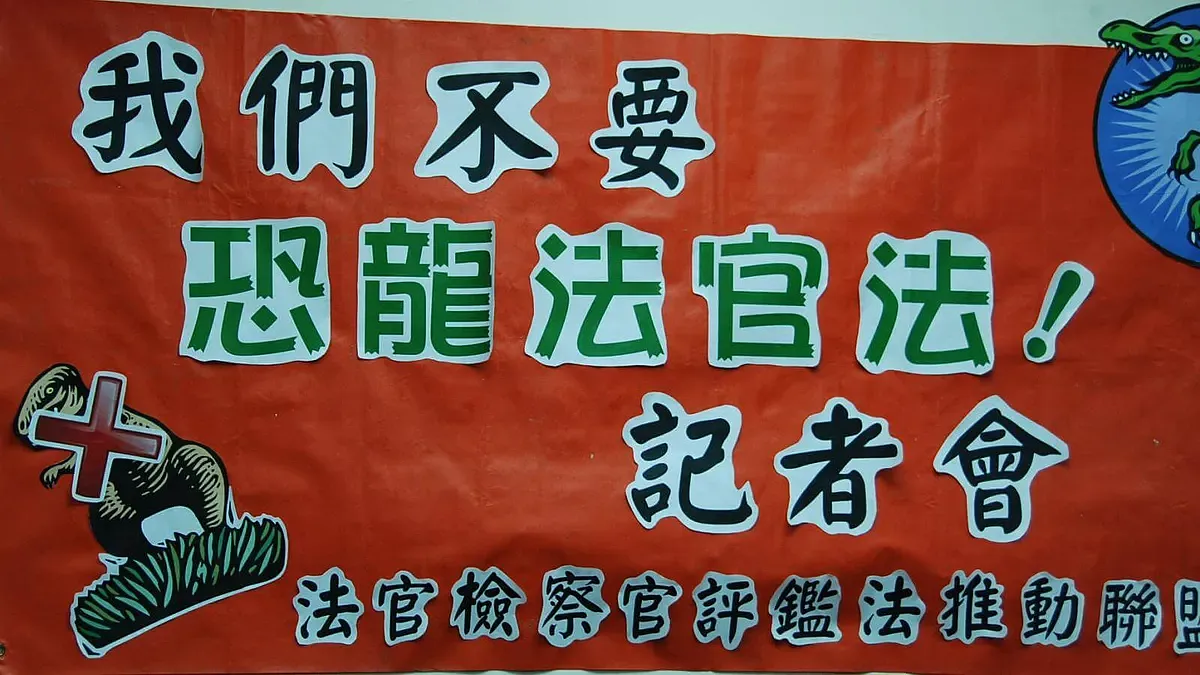
Passage of the Judges Act - JRF Statement
Last edited: 2026-07-27
Having a legislative history of over twenty years, the Judges Act was passed on third reading in the Legislative Yuan tonight. Our foundation offers the following views:
- The version of the Judges Act passed on third reading today is the product of a high degree of political compromise and remains far from ideal. It can be described as a 50-point Judges Act, and we must be prepared at any time to retake the exam.
- The Judges Act should have been built upon the two premises of "information transparency" and "introducing external oversight." However, the members of the Disciplinary Court who ultimately decide the disciplinary outcomes for judges are all professional judges, making mutual protection among officials inevitable. Furthermore, the public cannot directly file complaints against judges, and the selection of external members for the Evaluation Commission still retains a strong official hue. All of these run counter to the aforementioned premises. The Judges Act is far from living up to its name, and it is not hard to foresee what its effectiveness will be.
- Once this Act formally enters into force, the public will be able to observe the extent and speed of improvements in judicial quality. Our foundation will naturally continue to stand together with the public, jointly monitor the implementation of this Act, and timely propose suggestions for improvement.
- In view of the fact that the judge evaluation mechanism will officially take effect six months after the promulgation of this Act, in order to assist the public in reporting unqualified judges and prosecutors, our foundation will soon expand the formation of a pro bono lawyer panel to accept individual cases, officially establish an appeal center to receive public reports, and has set up a dedicated hotline (02-2542-1958) to be answered by dedicated personnel. The official establishment date will be announced separately for public awareness, and the public is welcome to make use of it.
Press Contact
JRF CEO, Attorney Lin Feng-cheng 02-2523-1178
Judges Act Passed on Third Reading A Major Milestone for Judicial Reform
Date of Issuance: June 14, 100th Year of the Republic (2011)
Issuing Unit: Judicial Yuan / Department of Judicial Administration
Contact Person: Specialized Commissioner / Huang Man-li
Contact Telephone: 02-23618577*279
File Number: 100-21
After 23 years of efforts by the Judicial Yuan to promote the draft Judges Act, it was passed on third reading today (the 14th) by the Legislative Yuan. A specialized act concerning judges—including provisions on diverse recruitment, evaluation, and exit mechanisms for judges—was born at the very last moment before the adjournment of the Legislative Yuan, following multiple rounds of compromise, communication, and negotiation, ultimately reaching a consensus and meeting the eager expectations of all sectors!
Judges represent the State in independently exercising their powers and bear grave responsibilities, differing from general civil servants who are subject to a relationship of obeying official orders. However, because related laws were scattered everywhere, the boundaries between judges and general civil servants were blurred, obscuring the spirit of the Constitution in guaranteeing judicial independence. Therefore, the Judicial Yuan began drafting the Judges Act on May 27, 77th Year of the Republic (1988), hoping to establish a sound judicial system, safeguard judicial independence, and simultaneously ensure the public's right to receive a fair trial.
The draft Judges Act was once introduced by legislators at the request of the third session of the 3rd Legislative Yuan, but legislation was not completed. At the end of 96 (2007), it was jointly submitted to the Legislative Yuan for deliberation with the Executive Yuan and Examination Yuan, but because it failed to gain the support and signatures of all party caucuses, legislation was not completed, resulting in a failure on the verge of success. After the bill was returned to the Judicial Yuan, a "Judges Act Research and Discussion Group" was formed anew to re-examine the contents of the draft, holding 14 meetings for discussion and completing joint submission. It was then sent to the Legislative Yuan for deliberation on September 21, 99 (2010). After numerous cross-party caucus negotiation meetings, a consensus was finally reached on the most controversial provisions, such as the members of the Personnel Review Committee of the Judicial Yuan and the composition method of the Judges Evaluation Commission.
The key points prescribed in the Judges Act are summarized as follows:
(I) Strengthening the Elimination Mechanism for Unqualified Judges
Parties and crime victims may petition a bar association, a national bar association, a foundation, or an association to request the Judges Evaluation Commission to conduct an individual case evaluation. If it is found that a judge is in need of disciplinary action, the case may be referred to the Control Yuan for review and then submitted to the Disciplinary Court for adjudication. Furthermore, in order to accelerate the elimination of unqualified judges, provisions concerning judge evaluation will take effect half a year after promulgation; to avoid triggering a wave of retirements among judges, provisions concerning judges' retirement allowances will take effect three and a half years after promulgation; and all remaining provisions will take effect one year after promulgation.
(II) Expanding the Grounds for Individual Case Evaluation
Cases where a judgment has become final or has failed to become final more than 6 years after being docketed in the first instance; where there is sufficient factual evidence that intentional act or gross negligence has led to obvious and major errors in the adjudication of a case, seriously infringing upon people's rights and interests; serious violations of case-handling procedural regulations or official duties; unjustified delay in case proceedings; and serious violations of judicial ethics norms, all under serious circumstances, are listed as grounds subject to evaluation.
(III) Introducing External Members to the Personnel Review Committee and Judges Evaluation Commission
- The Personnel Review Committee is composed of 11 persons designated by the President of the Judicial Yuan, 12 elected judge representatives, and 3 scholars and experts. The scholars and experts are nominated by the Ministry of Justice and the Taiwan Bar Association (representing persons other than prosecutors and attorneys, 3 each) and submitted to the President of the Judicial Yuan for appointment. To balance judicial transparency with the safeguarding of judicial independence, scholars and experts only have voting rights regarding the initial appointment, reappointment, transfer, dismissal, removal from office, and the review and term extension for judges undergoing probationary or tentative appointment; they have no voting rights regarding matters not entering or exiting the judgeship. For remaining matters, such as internal personnel transfers of judges, they may only attend to express opinions and have no voting rights.
- The Judges Evaluation Commission is composed of 3 judges, 1 prosecutor, 3 attorneys, and 4 scholars and socially impartial figures. Judges, prosecutors, and attorneys are selected through voting, while scholars and socially impartial figures are nominated by the Ministry of Justice and the Taiwan Bar Association (representing persons other than prosecutors and attorneys, 4 each) and submitted to the President of the Judicial Yuan for appointment.
(IV) Comprehensive Evaluation of Judges and Group Performance Rating System for Courts
The Judicial Yuan shall complete a comprehensive evaluation of judges at least once every 3 years. The results shall not be made public, but shall serve as a reference for judges' job performance assessments. Furthermore, group performance ratings for courts at all levels shall be conducted once every 3 years. The results shall be made public and shall serve as a reference for the job performance assessments of presidents of courts at all levels.
(V) Restrictions on Judges Transferring to Practice as Attorneys After Being Disciplined
Judges who are disciplined shall be relieved of their judicial positions and lose their qualifications for civil service appointment, be dismissed from office, be relieved of their judicial positions and transferred to non-judicial posts, fined, or reprimanded. Those subjected to the disciplinary sanctions of the first two items shall not act as attorneys, and those already practicing as attorneys shall have the execution of their duties suspended.
(VI) Establishing the Disciplinary Court to Adjudicate Matters Such as Judge Discipline
The Disciplinary Court shall be presided over by the Chairperson of the Commission on the Disciplinary Sanctions of Public Functionaries, forming a collegiate bench with four senior judges to conduct proceedings. The Disciplinary Court hears matters concerning the discipline of judges, remedies for the protection of status, and remedies against objections to official supervision. The Disciplinary Court adopts a single-level, single-trial system and conducts oral arguments.
The Judges Act is an important bill that the Judicial Yuan has worked for years to promote. Following its passage on third reading in the Legislative Yuan today, judicial reform has entered an important milestone and will further foster a sounder personnel and exit system for judges.
"Judges Act" Passed on Third Reading by the Legislative Yuan Today - Ministry of Justice Explanation
Date of Issuance: June 14, 100th Year of the Republic (2011)
Issuing Unit: Ministry of Justice
Contact Person: Fan Chia-yen
Contact Telephone: 02-23146871#2304
File Number: 00-054
The Legislative Yuan passed the "Judges Act" on third reading today (June 14, 100th Year of the Republic), with Chapter 10 explicitly prescribing provisions concerning "prosecutors." This includes elimination mechanisms such as prosecutors being subject to evaluation and discipline adjudicated by the Disciplinary Court of the Judicial Yuan. It is believed that under the norms of this Act, prosecutors will be able to perform their duties with greater impartiality, transcendence, diligence, and caution, displaying a new atmosphere of judicial innovation.
Amid long-term efforts and expectations from all sectors, the Judges Act was finally successfully passed on third reading by the Legislative Yuan today, completing the legislation. Taking into consideration that prosecutors and judges are both practitioners of judicial power with judicial attributes and should be equally subject to regulation and supervision, the Ministry of Justice has consistently and actively promoted the explicit formulation of prosecutors' related rights and obligations within the Judges Act. This legislation explicitly prescribes in Chapter 10 ("Prosecutors") the application mutatis mutandis of provisions concerning judges in Chapter 9, alongside other related articles. The key points of the Act concerning prosecutors are summarized as follows:
- It is explicitly prescribed that prosecutors represent the State in investigating and prosecuting crimes according to law, serving as public interest representatives for the maintenance of social order. Prosecutors must remain beyond political parties, safeguard the public interests protected by the Constitution and laws, and execute prosecutorial duties impartially, transcendentally, diligently, and cautiously.
- Establishment of an evaluation mechanism subjectable to prosecutors: It is explicitly prescribed that if a prosecutor, in handling a case, commits obvious and major errors due to intentional act or gross negligence, seriously infringing upon people's rights and interests, or seriously violates case-handling procedures, delays cases to the detriment of parties' rights and interests, or seriously violates prosecutorial ethics norms, they shall be submitted for individual case evaluation.
- Establishment of a mechanism where prosecutor discipline is adjudicated by the Disciplinary Court: It is prescribed that if a prosecutor has grounds subject to evaluation and is in need of disciplinary action, the referral and adjudication procedures for discipline shall apply mutatis mutandis to the disciplinary procedures for judges.
- It explicitly prescribes the composition of the Prosecutor Personnel Review Committee, the prosecutors' meetings of courts and their branch courts at all levels, and the concrete contents of the principle of prosecutorial unity.
Upholding the attitude that one must first correct oneself before correcting others and prioritize self-discipline, the Ministry of Justice actively adopted opinions from all sides during the bill negotiation process and formulated provisions with the expectation of establishing a comprehensive and effective evaluation and disciplinary mechanism. Following the implementation of this Act, the Ministry of Justice will surely weed out the inferior and retain the superior according to law, fulfilling the mission of a public interest representative through an outstanding prosecutor team and never failing the profound hopes of the nation's people for judicial reform.
This article is an AI-generated translation of the original Chinese text. In the event of any discrepancy, the Chinese version shall prevail.