
What Can Chiang Kuo-ch'ing's Blood Be Exchanged For?
Last edited: 2026-07-27
The Northern Military Court of the Ministry of National Defense held the first preparatory hearing for the retrial of the Chiang Kuo-ch'ing case under military jurisdiction on June 8 at 09:30. Citing that the case involves obstruction of sexual autonomy, the military court ruled that today's hearing would be closed to the public. With no precedent to follow, the pro bono legal team for the Chiang Kuo-ch'ing case reviewed the files in advance last Tuesday, obtaining the latest evidence held by the Taipei District Prosecutors Office, and vowed to clear Chiang Kuo-ch'ing's name in today's court.
Regarding the socially watched case concerning the abuse of power in prosecution leading to death allegedly committed by the "0912 Special Investigation Team" convened and formed by former General Headquarters of the Air Force Commander Ch'en Chao-min, the pro bono legal team submitted a petition before the expiration of the deadline for reconsideration on June 7, requesting the Taiwan High Prosecutors Office and the High Military Prosecutor's Office of the Ministry of National Defense to revoke the original non-prosecution disposition and remand the case for further investigation.
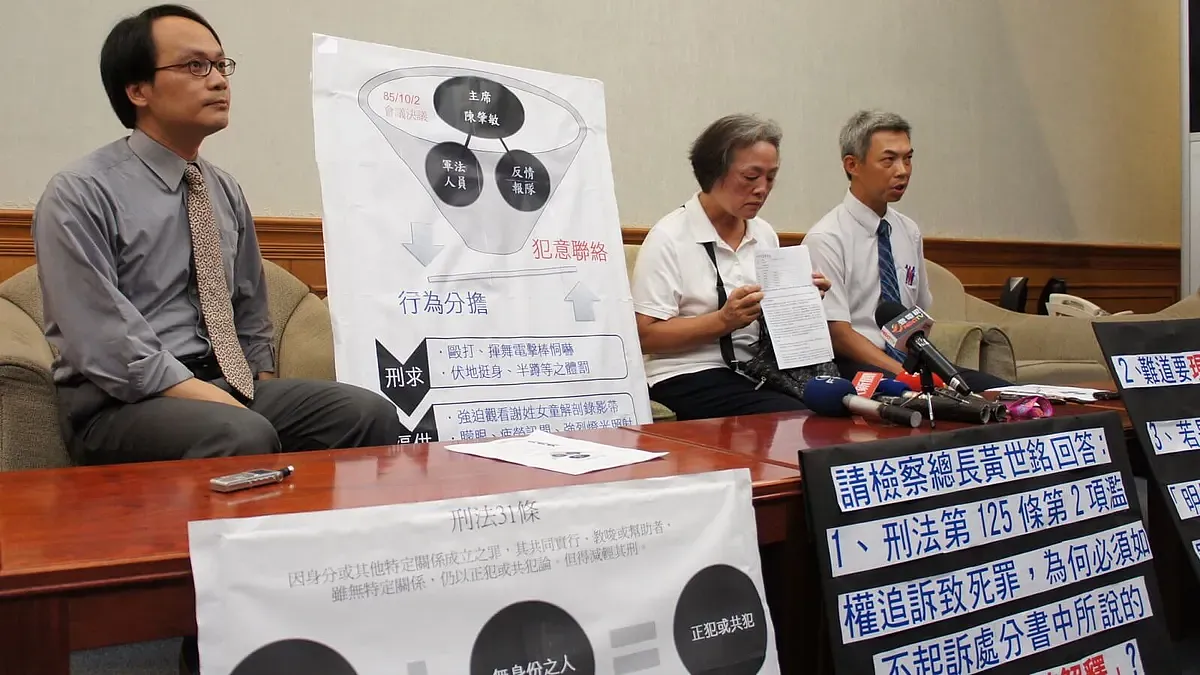
This case marks the first instance in the history of military trials where a case was overturned and retried after the execution of the defendant's death sentence. How the criminal offenses of the defendants involved in the abuse of power in prosecution leading to death and other crimes should be adjudicated has drawn intense public attention from all sectors of society. Following today's court session, our Foundation held a press conference inviting Chiang's mother and the pro bono legal team to publicly explain the progress of the retrial hearing and raise questions regarding the non-prosecution disposition.
We pose the following questions and ask Prosecutor-General Huang Shih-ming to answer:
- Why must Article 125, Paragraph 2 of the Criminal Code (abuse of power in prosecution leading to death) be subject to a "teleological restrictive interpretation" as stated in the non-prosecution disposition?
- Does it mean that only death resulting from on-site torture can constitute this offense?
- If Article 125, Paragraph 1, Subparagraph 3 of the Criminal Code ("knowingly subjecting an innocent person to prosecution or punishment") clearly involves no physical contact, how could there be any possibility of aggravating bodily injury leading to death under the prosecutors' interpretation?
We demand that judicial justice must be upheld, and Chiang Kuo-ch'ing's blood must not have been shed in vain!
附件
This article is an AI-generated translation of the original Chinese text. In the event of any discrepancy, the Chinese version shall prevail.