
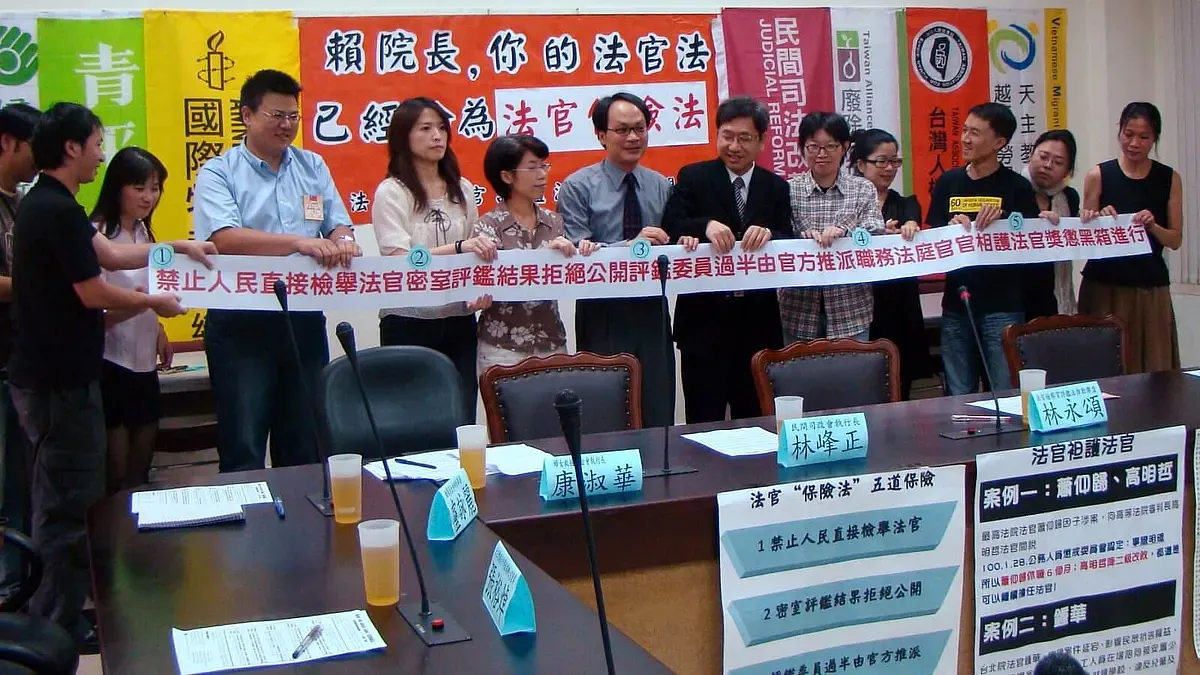
President Lai, Has Your Judges Act Become an "Insurance Policy for Judges"?!
Last edited: 2026-07-27
On May 16, Legislative Yuan President Wang Jin-pyng chaired cross-caucus consultations on the draft Judges Act, which once again proved helpless in removing bad judges. The negotiation terms put forth by the Judicial Yuan remain conservative, bureaucratic, and devoid of self-reflection; once someone passes the judicial examination, it is tantamount to purchasing lifelong insurance, rendering it fundamentally impossible to deal with bad judges. President Lai In-jaw, who took office last year carrying the heavy responsibility of judicial reform, has yielded to internal conservative forces, and the Judges Act he advanced has degenerated into an "Insurance Policy for Judges." The Judicial Yuan's version of the Judges Act sets up five layers of insurance for bad judges:
-
First Layer of Insurance: Prohibiting Citizens from Directly Reporting Judges
Regarding problematic judges, the Judicial Yuan has overturned the consensus built with civil society over many years by barring citizens from directly reporting them. Its stated reason is the fear that an influx of too many garbage cases would overwhelm evaluation committee members! Citizens can directly petition the Legislative Yuan and directly lodge complaints with the Control Yuan, yet the Judicial Yuan invokes the fear of abusive reporting as a pretext to block citizens from appealing against problematic judges.
The Judicial Yuan's existing judge evaluation regulations already reject direct reporting by citizens. Over the past 15 years, its judge evaluations have amounted to only 116 cases, ultimately resulting in merely 2 cases being referred to the Control Yuan and 2 cases handed over to the Judicial Yuan's Personnel Review Committee for disciplinary demerits. This is an ineffective judicial self-regulation mechanism. The removal mechanism of the Judges Act is meant to introduce external oversight, which naturally requires direct reporting by the citizens without needing to go through others. The Judicial Yuan refuses to improve and lets bad judges hide inside an ancient fortress; this is the first layer of insurance.
-
Second Layer of Insurance: Confidential Evaluations with Results Refused to Be Made Public
During his campaign, President Ma made a promise to introduce a regular judge evaluation system featuring diverse participation. Following strong advocacy from civil society, the Judicial Yuan merely promised to conduct a comprehensive judge evaluation once every three years as a reference for personnel promotions, while refusing to make the evaluation results public. Despite being repeatedly criticized as a black-box evaluation, the Judicial Yuan remains unmoved. When the methods, items, and details of the evaluation are operated internally by the Judicial Yuan itself, without even the participation of external experts and scholars, the unspeakable evaluation results allow bad judges to hide inside a black box; this is the second layer of insurance.
-
Third Layer of Insurance: Over Half of the Evaluation Committee Appointed by the Authorities
Pressed by internal conservative forces and lacking the resolve for reform, and coupled with the ruling Kuomintang's failure to distinguish right from wrong, the Judicial Yuan has demanded that among the 11 members of the Judge Evaluation Committee, the more-than-half majority of 6 scholars and socially impartial figures be changed to be appointed respectively by the Legislative Yuan, the Control Yuan, and the Judicial Yuan, with 2 members each. On the surface, this creates a three-branch balance, but behind the scenes, it is no different from the President—who controls the parliamentary majority and the nomination power for the heads of the Control and Judicial Yuans— monopolizing the appointment power of all 6 scholars and socially impartial figures. This completely violates the political principles of checks and balances and division of power, and causes the method of selecting evaluation committee members to lose objectivity and impartiality. Democratic oversight cannot be properly fulfilled; this is the third layer of insurance.
-
Fourth Layer of Insurance: Mutual Protection Among Officials in the Disciplinary Court for Judges
The Judicial Yuan insists that the members of the Disciplinary Court, which hands down the final disciplinary results, shall all be veteran judges, refusing the participation of external experts. The result is mutual protection among officials. For instance, Judge Hsiao Yang-kuei, whose lobbying was verified by the Control Yuan, was given only a six-month suspension by the Commission on the Disciplinary Measures of Public Functionaries—which is composed entirely of judges—and was still able to return to the bench. Doing so constitutes the fourth layer of insurance shielding bad judges.
-
Fifth Layer of Insurance: Black-Box Operations for Judges' Awards and Discipline
Bound by internal conservative pressure, the Judicial Yuan insists that the members of the "Personnel Review Committee," which holds sway over judges' personnel transfers, integrity, and evaluations, must all possess the status of judges, refusing to introduce a minority of external members to ensure transparent operations. Consequently, judicial seniority groups, personal grievances, and years of service become the primary factors determining judges' personnel assignments. Whether a judge is good or bad is cast aside; not only can bad judges not be eliminated, but they can also look forward to successive promotions; this is the fifth layer of insurance.
Facing such a Judges Act, the Legislative Yuan will hold consultations once again next Monday, May 23. The Alliance hereby calls upon Judicial Yuan President Lai to bravely respond to the public's expectations for judicial reform, and not let the Judges Act degenerate into an insurance policy for judges due to momentary weakness and pressure from bad judges. We also remind the ruling party's legislators to exercise strict gatekeeping; otherwise, how will they account to the voters during the elections early next year?
Participating Organizations
Catholic Diocese of Hsinchu, Scalabrini Social Center (Vn. Migrant & Immigrant Workers' Center) Supervisor Chang Yü-cho
Taipei Awakening Association Secretary-General Wang Shih-hsuan
Association for Judicial Reform, Taiwan Executive Director Lin Feng-cheng, Attorney Lin Yung-sung
Taiwan Association for Human Rights Secretary-General Tsai Chi-hsun
Green Party Taiwan (Qing Ping-Tai) Ting Yü-cheng, Shen Ching-kai
Foundation for Women's Rights Promotion and Development Executive Director Kang Shu-hua
Amnesty International Taiwan Section Deputy Secretary-General Yang Tsung-li
Taiwan Alliance to End the Death Penalty Executive Director Lin Hsin-yi
Environmental Jurists Association Secretary-General Lin Jen-hui
Garden of Hope Foundation R&D Specialist Lu Yung-li
Press Contacts
JRF Executive Director Attorney Lin Feng-cheng 02-2523-1178
This article is an AI-generated translation of the original Chinese text. In the event of any discrepancy, the Chinese version shall prevail.