
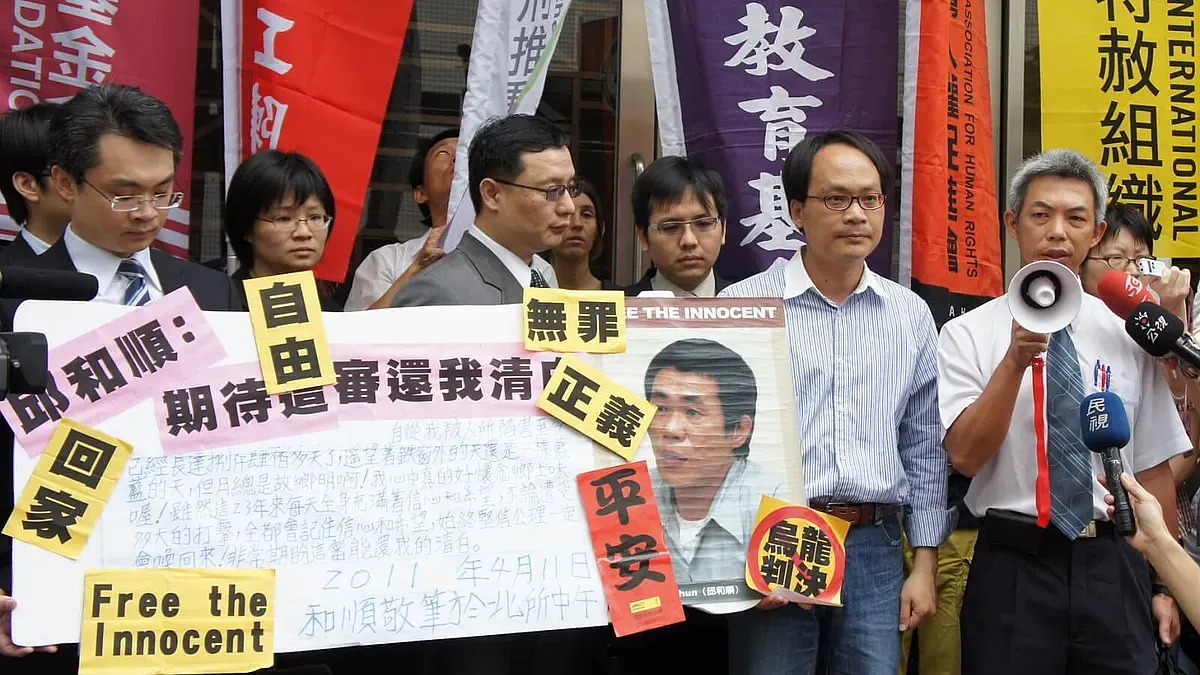
Chiou Ho-shun Case: 23 Years and 11th Remand Trial Guilty Verdict – Defense Counsel Statement
Last edited: 2026-07-27
Today, Presiding Judge Chou Ying-wen, Judge-in-Charge Chan Chun-hung, and Associate Judge Lin Hai-hsiang of the Criminal Division Collegial Panel of the Taiwan High Court delivered the verdict for Case No. 98-Chu-Shang-Chung-Keng-(Shih-I)-7, involving Chiou Ho-shun and others accused of robbery. The court found the defendant Chiou Ho-shun guilty and sentenced him to capital punishment, while sentencing defendant Lin K'un-ming to 17 years imprisonment and defendant Wu Shu-chen to 10 years imprisonment. This verdict completely disregards the presumption of innocence and the principle of adjudication based on evidence—which form the cornerstone of the Code of Criminal Procedure—preferring to execute the innocent rather than let the guilty escape. For this, we express our utmost sorrow, disappointment, and outrage!
This verdict is based entirely on the confessions of the defendants and others. Not only is there no evidence to prove that these confessions are true, but numerous pieces of evidence actually demonstrate that they are false. During the investigation stage, the defendants were subjected to improper interrogation methods by police officers, such as being repeatedly beaten and having chili water forced down their noses. This is proven by interrogation audio and video recordings, and was subsequently investigated and corrected by the Control Yuan. The police officers involved in the torture were also convicted by final court judgments! Given the old saying that under torture anything can be extracted, what kind of experience and rules of logic allowed the court to use such confessions as evidence to sentence a person to death?
This case has now reached its eleventh remand trial and is the case in Taiwan's judicial history where a defendant has been detained the longest. If, as the prosecution claims, the evidence against the defendants was conclusive, why has the case constantly oscillated between the second and third instances, taking 23 years without reaching a final determination? This shows that the Supreme Court has consistently harbored many doubts as to whether the defendants were truly the perpetrators. The as many as 288 interrogation confession records contradict each other and are full of loopholes. If we are to believe that the defendants truly participated in the crime, how can anyone believe that after producing 288 confession records, they still could not articulate a reasonable, complete criminal narrative supported by objective evidence? It is evident that there is only one truth: the defendants never committed this crime from beginning to end!
Furthermore, numerous pieces of evidence in the case file indicate that the crime was committed by persons other than the defendants. These pieces of evidence were specifically pointed out by the Supreme Court—on the grounds that human lives are at stake—in its judgment remanding the case for the eleventh time, requiring the eleventh remand court to conduct a thorough investigation. Regrettably, the eleventh remand court turned a blind eye and still chose the relatively "convenient" approach: embracing confessions obtained through the coercion of torture.
Worse still, after the indictment in this case, important physical evidence—including a black plastic bag containing the victim Ko Hung Yu-lan's shoes, a butchering knife, and men's briefs, as well as the extortion audio cassettes of the perpetrators—mysteriously went missing. The eleventh remand court searched far and wide in all directions, yet still could not find them. Today, all that remains are confessions covered in bruises. With crucial physical evidence missing and convictions rashly based on torture-extracted confessions, how can the deceased rest in peace and the living be free of grievance? How can the inexplicable loss of critical evidence, which deprives the defendants of the means to prove their innocence, be borne by the defendants? Is such a guilty verdict fair?
Defendant Chiou Ho-shun has been prosecuted and detained for over 23 years due to confessions made under the coercion of torture—unmatched in our nation's judicial history! It is no exaggeration to say that this case has become a stain on Taiwan's judiciary. Several scholars sharply criticized this in a human rights report on the case published in 2010. Yet, the eleventh remand court lacked the courage to face past mistakes and continued to gloss over them. How can the judiciary ever win the trust and respect of the people?
Therefore, we solemnly appeal to the Supreme Court: the tragedy of a wrongful execution must not be repeated! The Supreme Court should promptly annul the High Court's judgment, which is constructed upon a fragile and shattered foundation of torture-extracted confessions, so as to salvage public trust in the judiciary, if even by a sliver!
At the same time, the defense counsel team will uphold its consistent convictions and continue to assist the defendants in clearing their names until the day they are acquitted and able to return home!
Pro Bono Defense Counsel Team
Attorneys Yiu Po-hsiang, Sung I-hsin, Li Sheng-hsiung, Chou Han-wei, Lin Chun-hung, Lin Hung-wen, Cheng Kai-hung, Wei Chao-tsung, Ku Li-hsiung
Supporting Organizations
Huang-Pu Education Foundation, Judicial Reform Foundation, Taiwan Association for Human Rights, Taiwan Labour Front, Amnesty International Taiwan, Taiwan Alliance to End the Death Penalty
Press Contact
JRF CEO, Attorney Lin Feng-cheng 02-2523-1178
This article is an AI-generated translation of the original Chinese text. In the event of any discrepancy, the Chinese version shall prevail.