
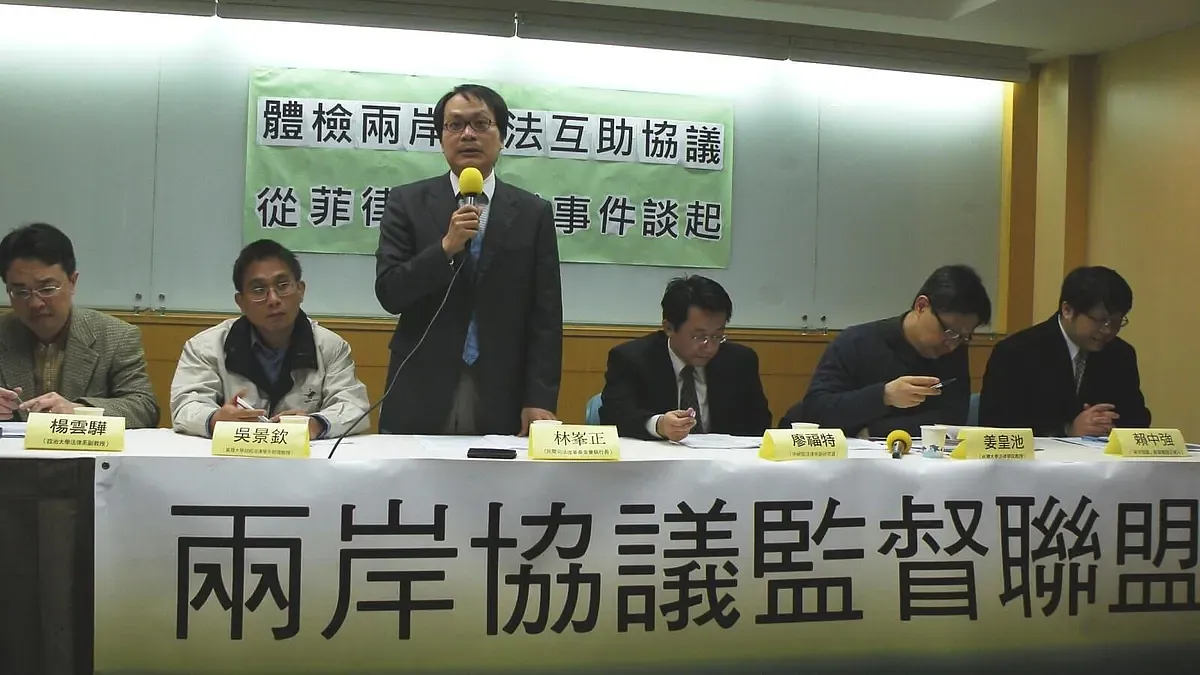
Post-Event Press Release|Reviewing the Cross-Strait Judicial Mutual Assistance Agreement—Starting from the Deportation Incident to the Philippines Seminar
Last edited: 2026-07-27
Recently, the Philippine government extradited 14 ROC citizens suspected of fraud to China, raising human rights concerns over the infringement of Taiwan's sovereignty and the lack of procedural safeguards for Taiwanese citizens facing criminal proceedings in China. To address the various issues behind this individual case, the Cross-Strait Agreements Oversight Coalition and the Judicial Reform Foundation jointly held a seminar to review the Cross-Strait Judicial Mutual Assistance Agreement, attempting to put forward policy recommendations to the Taiwan government from the perspectives of international law and criminal law.
Liao Fu-ter, a research fellow at the Institute of Legal Studies, Academia Sinica, pointed out that the Philippine government used the excuse that "cross-strait judicial mutual assistance agreements have already been signed, and both sides should resolve their disputes themselves," and even invoked the "One China" principle as an excuse to ignore Taiwan's request to repatriate the 14 nationals. The stance of "One China, respective interpretations" has led to confusion regarding the Republic of China's constitutional self-identity and the objective facts of international law, as well as blurring the lines between sovereignty and governance jurisdiction. Another major issue is that the "Cross-Strait Joint Crime-Fighting and Judicial Mutual Assistance Agreement" fails to incorporate human rights concepts. He suggested that before the People's Republic of China ratifies the International Covenant on Civil and Political Rights, the two international human rights covenants should serve as the human rights benchmark for both sides and be incorporated into the "Cross-Strait Joint Crime-Fighting and Judicial Mutual Assistance Agreement."
Chiang Huang-chih, a professor at the Department of Law, National Taiwan University, stated that the text of the "Cross-Strait Joint Crime-Fighting and Judicial Mutual Assistance Agreement" leaves much room for respective interpretations. In the event of a dispute, no objective third-party handling mechanism has been designed, which ultimately leads to compromises succumbing to power politics. During negotiations, Taiwan should demand greater clarity in the text of the provisions to prevent them from becoming even larger loopholes. Although diplomatic realities are unfavorable to Taiwan, with many countries adopting a One China policy, there has been no precedent of Taiwanese citizens being deported to China. The Philippines' handling of this matter violates past diplomatic traditions and conventions, and the Taiwan government should formally demand an explanation from the other party to remedy future undue infringements upon our sovereignty.
Wu Ching-chin, an assistant professor at the Department of Financial and Economic Law, Truth University, expressed that in this incident, the public has directed blame at the Philippines out of concern over the loss of Taiwan's sovereignty. However, based on the determination of jurisdiction in general transnational crimes, the location of the criminal result was in China, and according to the extradition treaty signed and enacted between China and the Philippines in 2005, the Philippines' handling in this case can be considered lawful. Currently, there is no judicial mutual assistance agreement between the Philippines and Taiwan, which naturally led to the decision to send the individuals to China. The most pressing task is to sign judicial mutual assistance agreements with countries such as the Philippines, rather than demanding that China repatriate the Taiwanese suspects.
Associate Professor Yang Yun-hua of the Department of Law, National Chengchi University, also noted that current public attention in Taiwan is focused on demanding that China repatriate the fourteen suspects. However, one must ask: since the victims, accounts, and evidence in this case are all in China, is it truly feasible for Taiwan to investigate and try this case? The Cross-Strait Judicial Mutual Assistance Agreement is a very special and rare case, signed only by two authorized non-governmental associations, without including important units such as the Ministry of Foreign Affairs, prosecution agencies, or judicial authorities. This shows that it fundamentally fails to touch upon the division of judicial jurisdiction, let alone crimes committed in a third country. Crimes involving a third country must be handled through multilateral treaties and cannot be decided solely through the cross-strait judicial mutual assistance agreement. On the other hand, many Taiwanese citizens currently face local criminal justice in China, yet their treatment receives little attention, and no demands for repatriation are made. Therefore, Professor Yang believes that the focal point of this incident should not be blaming the Philippines for improper conduct, but rather ensuring whether all Taiwanese suspects are guaranteed "due and fair trial procedures consistent with international standards," including the rights to select counsel for legal assistance and family visits.
While international law scholars and criminal law scholars raised different perspectives on various legal points, Lai Chung-chiang, an attorney and convener of the Cross-Strait Agreements Oversight Coalition, emphasized that what must be considered in such incidents is definitely not just "sovereignty" and "transnational crime-fighting," but a third element: "the judicial human rights of the criminal suspects." The Coalition has long advocated that negotiations for the Cross-Strait Bilateral Investment Agreement should explicitly guarantee the personal safety and personal freedom of the people on both sides. In particular, China should promptly ratify the International Covenant on Civil and Political Rights to ensure that nationals of any nationality have the right to a fair trial in China. Can these fourteen Taiwanese suspects freely choose their defense counsel? Can lawyers be present throughout the public security interrogation to protect their rights? Clearly, China's current mechanisms are inadequate. Furthermore, China's detention procedures are overly abusive. We care not only about these fourteen individuals, but about all individual cases adjudicated in China, in the hope that a due process mechanism can be established in the future.
Attorney Lin Feng-cheng, who has long been dedicated to judicial reform, also stated that when cross-strait disputes arise, human rights should be the most important principle. The government should bravely voice its basic human rights positions externally, but correspondingly, Taiwan must also review its own foreign national detention system and criminal human rights deficiencies, such as prolonged detention and failure to conduct hearings for review. At the seminar, the Cross-Strait Agreements Oversight Coalition and the Judicial Reform Foundation issued a joint statement, asserting that providing judicial procedural safeguards meeting international human rights standards should be the foundation of transnational cooperation in combating crime. However, given that the provisions of China's Criminal Procedure Law and their practical implementation lack adequate safeguards for judicial human rights, severely failing to align with international human rights norms such as the International Covenant on Civil and Political Rights, they demand that:
- The Chinese government must repatriate the 14 ROC nationals.
-
Prior to repatriation:
- The Chinese government must allow our officials and human rights organization representatives to visit the 14 ROC nationals and assist in retaining defense counsel.
- Regarding the criminal proceedings conducted prior to repatriation, the Chinese government must promise to provide the 14 ROC nationals with judicial procedural safeguards that meet international human rights standards.
- If the Chinese government fails to respond positively to the aforementioned demands before February 22, we will not welcome Chairman Ch'en Yun-lin of China's Association for Relations Across the Taiwan Straits (ARATS) to visit Taiwan.
This article is an AI-generated translation of the original Chinese text. In the event of any discrepancy, the Chinese version shall prevail.