
Inadequately Prepared, Chaotic Pace, Lagging Progress, Probation! ~ Review of the Ma Administration's One-Year Results in Implementing the Two Covenants
Last edited: 2026-07-27
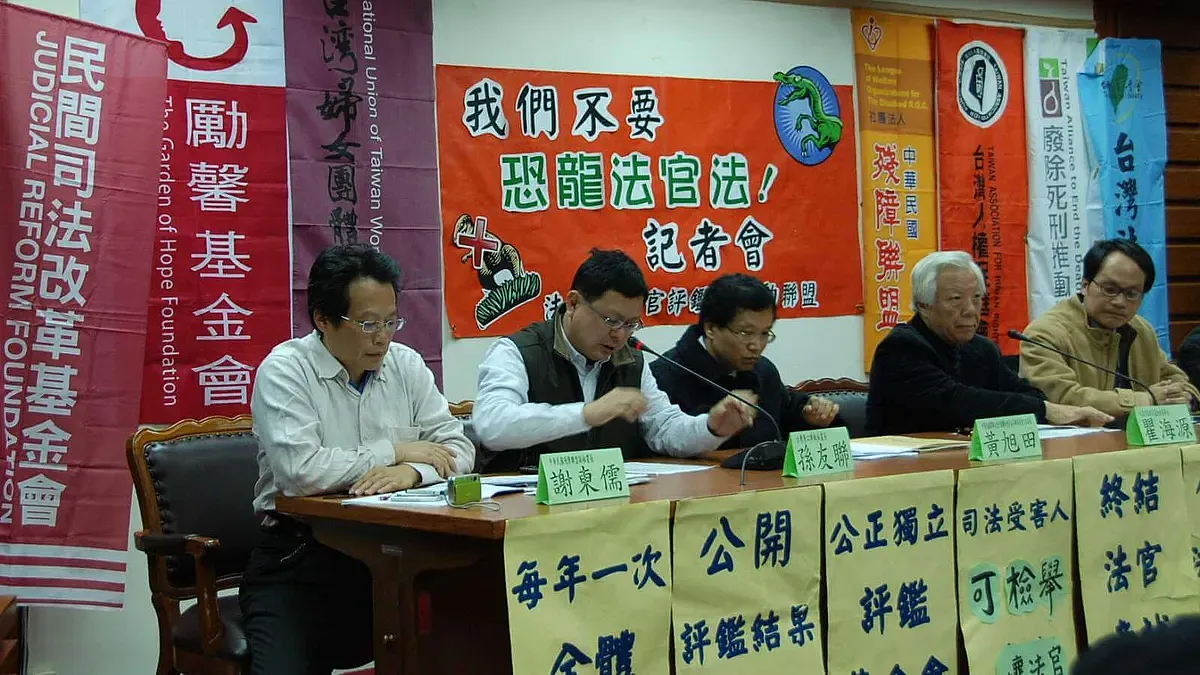
January 11 is Judicial Day. Yesterday, the President of the Judicial Yuan announced to the public the official establishment of the "National Judicial Reform Promotion Committee" personally led by him, making it seem as though the ship of judicial reform has set sail toward a smooth and broad path. Coincidentally, the legislative process for the Judges Act, which has been delayed for over 20 years and eagerly anticipated by society, also happened to pass its first reading on the eve of Judicial Day. Barring any unexpected events, the Legislative Yuan should be able to complete the legislation in the next session. However, if we follow the first-reading provisions currently dominated and passed by the Kuomintang (KMT), not only will it likely fail to weed out incompetent "dinosaur judges," but it may instead nurture, spawn, and protect even more of them.
The Alliance's Six Major Demands
- Reject: Evaluation by the Judicial Yuan itself once every five years!
Demand: Comprehensive evaluation of all judges once a year! - Reject: Black-box operations and fake evaluations!
Demand: Make evaluation results public! - Reject: An evaluation committee decided by a minority!
Demand: A fair and independent evaluation foundation! - Reject: Judicial victims having nowhere to voice their grievances!
Demand: Judicial victims must be able to report bad judges! - Reject: Judges who only know how to take tests!
Demand: End the judicial examination! - Reject: Supporting dinosaur judges for life!
Demand: Reasonable protections for judges!
The Judicial Yuan Evaluates Itself, Rejecting External and Independent Evaluation Bodies
Regarding the much-anticipated judges evaluation system, the Judicial Yuan brazenly established the evaluation unit under its own administration, refusing to let representatives of the evaluation committee be elected via ballots cast by judges, prosecutors, and lawyer association communities. Instead, it empowered the President of the Judicial Yuan, the Ministry of Justice, and the Taiwan Bar Association to appoint representatives at their own discretion. Furthermore, the KMT changed the majority of the 11 evaluation committee members—specifically six scholars and impartial social figures—so that two each are appointed by the Legislative Yuan, the Control Yuan, and the President of the Judicial Yuan. Such an arrangement is tantamount to the President—who holds the majority in the legislature and the nomination power for the heads of the Control and Judicial Yuans—monopolizing the appointment power for all six scholars and impartial social figures, which completely violates the political principle of checks and balances.
Once-Every-Five-Years Black-Box Reviews and Silenced Victims: A Crippled Judge Elimination Mechanism That Protects Dinosaur Judges
The Judicial Yuan feigned acceptance of regular evaluations for all judges, only to result in reviews conducted once every five years, handled behind closed doors within the Judicial Yuan, with the evaluation results refused to the public. The elimination mechanism is merely a sham, making a mockery of the public. The public outcry for comprehensive judge evaluations was diverted into backroom operations by the Judicial Yuan, completely stripping the mechanism of any supervisory significance and leaving only case-by-case evaluations—effectively a crippled elimination mechanism. Even more absurdly, the first-reading provisions overturned the consensus reached by the Judicial Yuan and civil society over many years by prohibiting parties to judicial cases from lodging complaints against judges presiding over their cases. This sacrifices the right of judicial victims to directly voice their grievances. Coupled with strong backing from the KMT, legal interpretations cannot serve as grounds for evaluating judges. Such a Judges Act renders everyone helpless against dinosaur judges. Moreover, the Disciplinary Court for Judges, which makes the final decision on judicial disciplinary outcomes, is composed entirely of judges, making professional courtesy inevitable and instead safeguarding dinosaur judges.
The President's Promise of a Diverse, Professional, and Publicly Participatory Regular Evaluation System Has Broken Its Promise Again
Compared to the current system where citizens can directly report judges to the Control Yuan, the judge evaluation system spearheaded by the KMT represents a severe regression. Furthermore, it directly breaches President Ma's campaign promise in the "New Century Declaration on Human Rights" to "eliminate judicial officers who abuse power or neglect their duties through a diverse, professional, and publicly participatory regular evaluation system." The President has broken his promise once again!
Dinosaur Judges Propagate Intergenerationally and Endlessly Through the Judicial Examination
Our "Reject the Dinosaur Judges Act" press conference points out that the evaluation system designed to weed out judges has become unrecognizable, leaving dinosaur judges completely unfearful. The Judicial Yuan demonstrates no reform determination or sincerity regarding the entry-level system for selecting individuals to serve as judges, still insisting on refusing to abolish the judicial examination system. Examinations cannot identify individuals suitable for serving as judges; selecting outstanding lawyers, scholars, and prosecutors to serve as judges is already a social consensus. The Judicial Yuan refuses to abandon this crutch simply out of convenience for the examination system, resulting in dinosaur judges continuing to propagate intergenerationally and endlessly through the judicial examinations.
Judges Trained by the Ministry of Justice: Subverting the System and Failing to Separate Prosecution and Adjudication
Other reform priorities related to the Judges Act include: whether the Personnel Review Committee—which holds jurisdiction over judicial promotions, leadership selection, and other important personnel matters—should introduce external members to promote transparent operations and prevent the ills of professional courtesy and inbreeding; and the long-standing systemic malaise of allowing the Ministry of Justice, rather than the Judicial Yuan, to oversee and conduct judicial training, effectively letting the executive branch "train" the judicial branch. Every single one of these is a critical factor determining the future success or failure of the Judges Act, yet they were similarly shot down during the Legislative Yuan's first-reading process and failed to gain favor.
The Entire Public Must Stand Up to Reject the Dinosaur Judges Act
On the other hand, welfare and preferential treatment for judges deriving from constitutional protections of lifetime tenure have all smoothly passed. Retired judges can still collect substantial pensions coupled with retirement care allowances. This Dinosaur Judges Act has failed to eliminate dinosaur judges; instead, it provides them with generous welfare and enhanced protections, turning them into civil servants holding a diamond rice bowl. Taxpayers are forced to "lawfully" support dinosaur judges for a lifetime! The "Judges and Prosecutors Evaluation Act Promotion Alliance," composed of nearly a hundred civil groups, seeks to tear away the true facade of the first-reading provisions and urgently call upon the entire public to stand up and reject the Dinosaur Judges Act.
Press Conference Moderator
JRF Executive Director, Attorney Lin Fêng-chêng
Judges and Prosecutors Evaluation Act Promotion Alliance Convener, Professor Ch'ü Hai-yüan
Attending Organization Representatives
Humanistic Education Foundation, Project Secretary Ch'en I-wen
Disabled Persons Federation of the Republic of China, Deputy Secretary-General Hsieh Tung-ju
Catholic Office for the Pastoral Care of Migrants and Itinerant People, Supervisor Chang Yü-cho and Father Hung Nguyen (阮文雄)
Taipei Bar Association, Secretary-General Hsu Kê-ming
Taiwan Association for Human Rights, Secretary-General Tsai Chi-hsun
Taiwan Law Society, Executive Secretary Pêng Ya-chen
Taiwan Indigenous Peoples Policy Association, Board Director Ch'en Min-yüan
National Alliance of Taiwan Women's Associations, Director Lin Chia-yüan
Taiwan Labour Front, Secretary-General Sun Yu-lien
Green Citizen's Action Alliance, Ting Yü-cheng, Lin Hsin-chang, Ch'en Wei-pin, Hsu Wei-ting
BARRO, Chairperson of the Judicial Reform Committee, Attorney Huang Hsu-t'ien
Keelung Bar Association, Secretary-General Cheng Wên-ting
Foundation for Women's Rights Promotion and Development, Executive Director Kang Shu-hua and Senior Research and Advocacy Specialist Hong Hsin-ping
Taiwan Alliance to End the Death Penalty, Executive Director Lin Hsin-hsi;i
Garden of Hope Foundation, Executive Director Chi Hui-jung and Researcher Lu Yung-li
Press Contacts
JRF Executive Director, Attorney Lin Fêng-chêng 02-2523-1178
This article is an AI-generated translation of the original Chinese text. In the event of any discrepancy, the Chinese version shall prevail.