
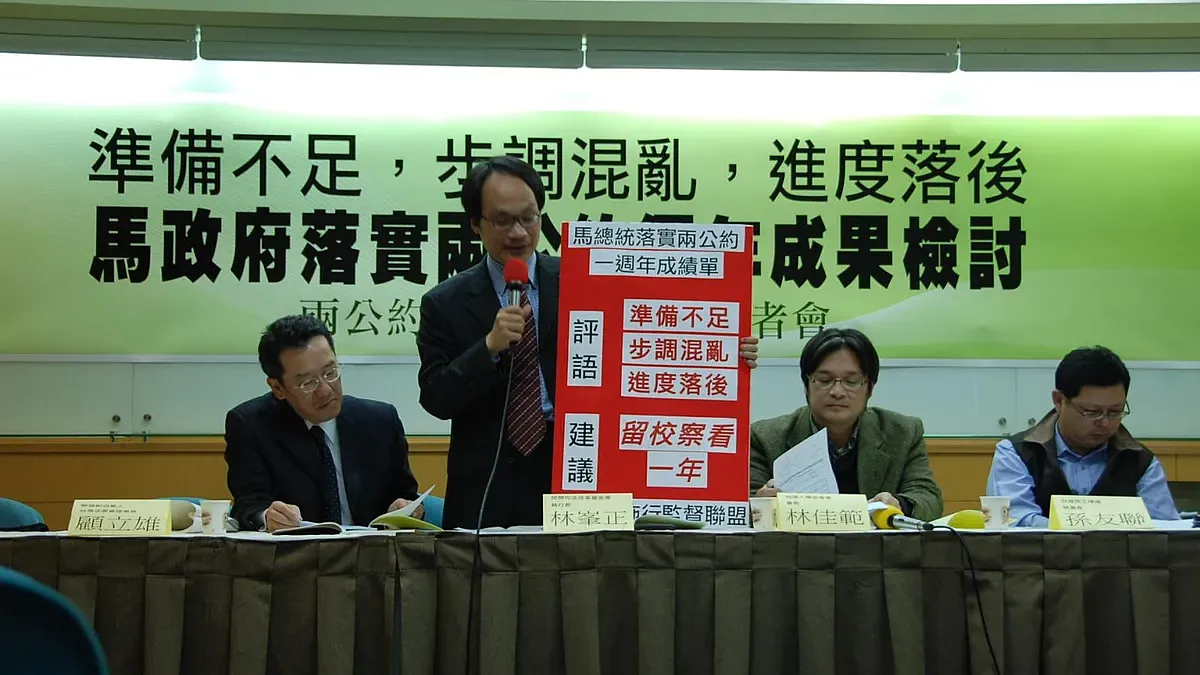
Inadequately Prepared, Chaotic in Pace, Lagging Behind in Progress, and Placed on Academic Probation! ~ Review of the Ma Administration's One-Year Results in Implementing the Two Covenants
Last edited: 2026-07-27
Last March, the Legislative Yuan passed the ratification bills for the Two Covenants (the International Covenant on Civil and Political Rights and the International Covenant on Economic, Social and Cultural Rights), as well as the Enforcement Act of the Two Covenants, which domesticates them. The Enforcement Act took effect on December 10 of last year, International Human Rights Day, marking its one-year anniversary today. The NGO Coalition for the Enforcement of the Two Covenants, comprising 42 civil society organizations, has released an 80-page annual monitoring report tracking the planning, execution, and effectiveness of the government's "Big Steps Forward for Human Rights" plan to implement the Two Covenants, offering detailed reviews, criticisms, and recommendations.
The NGO Coalition for the Enforcement of the Two Covenants believes that if a grade were to be given to the government for its implementation of the Two Covenants since last March, it can only be described as inadequately prepared, chaotic in pace, and lagging behind in progress, warranting a recommendation of one year of academic probation. It can only be deemed a failing grade. Below are merely the most representative symptoms:
Leaving a mere 7 months and 18 days of preparation time before implementation is virtually dereliction of duty!
The United Kingdom, which has decades of experience in implementing international human rights treaties, specifically reserved a full two-year preparation period prior to the implementation of the Human Rights Act—its legislation domesticating the European Convention on Human Rights—to conduct necessary preparatory work. In contrast, Taiwan, having been detached from the United Nations human rights system for 39 years, reserved only 7 months and 18 days of preparation time. Consequently, the relevant training for civil servants, as well as the review of laws and administrative measures required under the Enforcement Act of the Two Covenants, were of poor quality and reduced to mere formalities. This has severely impacted the subsequent correction of laws and improvement of administrative measures that fail to comply with the Two Covenants.
The planning of a "government-civil society hybrid" national human rights report is bizarre and improper!
When President Ma announced on December 3 the establishment of the Presidential Office Human Rights Consultative Committee to be launched today, he simultaneously announced that its members would "jointly publish the Taiwan Human Rights Report in conjunction with civil society organizations over the next year." Such a "government-civil society hybrid" human rights report clearly violates Article 6 of the Enforcement Act of the Two Covenants, which stipulates that the national human rights report system "shall be in accordance with the provisions of the Two Covenants." Under international practice, national human rights reports should be official government reports, while civil society organizations submit "shadow reports" or "counter-reports" for monitoring purposes, facilitating systematic human rights dialogues between the government and the public. The "government-civil society hybrid" national human rights report proposed by President Ma severely blurs the boundaries between the monitor and the monitored. Not only does this violate the Enforcement Act of the Two Covenants, international practice, and democratic common sense, but it also demonstrates the chaotic pace of the government in implementing the Two Covenants.
Allocating a "pittance budget" for the implementation of the Two Covenants!
According to Article 8 of the Enforcement Act of the Two Covenants: "All levels of government agencies shall, in accordance with the provisions of the Two Covenants, review the laws, regulations, and administrative measures under their jurisdiction; those that do not conform to the Two Covenants shall be subject to the enactment, amendment, or repeal of laws and regulations, as well as the improvement of administrative measures, within two years from the implementation of this Act." What is required is a massive project of correction and reform.
This year marks the first of the two-year deadline. The Ministry of Justice, as the coordinating agency for the implementation of the Two Covenants, budgeted a mere NT$1,113,000 for this purpose. Next year will be the final year, and according to the Ministry of Justice's general budget draft, the amount allocated for "human rights operations and promoting the Two Covenants" will be only NT$1,750,000. Even if another item of NT$2,000,000 for "holding international human rights seminars" is included, the total amounts to no more than NT$3,750,000—falling short of the NT$5,000,000 allocated for "handling anti-corruption laws, corporate integrity, and other anti-corruption advocacy and activities"! This clearly violates the requirement under the Enforcement Act of the Two Covenants that funding needed for implementation "shall be budgeted with priority," and further demonstrates the government's insufficient commitment and ineffective execution in implementing the Two Covenants.
The NGO Coalition for the Enforcement of the Two Covenants feels deeply pessimistic about the rigorous implementation of the Two Covenants. Aside from urging the government to respect the Enforcement Act of the Two Covenants and exert its utmost efforts during the final year, the Coalition proposes six recommendations for short- and medium-term remedial measures:
- Establish a task-force-based dedicated mechanism for implementing the Two Covenants.
- Develop more thorough planning for the national human rights reporting system.
- Establish a clearer positioning for the Presidential Office Human Rights Consultative Committee.
- Ratify and domesticate other major international human rights treaties.
- Establish a National Human Rights Commission compliant with the Paris Principles.
- Subsidize universities to establish international human rights (law) research centers.
Appendix
Attendees
Ku Li-hsiung (Vice Convenor, NGO Coalition for the Enforcement of the Two Covenants; President, Taiwan Law Society)
Lin Feng-cheng (Executive Director, Judicial Reform Foundation)
Lin Chia-fan (President, Taiwan Association for Human Rights)
Sun Yu-lien (Secretary-General, Taiwan Labour Front)
Press Contact
Yeh Ting-chun (Director, Policy Advocacy Department, Taiwan Association for Human Rights) 02-2596-9525
Member Organizations of the NGO Coalition for the Enforcement of the Two Covenants
Taiwan Association for Human Rights, Judicial Reform Foundation, Taiwan International Medical Alliance, Taiwan Labour Front, Taiwan Bar Association, Parents' Association of Intellectual Disabilities, Taiwan, National Alliance on Mental Illness / Taiwan Alliance of Formosa Support for the Handicapped, Taiwan Lourdes Association, Taiwan Federation of Financial Workers' Unions, Nanyang Taiwan Sisters Coalition, millet-穗 Indigenous Cultural Foundation, Taiwan Teachers' Association, Taiwan Alliance to End the Death Penalty, Citizen Congress Watch, Working Holiday Taiwan, Taipei Office Workers Association, Taipei Women's Rights Association, Human Rights Protection Committee of the Taipei Bar Association, Taiwan Pacific Development Association, Taiwan Association for Rights of Children and Youths, Taiwan Northern Society, Taiwan Corporate Social Responsibility Association, Free Burma Coalition - Taiwan, Taiwan Gender Queer Rights Advocacy, Taiwan Law Society, Taiwan Association for Peace Promotion, Taiwan Indigenous Non-Governmental Organizations Alliance, Taiwan Indigenous Peoples Policy Association, Taiwan Indigenous College Promotion Association, Chinese (Taiwan) Society of International Law, National Alliance of Taiwan Women's Associations, Taiwan Association for Labor and Social Policy Research, Association of Taiwan Journalists, Friends of Tibet Taiwan, Taiwan Environmental Action Network, Taiwan Youth Anti-Reverse Front, Association of Chinese in Taiwan, Chang Fo-chuan Center for Human Rights at Soochow University, Green Party Taiwan, National Association for the Promotion of Community Universities, National Human Rights Commission Promotion Alliance, Amnesty International Taiwan, Judicial Reform Foundation / Awakening Foundation / Coolloud / Green Front Association / Cheng Nan-jung Liberty Foundation
(NGOs are welcome to join)
This article is an AI-generated translation of the original Chinese text. In the event of any discrepancy, the Chinese version shall prevail.