
Civil Society Public Hearing on the Vice-Presidential Nominee for the Judicial Yuan - Su Yung-chin
Last edited: 2026-11-03
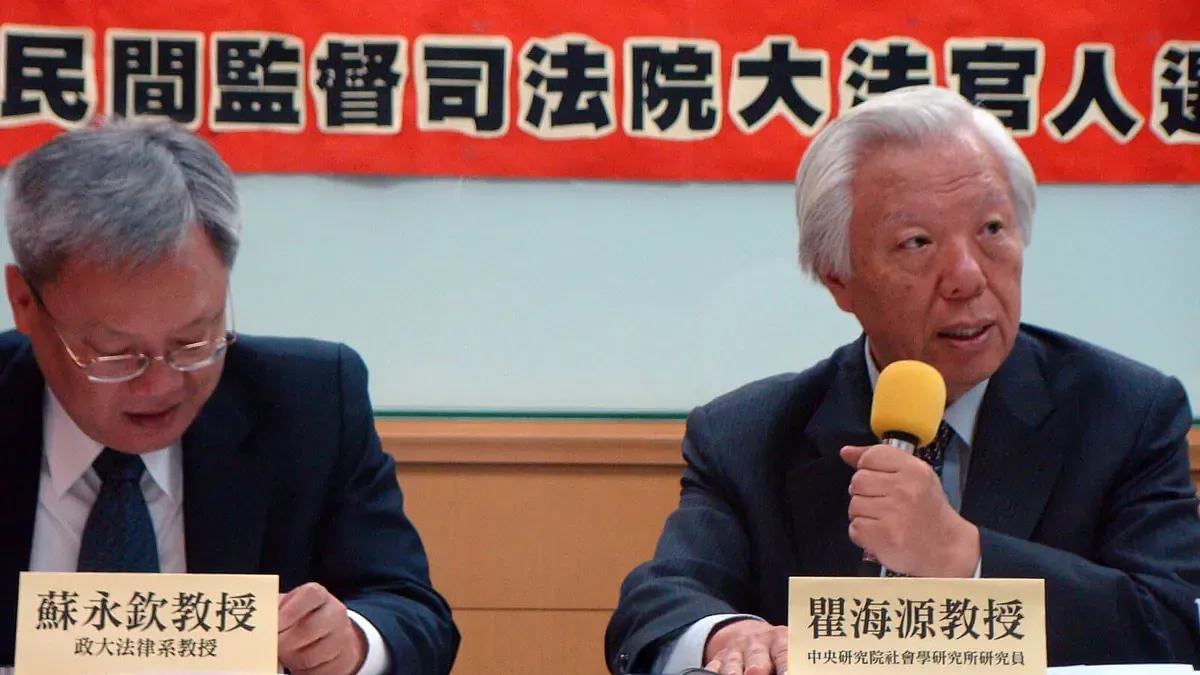
On August 24, President Ma Ying-jeou officially nominated Central Election Commission Chairman Lai Hao-min as President of the Judicial Yuan, and former NCC Chairman and NCCU Professor Su Yung-chin as Vice-President. This morning (the 4th), the Legislative Yuan held a review public hearing for the two nominees. In the afternoon, the Alliance of Citizens for Judicial Reform also invited Vice-Presidential nominee Professor Su Yung-chin to participate in a civil society public hearing for an open and rational civic dialogue.
This public hearing lasted 150 minutes. Participating representatives each posed two questions to Professor Su Yung-chin. The list of questions is as follows:
- Taipei Bar Association President Li Chia-ch'ing asked whether the resolutions of the 1999 National Judicial Reform Conference would be re-evaluated in the future and how official and civil consensus could be reached; he also inquired about views on reforming the entry (examination and selection) mechanism for judges.
- Disabled Alliance Deputy Secretary-General Hsieh Tung-ju noted that judges have recently been observed making unacceptable rulings due to a lack of understanding of the situations of persons with disabilities, and asked how to strengthen judges' awareness of the situations of disadvantaged groups; he also asked whether citizen participation in trials could remedy professional judges' lack of social awareness.
- JRF Board Director and Attorney Lin Yung-sung asked about the exit mechanism for judges, noting that the evaluation methods prescribed in the official and civil versions of the Judges Act or the Judges Evaluation Act differ, and inquired about his views. He also asked how Su would face internal backlash if reforms were pursued upon taking office.
- Taiwan Association for Human Rights Vice-President Liao Fu-t'e asked, given his status as a grand justice nominee, how the constitutional interpretation system could handle the Assembly and Parade Act acting as a barrier to citizens exercising their right to assembly and parade, and how ordinary judges should respond. Additionally, he asked how the two Covenants should be implemented in judicial trials following their ratification by the Legislative Yuan.
- Taiwan Law Society President Ku Li-hsiung asked for views on the previous civil society proposal to President Ma to establish a judicial reform committee featuring ordinary citizen participation under the Office of the President; he also asked how to handle the inevitable drastic reduction in court-of-last-resort judges if a pyramid-shaped litigation system were established.
- Taiwan Labour Front Supervisor Chang Feng-yi mentioned the hope for the prompt establishment of a specialized labor court, and expressed the desire that both the selection and in-service training of judges incorporate an understanding of the plight of workers.
- Limestone Society President Huang Kuo-chich asked how Article 13 of the State Compensation Act should be interpreted, given that there are virtually no successful claims in Taiwan for violations of citizens' right to a speedy trial. He also mentioned that the Supreme Court dismisses a large number of cases on grounds of unlawful appeals in order to reduce caseloads, and that divergent views among various panels force citizens to "rely on luck" when entering the courtroom; he asked whether the Judicial Yuan might change this unreasonable phenomenon.
- Alliance Convener Professor Ch'u Hai-yuan asked what he considers to be the most critical issue in judicial reform and the area that must be reformed with full effort immediately upon taking office. He also asked how to handle the prolonged failure to successfully amend or legislate the Judicial Yuan Organization Act and the Judges Act.
Su Yung-chin provided fairly detailed responses to all of the above questions.
Regarding the resolutions of the 1999 National Judicial Reform Conference, he expressed the view that the conference was part of our country's judicial reform process, but whether it represented the majority public opinion at the time is open to question. He also explicitly stated that the current Judicial Yuan has no obligation to abide by the conclusions of a national judicial reform conference held over a decade ago.
Regarding spontaneous civic movements triggered by public distrust in the judiciary, such as the White Rose Movement, he believes that in addition to stimulating self-reflection within the legal sector, efforts should be made to enhance the judiciary's accessibility to the public—such as proactively communicating judicial independence to the citizens and giving people opportunities to participate in trials. He considers the "observer-participation system" (ko-shen-chih) to be a way for citizens to initially participate in trials.
As for the judge evaluation system, Su Yung-chin believes it must ultimately return to judicial administration handling. If supervision were placed under other competent authorities, issues of matching power and responsibility as well as who supervises this external unit would arise.
Regarding external criticisms of the Supreme Court, he believes that establishing sound incentive and punishment systems, as well as rationalizing joint meetings and the precedent system, are urgent tasks that must be undertaken immediately.
He also mentioned that he and presidential nominee Lai Hao-min have reached a consensus that upon taking office, the first issues to be addressed will be judicial integrity and discipline, followed by the improvement of judgment quality, and shortening the distance between the public and the judiciary to increase public trust in the judicial system.
Finally, he noted that the Judicial Yuan's greatest deficiency is its dialogue with society. Therefore, if he successfully assumes the office of Vice-President, he will continue to engage in dialogue with civil society in addition to this public hearing.
Moderator
Professor Ch'u Hai-yuan, Institute of Sociology, Academia Sinica
Attendee
Professor Su Yung-chin, Vice-Presidential Nominee of the Judicial Yuan
Questioning Representatives
Attorney Li Chia-ch'ing, President, Taipei Bar Association
Mr. Hsieh Tung-ju, Deputy Secretary-General, Disabled Alliance
Attorney Lin Yung-sung, Board Director, Judicial Reform Foundation
Professor Liao Fu-t'e, Vice-President, Taiwan Association for Human Rights
Attorney Ku Li-hsiung, President, Taiwan Law Society
Mr. Chang Feng-yi, Supervisor, Taiwan Labour Front
Professor Huang Kuo-chich, President, Limestone Society
Professor Ch'u Hai-yuan, Convener, Alliance of Citizens for Judicial Reform
Press Contact
Yang Tsung-li, Executive Secretary, JRF 02-2523-1178*16
Alliance Members
Limestone Society
Taipei Bar Association
Taiwan Law Society
Taiwan Association for Human Rights
Judicial Reform Foundation
Taiwan Bar Association
This article is an AI-generated translation of the original Chinese text. In the event of any discrepancy, the Chinese version shall prevail.