
Ending 20 Years of Public Endurance: Promptly Enacting the Draft Judges and Prosecutors Evaluation Act
Last edited: 2026-07-27
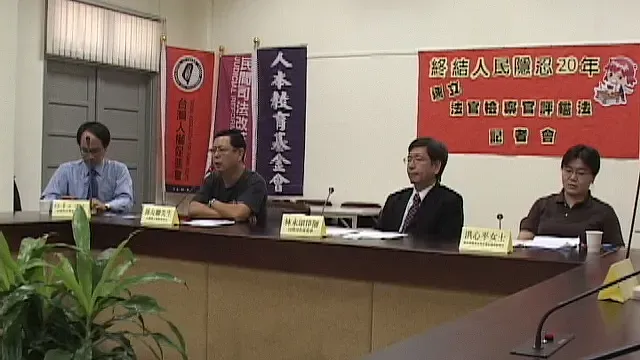
The Alliance to Promote the Judges and Prosecutors Evaluation Act, composed of nearly 100 civil society organizations including the Judicial Reform Foundation, proposed the civil society draft of the Judges and Prosecutors Evaluation Act today. Its main goal is to establish an evaluation mechanism for judges and prosecutors to weed out incompetent ones. The key points of the civil society draft are as follows:
Establishment of an Independent Judges and Prosecutors Evaluation Foundation Outside the Judicial Yuan
The civil society version insists on establishing an evaluation foundation outside the Judicial Yuan to maintain transcendent independence. In contrast, the official version sets up an evaluation committee within the Judicial Yuan, forfeiting its independence.
The Evaluation Foundation Actively Conducts General Evaluations at Least Once a Year
Under the civil society version, the evaluation foundation can not only accept public complaints to conduct case-specific evaluations, but its primary task is to actively conduct general evaluations "at least once" a year. Furthermore, it must make the evaluation results public and may suggest disposition methods to the Judicial Yuan and the Ministry of Justice. Meanwhile, the official version perpetuates the passive attitude of "no action without a complaint," only conducting investigations when passively receiving public complaints, failing to fulfill the function of evaluation.
Specific and Broad Grounds for Evaluation
In addition to general evaluations, Article 6 of the civil society draft sets forth detailed, specific grounds for judges and prosecutors to be subject to case-specific investigations, such as: abuse of power infringing upon human rights, poor handling attitude, serious violation of procedural rules, unwarranted delay in proceedings, and obvious errors in investigation and trial cases that impair the rights and interests of parties or judicial credibility under serious circumstances. Through this, judges and prosecutors who render absurd judgments or dispositions can be filtered out through case-specific evaluations. In contrast, the official version only stipulates abstract and vague grounds for evaluation, with a high threshold that makes determination difficult.
Establishment of the Disciplinary Court and Lay Adjudicators
The Disciplinary Court designed in the civil society version handles disciplinary matters concerning judges and prosecutors. In addition to senior judges and prosecutors, its members include a majority of external participants, such as attorneys, professors, or impartial members of society serving as lay adjudicators. This differs from the official version, where all members are senior judges, carrying the hazard of protecting one another within the official hierarchy.
Synthesizing the foregoing explanations, the primary purpose of all designs in the civil society version is to effectively combat incompetent judges and prosecutors, achieving the ultimate goal of weeding them out. To smoothly promote legislation, we are releasing the content of the draft Judges and Prosecutors Evaluation Act to the public through this press conference, and demanding that cross-party legislators pass this evaluation mechanism—so eagerly anticipated by the public—during the current legislative session opening on September 24, thereby ending 20 years of judicial grievances endured in silence.
※ Note: Disciplinary Court—After the Evaluation Foundation accepts an evaluation, if the evaluation result of the evaluated judge or prosecutor evidently involves serious negligence or other faults, the case is handed over to the Disciplinary Court to adjudicate disciplinary matters regarding judges and prosecutors.
Attachments
- Civil Society Draft of the "Judges and Prosecutors Evaluation Act"
- Civil Society Draft Judges and Prosecutors Evaluation Act VS. Judicial Yuan Draft Evaluation System under the Judges Act
Comparison Focus Civil Society Draft Judges and Prosecutors Evaluation Act Judicial Yuan Draft Evaluation System under the Judges Act Evaluation Institution An independent evaluation foundation under the Control Yuan An internal judges evaluation committee within the Judicial Yuan, lacking independence Types of Evaluation - Actively conduct general evaluations at least once a year
- Conduct case-specific evaluations upon accepting public complaints
Only passively and negatively accepts public complaints Grounds for Evaluation Specific and broad: encompasses various types of specific phenomena of incompetent judges and prosecutors Abstract and narrow: grounds are overly abstract and vague, with an evaluation threshold too high to be easily applied Evaluation Results General evaluation results shall be made public: submitted to the Judicial Yuan and the Ministry of Justice for study and handling, with proposed disposition methods No general evaluations Members Judicial Yuan Disciplinary Court, consisting of 7 members in total, with a majority of 4 civil society representatives to prevent official protection of one another Judicial Yuan Disciplinary Court, consisting of 5 members in total, all of whom are senior judges and prosecutors, making mutual protection among officials inevitable
Attendees
Attorney Lin Feng-cheng, Executive Director, JRF
Attorney Lin Yung-sung, Board Member, JRF
Sun Yu-lien, Secretary-General, Taiwan Labor Front
Wang Yu-ling, Secretary-General, National Alliance of the Mentally and Physically Disabled
Hung Hsin-ping, Senior Policy Advocacy Specialist, Awakening Foundation / Garden of Hope Foundation (Note: translated contextually as Women's Rescue Foundation)
Li Ying-hsuan, Director of Policy Department and City Councilor Candidate, Green Party Taiwan
This article is an AI-generated translation of the original Chinese text. In the event of any discrepancy, the Chinese version shall prevail.