
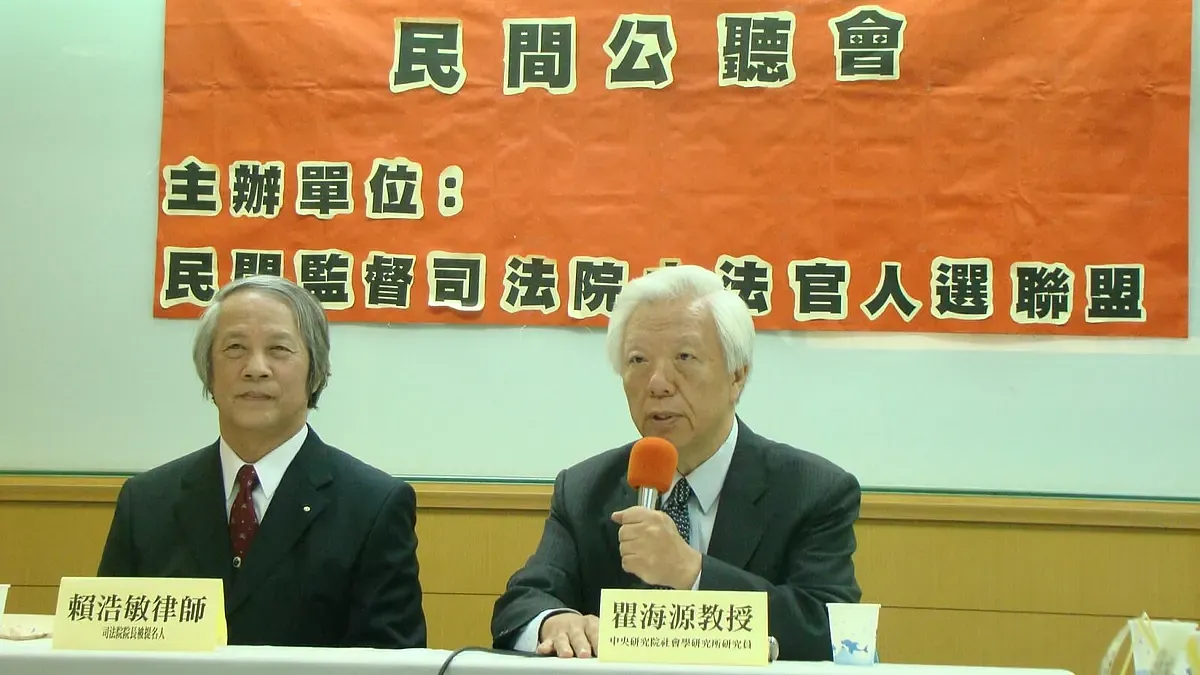
Civil Society Public Hearing on the Nominees for President and Vice President of the Judicial Yuan—賴浩敏 (Rai Hau-min)
Last edited: 2026-07-27
On August 24, President Ma Ying-jeou officially nominated Central Election Commission Chairperson Rai Hau-min as President of the Judicial Yuan, and former National Communications Commission Chairperson and National Chengchi University Professor Su Yeong-chin as Vice President. Today (the 23rd), on the eve of the Legislative Yuan's legislative session, the Alliance for Civil Oversight of Judicial Yuan Grand Justice Nominees invited the two nominees to participate in a civil society public hearing for an open and rational civic dialogue. It is hoped that by conveying the voices of civil society, the nominees will clearly understand the public's sense of urgency and expectations for judicial reform, and that the public will understand the nominees' vision for judicial reform. At this public hearing, Rai Hau-min shared his thoughts on judicial reform, while Su Yeong-chin was unable to attend due to a last-minute meeting.
The public hearing lasted for two hours, and the participating representatives each posed two questions to Rai Hau-min, listed as follows:
- Attorneys Lin Yung-sung of the Judicial Reform Foundation asked whether Rai would support the evaluation mechanisms for judges and prosecutors proposed by civil society, and whether he would support citizen participation in trials.
- Awakening Foundation Chairperson Yang Wan-ying mentioned recent public criticism of cases where child sexual assault resulted in lenient sentences, expressing the hope that in the future there will no longer be judges who fail to understand the plight of victims of offenses against sexual autonomy. She also inquired about his views on the decriminalization of adultery.
- Taiwan Bar Association representative Attorney Li Yueh-lin asked whether Rai has a "blueprint for judicial reform" in mind and about his personal journey in agreeing to be nominated as President of the Judicial Yuan.
- Taiwan Labor Front Secretary-General Sun Yu-lien asked whether Taiwanese laborers can look forward to the birth of a specialized labor court, and how Taiwanese laborers can expect judicial personnel with labor expertise.
- Professor Wu Yu-tsung of the Taiwan Law Association asked how the President of the Judicial Yuan should conduct re-education for currently serving judges, and inquired whether he thinks Taiwan is currently suitable for introducing lay participation or jury systems.
- Disabled People's Federation Secretary-General Wang Yu-ling mentioned that judges' determinations regarding the autonomous intent of intellectually disabled persons and the identification of psychiatric disabilities often differ from those of expert witnesses, raising obvious questions about whether judges are truly professional. She also asked how long it would take for the "reconstruction of the entry mechanism for judges" that Rai mentioned during the meeting.
- Taipei Bar Association Chairperson Li Chia-ching also asked about Rai's blueprint for judicial reform and the timeline for its promotion.
- Taiwan Association for Human Rights Secretary-General Tsai Chi-hsun asked Rai for his view on the recent ruling by the Taipei High Administrative Court, which was heavily criticized by the Environmental Protection Administration—representing the executive branch—seriously damaging judicial power, and asked how, after becoming a Grand Justice, he would ensure that laws and their application meet the requirements of international human rights conventions.
- Citizen's Congress Watch (Socio-Public) President Huang Kuo-chong asked for his view on the positioning of the Judicial Yuan, and how to resolve the current situation where, following the Grand Justices' Interpretation No. 530, legislative inertia has undermined judicial power.
Regarding the aforementioned questions, aside from emphasizing that he was responding to the participants' questions in his personal capacity, Rai Hau-min also stressed that "justice should exist for the benefit of the people," and that he supports any reform as long as it is for the benefit of the people's interests. Regarding the reform of the judicial system, he believes that judges should shed their arrogant power, must constantly engage in self-reflection and self-discipline, and must remain close to society rather than detached from social reality. In addition, he also affirmed that there should be a reasonable, effective external accountability mechanism that does not interfere with trials, and that the establishment of both entry and exit mechanisms is very important, as this is the key to improving the quality of adjudication.
Furthermore, in response to the inquiry regarding whether he was indeed handpicked by President Ma as the President of the Judicial Yuan, he specifically mentioned that "whatever role I take, I act the part, and I will certainly not be a vase (figurehead)."
Although he did not mention his specific blueprint for judicial reform during the meeting, Rai Hau-min stated in his concluding remarks that he has already established a short-, medium-, and long-term judicial reform plan in his mind, hoping to immediately respond to the public's expectations. He also expressed the hope that if he successfully assumes the position of President of the Judicial Yuan in the future, should there be any inadequacies in the plan, he will consult opinion leaders representing public opinion at any time to achieve the goal of "judicial reform that exists for all the people."
Moderator
Professor Ch'u Hai-yuan, Institute of Sociology, Academia Sinica
Attendee
Chairperson Rai Hau-min, Nominee for President of the Judicial Yuan
Group Questioning Representatives
Attorney Lin Yung-sung, Director of the Judicial Reform Foundation
Professor Yang Wan-ying, Chairperson of the Awakening Foundation
Attorney Li Yueh-lin, Secretary-General of the Taiwan Bar Association
Mr. Sun Yu-lien, Secretary-General of the Taiwan Labor Front
Professor Wu Yu-tsung, Representative of the Taiwan Law Association
Ms. Wang Yu-ling, Secretary-General of the Disabled People's Federation
Attorney Li Chia-ching, Chairperson of the Taipei Bar Association
Ms. Tsai Chi-hsun, Secretary-General of the Taiwan Association for Human Rights
Professor Huang Kuo-chong, President of Citizen's Congress Watch
Press Contact
Executive Secretary Yang Tsung-li of the Judicial Reform Foundation 02-2523-1178*16
Alliance Members
Citizen's Congress Watch
Taipei Bar Association
Taiwan Law Association
Taiwan Association for Human Rights
Judicial Reform Foundation
Taiwan Bar Association (National Federation)
This article is an AI-generated translation of the original Chinese text. In the event of any discrepancy, the Chinese version shall prevail.
