
How Much Longer Must We Wait to Weed Out Bad Judges? President Lai, Outrage Alone Is Not Enough!
Last edited: 2026-11-03
Judicial integrity is once again under a dark cloud! In the present day of 2010, while we know the judiciary has flaws, we should have thought corruption was a thing of the past. Yet yesterday, news broke of a collective bribery scandal involving judges of the Taiwan High Court. How can the public trust such a judiciary? How can public grievances against the justice system not arise?
On July 13, the Special Investigation Division of the Supreme Prosecutors Office concluded that the Taiwan High Court and the Taipei District Prosecutors Office had shielded former Legislator Ho Chih-hui, the principal suspect in the Miaoli T'ung-luo land development corruption case who was previously heavily sentenced to 19 years in prison in the first instance, only to be acquitted upon retrial (Geng-Yi). Believing that the presiding judges and prosecutors had collectively engaged in bribery, they launched massive searches at the High Court and the District Prosecutors Office, detaining three High Court judges and one District Prosecutor. They immediately applied to the court for detention and prohibition of communication. On July 14, the Taipei District Court ordered that all of them be detained and held incommunicado. Even more unbelievable, one of the detained judges was actually a member of the High Court's Self-Discipline Committee and the Judicial Yuan's Personnel Review Committee. For such a person to serve as a "self-discipline" member and "review personnel" among peers—what kind of self-discipline or review could possibly result? It is hard to imagine!
Regrettably, at the very first instance, the Judicial Yuan merely issued a statement reiterating its stance of attaching importance to judicial integrity and ethics, stating that President Lai was "greatly outraged" and immediately instructed Vice President Hsieh to convene a task force composed of representatives from the Judicial Yuan, various levels of courts, and政風 (anti-corruption/ethics) personnel to propose concrete and effective measures to improve judicial integrity within two months... In other words, the Judicial Yuan simply handled this sudden incident according to standard operating procedures, and we could not sense any genuine "emphasis" on this major integrity case.
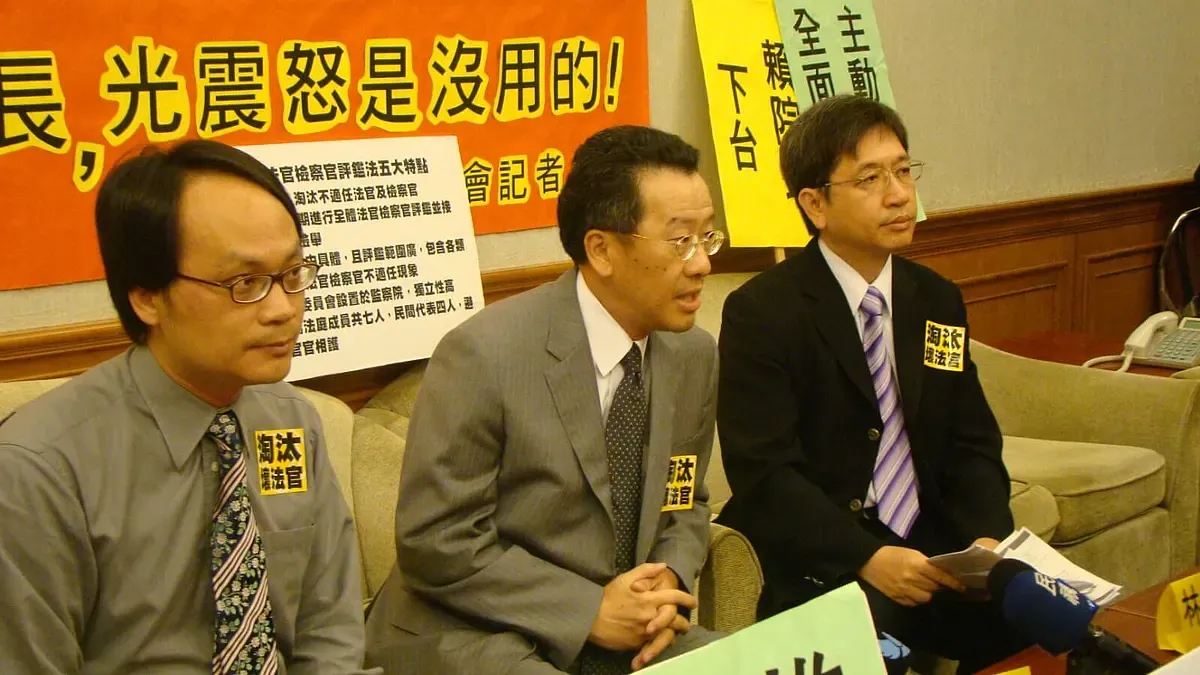
JRF Chairperson and Attorney Ku Li-hsiung stated that since taking office, President Lai has accomplished nothing regarding judicial reform, and in terms of personnel appointments, he has allowed the old conservative forces to regroup. This incident can be described as the result of such dereliction. Furthermore, pushing for the Judges Act does not end with the bill entering the Legislative Yuan; compared to the Judicial Yuan's proactive attitude last year in promoting the "Criminal Speedy Trial Act," one can hardly believe its determination to advance the Judges Act.
JRF Board Director and Attorney Lin Yung-sung bluntly stated that not only should the President of the High Court step down immediately, but President Lai should also step down at once. President Lai is unclear about the integrity of his subordinates, yet when trouble arises, he merely expresses "outrage"; a principled politician's reaction should not stop there. Moreover, the judicial Personnel Review Committee and court Self-Discipline Committees simply cannot function. Last year, when the JRF reported Judge Chung Hua of the Taipei District Court as an unsuitably qualified judge, the Judicial Yuan approached the JRF for "private communication," and the self-discipline result was merely a slap on the wrist, making it difficult to believe in its sincerity toward self-discipline. Therefore, the Judicial Yuan should immediately promote legislation for external judicial evaluation, relying on external oversight to resolve the problem of weeding out bad judges.
The JRF feels profound grief and regret regarding this news and the Judicial Yuan's attitude toward the matter. If the corruption of judicial integrity cannot be improved, it is even more impossible to expect other proactive judicial reform actions from official authorities. We believe that such a shocking corruption case still harbors filth within the conservative judicial bureaucratic system. In response, the JRF solemnly puts forward the following demands:
- President Lai, who is unwilling to carry out reforms, should step down immediately.
- The newly appointed President of the Judicial Yuan should immediately promote legislation for a judge evaluation mechanism.
- The judge evaluation mechanism should at least include the following key points:
- The evaluation mechanism should be established outside the Judicial Yuan to facilitate external oversight.
- The grounds for evaluation should encompass specific manifestations of unsuitability.
- In addition to passively accepting public reports, comprehensive evaluations should be conducted proactively and regularly.
- The disciplinary decision-making body (the Disciplinary Court) should include a majority of non-official representatives to prevent officials from shielding one another.
We hope that President Lai—who only knows how to be "outraged," propose a "two-month deadline for improvement," and "demand that colleagues keep themselves clean and self-disciplined"—will not once again remain silent and inactive after the news fervor subsides. Otherwise, the demand that "the President of the Judicial Yuan should know when to advance or retreat" may well become the newest consensus of Taiwanese society!
Attendees
Taiwan Judicial Reform Foundation Chairperson, Attorney Ku Li-hsiung
Taiwan Judicial Reform Foundation CEO, Attorney Lin Feng-cheng
Taiwan Judicial Reform Foundation Board Director, Attorney Lin Yung-sung
Media Contact
Taiwan Judicial Reform Foundation CEO Lin Feng-cheng 02-2523-1178
This article is an AI-generated translation of the original Chinese text. In the event of any discrepancy, the Chinese version shall prevail.