
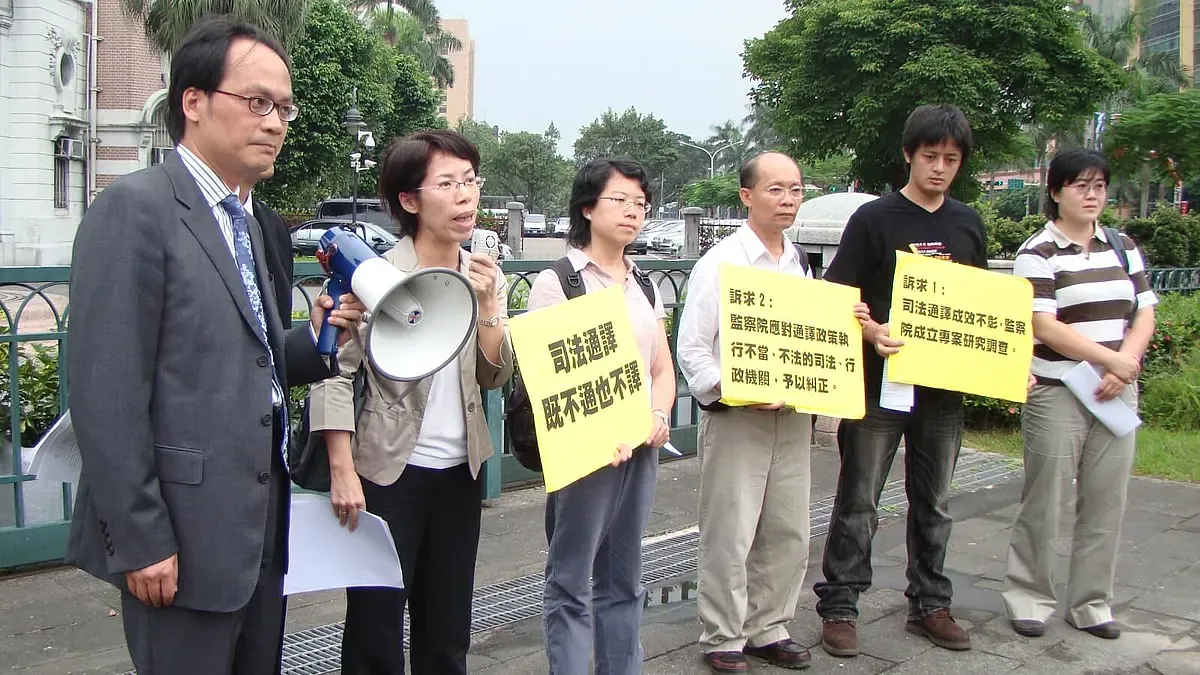
"Judicial Professionalism Promotion Alliance" Promotes Court Interpretation System and Visits Control Yuan
Last edited: 2026-07-27
Recently, news regarding the abuse of foreign migrant workers by Taiwanese people—such as the inhumane treatment of forcing Muslim migrant workers from Islamic countries to eat pork, and the ongoing abuse and discrimination suffered by new immigrants who are already "New Taiwanese"—has frequently made international media headlines. Beyond dealing a blow to Taiwan's international image, what truly deserves the public's attention and review is that, apart from Taiwan's society still needing to continuously build a mindset of respect for cultural diversity, there are still many government agencies and systems that fail to genuinely achieve inclusivity toward diverse cultures in their institutional design.
Taking the judicial system as an example, foreign nationals in general, or new immigrants who have just arrived in Taiwan, similarly face systemic difficulties even within a judicial system that proclaims "justice." Most fundamentally, the problem that court interpreters "can neither interpret nor translate" continues to persist. Taking the court observation program long implemented by the Judicial Reform Foundation as an example, among the judicial personnel most criticized by the general public in court, interpreters rank near the top and are often described by court observers as judicial personnel who "sit" and collect a government salary without actually translating.
However, upon closer examination of the interpretation system, one can find a myriad of problems. For instance, it is common for an interpreter arriving at a police station to find that the interrogation record has already been completed, leaving only the need for the interpreter to sign and endorse it; or, for the sake of convenience, incapable foreigners within foreign national detention centers are found to interpret for each other, or so-called "runaway migrant workers" act as interpreters for one another. In terms of budget allocation for interpretation, most judicial or administrative agencies related to foreign national affairs either have no budget allocated or have insufficient budgets. The transparency of the interpreter talent database is also low; some units have a roster of contract interpreters but do not make it public, or do not even compile a roster at all. Furthermore, in the absence of a recusal system and ethical standards for interpreters, unscrupulous brokers frequently become interpreters for foreign victims, which is of no help to the discovery or clarification of the facts of the case—the judicial litigation surrounding the Kaohsiung MRT migrant worker scandal is a clear example. In addition, there is a lack of comprehensive educational training mechanisms and certification standards required to become a truly qualified interpreter. Furthermore, judicial and administrative agencies fail to proactively arrange appropriate and free court interpreters for foreign nationals, which also fails to comply with the provisions of the two Covenants that have been domesticated into Taiwan's legal system.
Therefore, the "Judicial Professionalism Promotion Alliance"—composed of over twenty civil society organizations including the Trans-Asia Sisters Association, Taiwan (TASAT), the Awakening Foundation (Note: actually Warm Life / Women's Rescue Foundation), Taiwan Association for Indigenous Peoples, the Association for Promotion of New Immigrants' Labor Rights, the Catholic Diocese of Hsinchu Migrant Workers' Concern Center (Vietnam Migrant Workers and Brides Office), and the Judicial Reform Foundation—went to the Control Yuan in a joint visit on the afternoon of June 9. They met with Control Yuan Member Shen Mei-chen, hoping to leverage the Control Yuan's supervisory function to urge it to promptly establish a research project to investigate the problem of ineffective court interpreters. They also hope that after the Control Yuan's investigation, if it is found that the relevant judicial and administrative agencies have indeed acted unlawfully or improperly, corrections should be issued promptly.
Attendees
Father Nguyen Van Hung, Catholic Vietnam Migrant Workers and Brides Office
Wu Chia-chen, Director of Northern Office, Trans-Asia Sisters Association, Taiwan
Li Li-hua, Secretary-General, Association for Promotion of New Immigrants' Labor Rights
Kang Shu-hua, Executive Director, Women's Rescue Foundation
Yapasuyongu (Ch'en Min-yuan), Board Director, Taiwan Association for Indigenous Peoples
Lin Yung-sung, Board Director, Judicial Reform Foundation
Lin Feng-cheng, Executive Director, Judicial Reform Foundation
Press Contact
Yang Tsung-li, Executive Secretary, Judicial Reform Foundation 02-2523-1178 ext. 16
This article is an AI-generated translation of the original Chinese text. In the event of any discrepancy, the Chinese version shall prevail.