
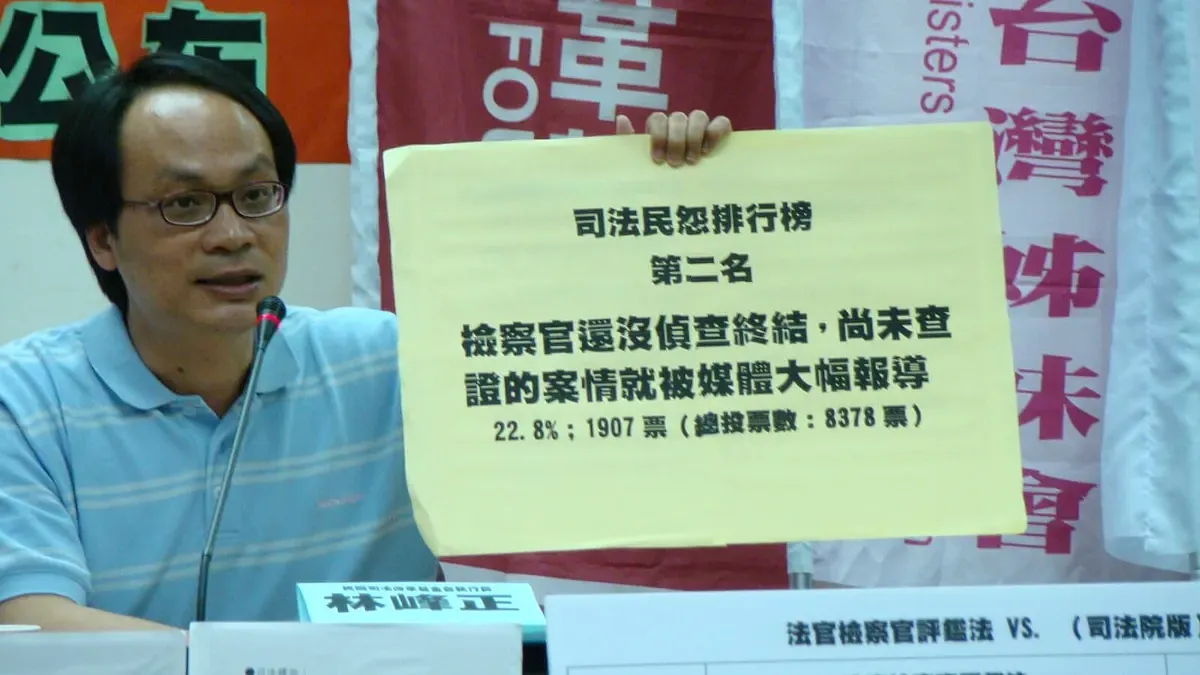
The Culmination of Judicial Disgrace?! Establish an Evaluation Mechanism Immediately to End Public Grievances Against the Judiciary - Press Conference on the Draft Judges and Prosecutors Evaluation Act
Last edited: 2026-07-27
The existence of public grievances is a disgrace to those in power; this ought to be a social consensus in a democratic era. Whether public grievances exist, and how severe they are, should be subject to constant examination.
In collaboration with Yahoo! Kimo, the Judicial Reform Foundation conducted an online poll on public grievances against the judiciary from May 3 to May 8, with a total of 8,378 netizens voting. Among them, 2,820 netizens (33.6%) considered the biggest public grievance against the judiciary to be "being helpless against unsuitable judges and prosecutors, with no 'law' to eliminate them." Meanwhile, 1,373 netizens (16.4%) believed that "judges are not punished for making wrong judgments, nor do they have to compensate victims of wrongful imprisonment" was the biggest grievance. Additionally, 1,907 netizens (22.8%) considered "prosecutors leaking unverified case details to the media in extensive reports before concluding their investigations" as the worst action committed by judicial units (see Table 1 for details).
The results of the above online poll clearly show that the public is heartbroken by the unlawful and inappropriate conduct of unsuitable judges and prosecutors, eagerly seeking oversight and elimination, yet finding no applicable law. This is the most severe public grievance against the judiciary.
Since 1988, the Judicial Yuan has deliberated on the legislation of the Judges Act, hoping to oversee judges and prosecutors who are guaranteed lifelong tenure under the Constitution. However, spanning 23 years up to the present, the legislation has repeatedly failed to pass. While the reasons for the failure to enact the Judges Act are multifaceted, the results of the online poll reveal that the public is no longer willing to wait and demands action against unsuitable judges and prosecutors right now.
To this end, the Judicial Reform Foundation has specifically united dozens of civil society organizations today to hold a press conference and launch the draft "Judges and Prosecutors Evaluation Act" (Appendix). Its content focuses on the evaluation of judges and prosecutors, stipulating that severely unsuitable individuals shall be eliminated. Furthermore, taking into account the experience of the Judicial Yuan failing to pass the Judges Act for over two decades, the draft focuses on the establishment of an evaluation mechanism. Its main features include: not only passively accepting public reports for individual case evaluations, but also periodically and proactively conducting comprehensive evaluations of judges and prosecutors; establishing the Evaluation Advisory Committee within the Control Yuan; and ensuring that civilian members make up the majority of the Disciplinary Court—which holds the final decision-making power over the disciplinary punishment of judges and prosecutors—to prevent cronyism (see Table 2 for details). The primary objective of all these measures is to effectively crack down on unsuitable judges and prosecutors and achieve the ultimate goal of eliminating them.
To smoothly promote this legislation, we are taking this press conference to publicize the content of the draft Judges and Prosecutors Evaluation Act to the general public, while beginning to solicit endorsements from civil society groups to garner broad public support for a new wave of judicial reform movement. We also hope that the Judicial Yuan and the Ministry of Justice will listen to the voices of the people, and that legislators representing public opinion will jointly assist in completing the legislation.
Most importantly, President Ma, who has reached the midpoint of his term, must understand where public grievances against the judiciary lie, prescribe the right remedy, and respond positively to the demands of the people. Otherwise, if judicial grievances are allowed to spread unchecked, is it not a disgrace to those in power, and a personal disgrace to President Ma?
Table 1 Results of the Online Poll on Public Grievances Against the Judiciary
【Voting Period】May 3, 2010 – May 7, 2010
【Source of Data】Yahoo! Kimo News
【Question】Based on your personal experience or impression, what do you think is the worst aspect of judicial units?
【Question Source】Judicial Reform Foundation
【Voting Results】
| Question | Percentage | Votes |
|---|---|---|
| Being helpless against unsuitable judges and prosecutors, with no "law" to eliminate them | 33.6% | 2,820 votes |
| Judges are not punished for making wrong judgments, nor do they have to compensate victims of wrongful imprisonment | 16.4% | 1,373 votes |
| Prosecutors casually request detention for defendants and use detention to extort confessions during investigations | 11.3% | 949 votes |
| Failing to listen to the statements of parties involved and lecturing them based on personal subjective biases | 7.9% | 662 votes |
| Prosecutors leaking unverified case details to the media in extensive reports before concluding their investigations | 22.8% | 1,907 votes |
| Refusing to investigate evidence applied for by parties involved without providing any reasons | 1.8% | 149 votes |
| Disregarding the wishes of parties involved and coercing them into settlements or withdrawing lawsuits | 6.2% | 518 votes |
Table 2 Civil Society Version of the Judges and Prosecutors Evaluation Act vs. Judicial Yuan Version of the Judges Act Evaluation System
| Comparison Focus | Civil Society Version of the Judges and Prosecutors Evaluation Act | Judicial Yuan Version of the Judges Act Evaluation System |
|---|---|---|
| Evaluation Body | An independent Evaluation Foundation under the Control Yuan | An internal Judges Evaluation Committee within the Judicial Yuan, lacking independence |
| Types of Evaluation |
|
Only passively and reluctantly accepts public reports |
| Grounds for Evaluation | Concrete and broad in scope: Includes various specific phenomena of unsuitability among judges and prosecutors | Abstract and narrow in scope: Grounds are overly abstract and vague, with evaluation thresholds set too high to facilitate evaluation easily |
| Evaluation Results | Results of general evaluations shall be made public: Submitted to the Judicial Yuan and the Ministry of Justice for processing and handling, with recommended disciplinary measures | No general evaluations |
| Members | Disciplinary Court of the Judicial Yuan, consisting of 7 members in total, with 4 civilian representatives holding the majority to prevent official protectionism | Disciplinary Court of the Judicial Yuan, consisting of 5 members in total, all of whom are senior judges and prosecutors, making official protectionism inevitable |
※ Note
- Evaluation Committee: The receiving entity when public requests are made to conduct evaluations on all judges and prosecutors.
- Disciplinary Court: After the Evaluation Committee accepts an evaluation case and the evaluation results of the evaluated judge or prosecutor clearly show serious misconduct, the case is handed over to the Disciplinary Court to adjudicate disciplinary matters concerning judges and prosecutors.
Appendix
Draft Judges and Prosecutors Evaluation Act (May 18, 2010 Version)
List of Organizations in the Alliance for Civil Promotion of the Judges and Prosecutors Evaluation Act
Association for Autonomy in Education
Catholic Vietnam Migrant Spouses Office
ROC Association of Parents of Mentally Retarded
Disabled Persons Federation, R.O.C.
Chinese Federation of Labour
Debt Debtors Self-Help Association
Taiwan Association for Human Rights
Taiwan Law Society
Taiwan Labour Front
Taiwan Association for Labor and Social Policy
Taipei Women's Development Association
Taipei Bar Association
Taiwan Indigenous Peoples Policy Association
National Alliance of Taiwan Women's Associations
Taiwan Green Party
Nanyang Taiwan Sisterhood
National Federation of Banking Workers' Unions
婦女救援基金會 (Translate meaning if needed, otherwise: Taipei Women's Rescue Foundation)
Taiwan Alliance to End the Death Penalty
勵馨基金會 (Garden of Hope Foundation)
This article is an AI-generated translation of the original Chinese text. In the event of any discrepancy, the Chinese version shall prevail.