
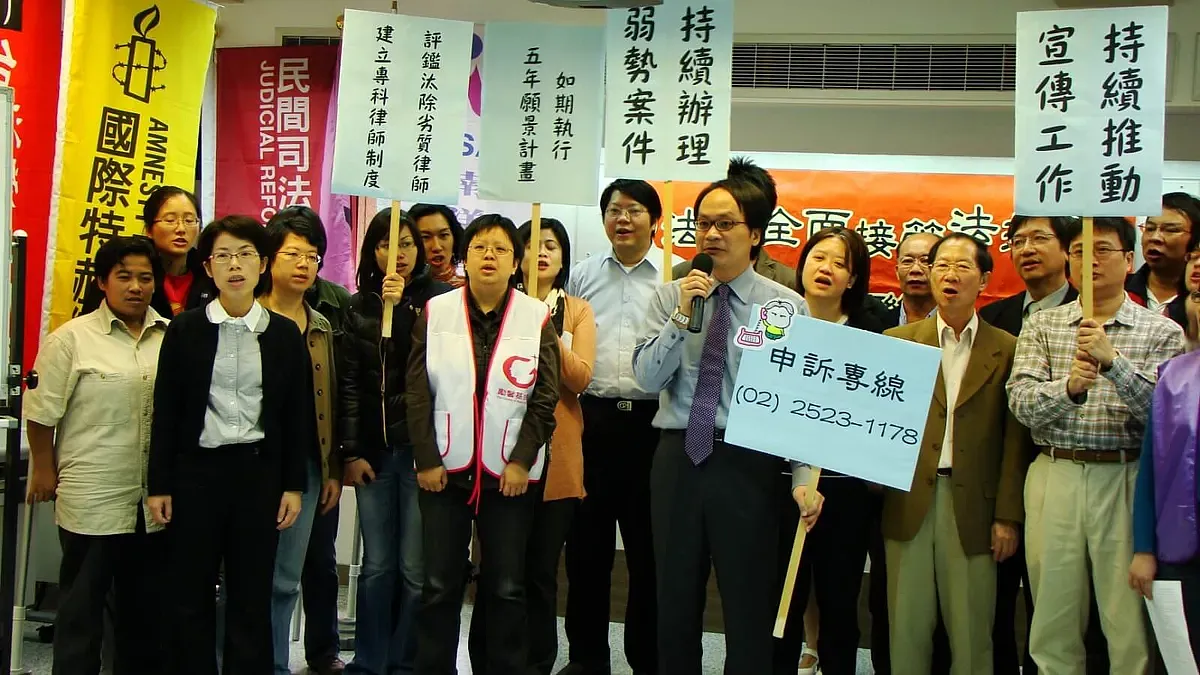
Judicial Yuan Taking Full Control of LAF? Press Conference on the Establishment of the "Protect LAF Alliance"
Last edited: 2026-07-27
On March 23 this year, the Legal Aid Foundation inaugurated its third board of directors, forming a new leadership team composed of the newly appointed Chairperson Wu Ching-fang and Secretary-General Atty. Kuo Chi-jen, who is entering his fifth year of service at LAF. Various NGO groups assisting and caring for disadvantaged cases and issues jointly established the Protect LAF Alliance, hoping that LAF will continue to uphold the spirit of standing with the disadvantaged, resist the interference and pressure from the Judicial Yuan, and promote legal aid work.
In July 1989 (ROC 88), the National Judicial Reform Conference resolved that the Ministry of Justice and the Judicial Yuan should respectively draft the Legal Aid Act and allocate budget subsidies to establish a corporate legal aid specialized organization. Afterwards, the Ministry of Justice transferred jurisdiction to the Judicial Yuan and drafted it separately on the grounds that legal aid matters were largely related to the business of the Judicial Yuan.
However, at the beginning of the drafting of the Legal Aid Act, the Judicial Yuan considered that legal aid only needed to assist criminal mandatory defense cases, while remaining civil, administrative, or family cases would generate extra cases for courts at all levels under the Judicial Yuan and burden judges, and thus should not be included in the scope of assistance by legal aid organizations. During the legislative process, civil society continuously lobbied, and the official draft, which limited aid to criminal cases, ultimately failed to gain support in the Legislative Yuan. Nevertheless, over the six years since LAF's establishment, authorities have still used various means to reduce LAF's aid capacity, through the following methods:
-
The Judicial Yuan once prepared a legislative proposal to give official board seats a majority, which was dropped only after strong opposition from civil society
Around August of last year, the Judicial Yuan proposed amendments to the Legal Aid Act, attempting to transform the originally civil-led, vibrant, flexible, and efficient LAF into one where official-appointed directors and supervisors held a majority. With the assistance of NGOs' joint petitions, the Judicial Yuan abandoned the legislative amendment move.
-
The Judicial Yuan believes that civil case aid should be reduced in order to decrease judges' caseloads
Secondly, the Judicial Yuan has also expressed differing views on the types of cases aided by legal aid. The Judicial Yuan believes that the proportion of aid for civil cases should decrease, while mandatory defense cases should be unconditionally approved. The underlying mentality is none other than the legal stipulation that mandatory defense cases cannot proceed without lawyer assistance; therefore, LAF helping with mandatory defense cases is assisting the courts. However, civil cases, which burden the courts, should be strictly reviewed.
In 2008 (ROC 97), responding to the implementation of the Consumer Debt Clearance Act, LAF launched the debt-card project, increasing debt-card cases by 10,000 in that year. In 2009 (ROC 98), LAF accepted commission from the Council of Labor Affairs to handle the labor aid project, adding another 2,500 labor cases. These cases helped disadvantaged debt-card holders apply for consultations, rehabilitation, and liquidation, and also helped laborers fight for their due rights. Strangely, these practical actions helping the disadvantaged were met with severe questioning in the Legislative Yuan, and their budget was frozen. Why did the opinions of legislators coincide with those of the Judicial Yuan, which is unwilling to help the disadvantaged? How strange indeed!
-
Propaganda budgets are declining year by year
Authorities believe that vigorously promoting LAF's functions would prompt more citizens to utilize legal aid resources, generating more cases, increasing judges' workloads, and even crowding out budgets of various courts. These are all outcomes the Judicial Yuan does not wish to see.
Civil society groups establish the "Protect LAF Alliance" and put forward the following expectations
NGO groups worry that if the Legal Aid Foundation loses its independence and falls into bureaucratization, it will have a severe impact on civic associations and the disadvantaged—such as important projects stagnating or being delayed, review conditions becoming increasingly stringent or rigid, and a loss of proactive concern for disadvantaged issues. Therefore, they jointly established the Protect LAF Alliance and put forward the following expectations:
- We hope that the Five-Year Vision Plan proposed by LAF in 2007 (attachment) can be truly executed on schedule.
- LAF should improve the quality of lawyers' assistance. Aside from passively conducting lawyer evaluations and eliminating inferior lawyers, it should actively establish a specialized lawyer system and recruit more full-time lawyers to invest in legal aid work.
- LAF should be able to continuously handle cases on disadvantaged issues, such as the debt-card project and projects commissioned by the Council of Labor Affairs.
- Continue to promote publicity work so that the disadvantaged can better access and utilize legal aid resources.
Civil society groups will pay a visit to the LAF Board of Directors and continuously monitor LAF's various operations
In addition to monitoring the execution status of the aforementioned LAF operations, this alliance expects to visit the LAF Board of Directors in May. If citizens encounter improper handling of their cases by LAF, they can also submit complaints to this alliance via the complaint hotline (02-2523-1178), and the alliance will urge LAF to improve. It is hoped that by guarding LAF in this way, the disadvantaged can obtain timely and necessary legal aid.
Attendees
JRF Executive Director, Atty. Lin Feng-cheng
Former LAF Deputy Secretary-General, Atty. Ch'en Wei-hsiang
Former LAF Taipei Branch Director, Atty. Lin Yung-sung
Statements by representatives of various associations
Members of the Protect LAF Alliance
Asia Pacific Mission for Migrants (APMM), Indigenous People's Cultural Foundation, Association for Victims of Occupational Injuries, National Alliance of Senior Citizens' Welfare, ROC, League of Welfare Organizations for the Mentally Disabled ROC, National Union of Parliament of Persons with Disabilities, Catholic Diocese of Hsinchu - Migrants and Immigrants Service Center (Vietnam), Taipei Bar Association, Taiwan Association for Human Rights, Taiwan Alliance for Advancement of Youth Rights and Welfare, Taiwan Indigenous Peoples Policy Association, Taiwan Labour Front, Taiwan Labor and Social Policy Research Association, Judicial Reform Foundation, The Peace Foundation, Nanyang Taiwan Sisterly Association, Amnesty International Taiwan Section, Awakening Foundation, Sunshine Social Welfare Foundation, Taiwan Alliance to End the Death Penalty, Garden of Hope Foundation, Wild at Heart Legal Defense Association
Media Contact
JRF Executive Director, Atty. Lin Feng-cheng 02-2523-1178
This article is an AI-generated translation of the original Chinese text. In the event of any discrepancy, the Chinese version shall prevail.