
Minister Wang, and Society's Dilemma—Statement by the Taiwan Alliance to End the Death Penalty on the Resignation of Minister Wang Ching-feng
Last edited: 2026-07-27
I have never blamed those who publicly declare themselves to be in favor of the death penalty. Whether to hope for the abolition of the death penalty or to wish to maintain it is merely a moral choice, belonging to the conscience of each individual. However, what displeases me in the mindset of a Minister of Justice is that an intellectual, someone who claims to advocate for the abolition of the death penalty, is willing to maintain it simply because public opinion polls show that the public favors maintaining the death penalty.
Regarding the oral resignation tendered by Minister Wang Ching-feng at around 10 p.m. last night to Premier Wu Den-yih of the Executive Yuan and President Ma Ying-jeou, which was promptly accepted, the Taiwan Alliance to End the Death Penalty expresses its regret.
Upon taking office, Minister Wang Ching-feng expressed her personal belief in supporting the abolition of the death penalty. Following the passage of the Covenants, she continued the Ministry of Justice's policy of "gradual abolition of the death penalty," carefully reviewing finalized death penalty cases and substantially halting executions. She also established the "Research and Promotion Task Force on the Gradual Abolition of the Death Penalty" within the Ministry of Justice, hoping to foster in-depth discussions among scholars, experts, and various representatives to formulate complementary measures for abolishing the death penalty, for which we express our respect. However, we deeply regret her sudden resignation last night.
At this moment, we call upon the Office of the President, the Executive Yuan, the Legislative Yuan, and both the ruling and opposition parties not to view the issue of the death penalty through the lens of short-term electoral calculations, but rather to take human rights values as a starting point and carefully consider how Taiwan should move forward in the next step.
Open up the economy, do not isolate human rights
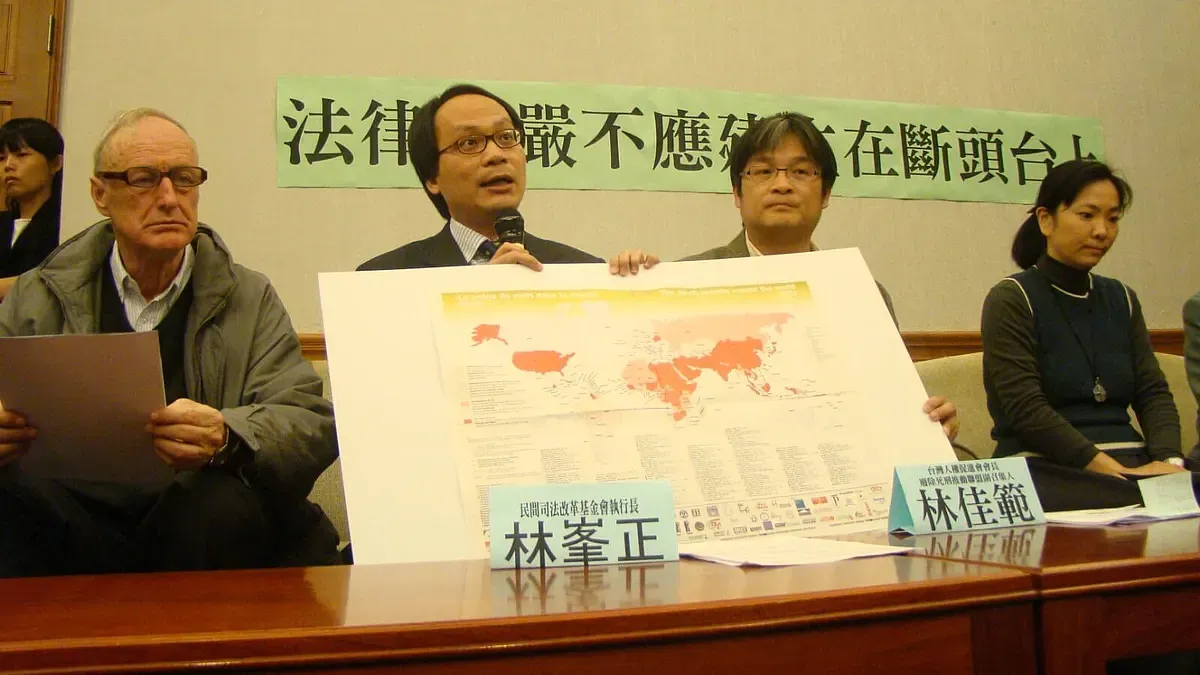
Taiwan's society and economy are open, actively participating in international economic cooperation frameworks while also signing the Cross-Strait Economic Cooperation Framework Agreement (ECFA) with China. While opening up economically, there is an intention to isolate Taiwan in terms of human rights concepts. Although Taiwan is not a member of the United Nations, it cannot detach itself from the international community: we cannot ignore the UN General Assembly resolutions adopted in 2007 and 2008 calling for a "global moratorium on the use of the death penalty"; we cannot ignore the fact that 139 countries worldwide have abolished the death penalty in law or in practice; nor can we fail to heed Professor William Schabas—who is assisting the UN in issuing a global overview of the death penalty in June—in his prediction that "the goal of total abolition of the death penalty will be achieved between 2015 and 2025." Taiwan's pace may be slowed or adjusted, but it must not stop moving forward on the path toward the abolition of the death penalty.
Deliberations on complementary measures must not be interrupted
Abolishing the death penalty is arduous work, and the traditional idea of "a life for a life" is deeply ingrained, requiring long-term education and advocacy to change. Therefore, we cannot base the existence or abolition of the death penalty solely on the public opinion of a given period. Although we often say that democratic politics is the politics of public opinion, when facing such a complex issue, open discussion and debate are indispensable. Only through open discussion and debate can true public opinion emerge.
Both the Office of the President and the Executive Yuan acknowledge that abolishing the death penalty is a "long-term" goal, but without a gradual process in between, the long-term goal will become an unattainable one. Therefore, the deliberation of complementary measures must not be interrupted, and the mission of the Ministry of Justice's "Research and Promotion Task Force on the Gradual Abolition of the Death Penalty" must continue. By proposing appropriate complementary measures and helping the public understand them, we believe Taiwan will still move in the right direction.
Comprehensive defense for death penalty cases
The Office of the President and the Executive Yuan have also stated that they will reduce the use of the death penalty through legal amendments. The death penalty is a punishment that deprives individuals of the right to life; we believe that while the current death penalty system remains in place, judicial authorities must adhere to the most rigorous due process of law when issuing death penalty judgments. We specifically recommend the following legal amendments:
- Death penalty judgments must be made by a collegiate panel through unanimous consensus.
- The Supreme Court must hold oral arguments for death penalty cases.
- Mandatory legal representation by attorneys must be implemented for third-instance trials in death penalty cases.
Expectations for the future Minister of Justice
Legislator Hsieh Kuo-liang stated, "Executing 44 people is simply a massacre!" We expect the new Minister of Justice not to take office merely to act as an executioner; we expect the new Minister of Justice to exercise their powers prudently in accordance with the Code of Criminal Procedure and the two Covenants. The Taiwan Alliance to End the Death Penalty will also continue to assist individuals facing finalized death penalty sentences.
This article is an AI-generated translation of the original Chinese text. In the event of any discrepancy, the Chinese version shall prevail.