
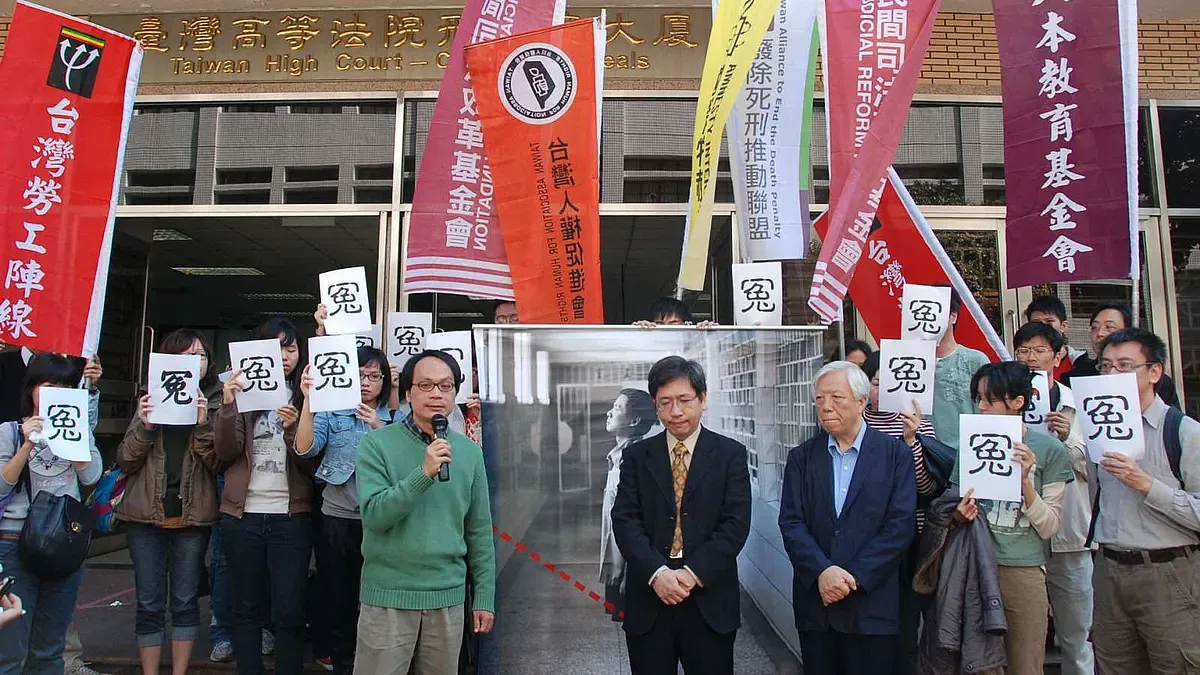
Wrongful Conviction!~Statement on the Guilty Verdict in the Hsu Tzu-chiang Case
Last edited: 2026-07-27
We deeply regret the guilty verdict rendered against Hsu Tzu-chiang. This case has been dragged through the courts for over 14 years, with the sixth remand proceeding alone lasting more than 4 years. Furthermore, Hsu has been detained for over 13 years—longer than Su Chien-ho and his two co-defendants! Much like many cases caught in protracted litigation, the prosecutors presented no concrete evidence linking Hsu to the crime, yet the courts continuously permitted his prolonged detention, subjecting him to cruel torment through the judicial process.
In 1995 (the 84th year of the Republic), a real estate agent in Dazhi was kidnapped and murdered. On September 25, 1995, the police arrested suspect Huang Chun-ch'i in Taoyuan, who claimed there were two accomplices, Hsu Tzu-chiang and Ch'en I-lung. In June of the following year, Hsu Tzu-chiang surrendered to the Shihlin District Court accompanied by his lawyer and was subsequently sentenced to death.
However, this case is fraught with doubts. Ever since it entered the Taiwan High Court in 1996, the case has bounced back and forth between the Supreme Court and the High Court. The reason lies in the endless flaws throughout the trial process. The confessions of Huang and Ch'en also contained numerous internal contradictions, yet the courts nonetheless adopted such confessions as testimony that Hsu was an accomplice. Moreover, the facts established in the judgments through the confessions of co-defendants were neither thoroughly investigated nor supported by concrete evidence proving Hsu Tzu-chiang's involvement. Subsequently, an investigation report released by the Control Yuan explicitly pointed out the carelessness of the courts in the Hsu Tzu-chiang case and their failure to fulfill their duty of investigation. Furthermore, Judicial Yuan Interpretation No. 582 explicitly stated that the confessions of co-defendants must undergo cross-examination procedures (confrontation), and declared that a confession cannot serve as the sole basis for a guilty verdict.
The Flawed Confessions of Co-Defendants Remain the Sole Basis for Hsu's Guilty Verdict; the Court Turns a Blind Eye to Judicial Yuan Interpretation No. 582
First with the Control Yuan's investigation report and later with Interpretation No. 582, both directly and indirectly established the flaws in the trial proceedings of this case. Why did the High Court treat both as a dead letter in this retrial, failing to break free from the trap of the original judgment? Why did it even use the testimony of Huang and Ch'en—who refused to answer all questions when the defense counsel requested cross-examination and confrontation—as the foundation for Hsu's guilty verdict? Why does the court dare not base its actions on the spirit of the presumption of innocence prescribed by the Code of Criminal Procedure to return innocence to Hsu?
The "Urgent Judicial Trial Act" Will Only Cause Hsu Tzu-chiang to "Die Faster"
While the Judicial Yuan actively promotes the "Urgent Judicial Trial Act" pursuant to the International Covenant on Civil and Political Rights ratified by the Legislative Yuan, we once again witness in Hsu's case that "judicial power knows no bounds"—trials that never end. Even worse, under the official version of the Urgent Judicial Trial Act, appealing to the Supreme Court on the grounds of unclarified facts is not permitted. Decades later, when the truth of this case is difficult to reconstruct, the probability of an appeal being dismissed and finalized is exceedingly high, and Hsu Tzu-chiang will once again face the execution of the death penalty. An Urgent Judicial Trial Act that cannot restore innocence to defendants of wrongful cases will ultimately serve only to hastily clear away a backlog of cases dragging on for over a decade, sparing the courts from having to face this case any longer. What is the use of such an Urgent Judicial Trial Act?
Whether it is Su Chien-ho, Chiou Ho-shun, or Hsu Tzu-chiang, what we observe is that defendants who insist on their innocence during trial proceedings—arising from shoddy investigative stages—can only continue to sink and float in a vortex of procedures with no end in sight, while judges and prosecutors merely look on with cold detachment. How can a judiciary that fails to understand the suffering of the people ever gain the people's trust!
All civic organizations concerned about this case have gathered here today not only to express their anger and impatience toward an incompetent judiciary, but also to proclaim to the general public that we will exhaust all possible means to pool our strength in rescuing the Hsu case, until a judgment meeting fairness and justice is attained!
This article is an AI-generated translation of the original Chinese text. In the event of any discrepancy, the Chinese version shall prevail.