
We Cannot Do Without You! Disaster Victims and Vulnerable Groups Need Private Legal Aid ~ NGOs Oppose Majority Official Board Seats in the Legal Aid Foundation
Last edited: 2026-07-27
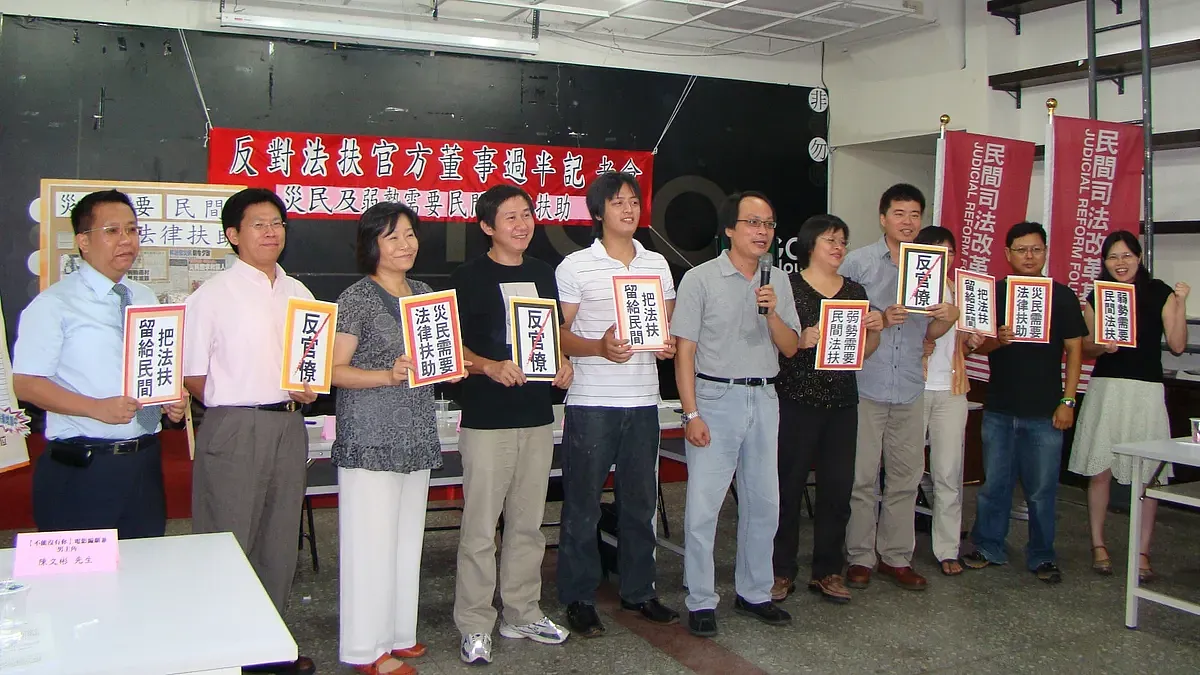
In the recent typhoon disaster, we witnessed the government's callousness, arrogance, and inefficiency during disaster relief operations. Without the participation of civil society forces, the disaster would have been even more catastrophic. However, the Judicial Yuan now intends, pursuant to a legislative rider by the Legislative Yuan, to amend the law to increase the number of official representatives on the Legal Aid Foundation (hereinafter referred to as the LAF)—which has long assisted vulnerable groups—so that official representatives hold a majority, thereby placing the LAF under government control. In response, the Judicial Reform Foundation and major domestic NGOs jointly voiced their opposition to official directors holding a majority in the LAF, and held a press conference titled "NGOs Oppose Majority Official Board Seats in the Legal Aid Foundation" at 10:00 a.m. on September 1 at the NGO Center. The NGOs jointly expressed that if legal issues arising from this disaster lead to the LAF representing disaster victims in lawsuits against the government in the future, how can its neutrality be maintained? Furthermore, judging by the government's performance in this disaster relief effort, the NGOs also question whether the so-called government can truly understand the genuine needs of the people. The press conference specially invited Ch'en Wen-pin, the screenwriter and male lead of the film 'I Can't Live Without You', to share how helpless vulnerable groups feel when facing a massive, cold state apparatus. Finally, the JRF and other NGOs jointly signed a petition and held up signs reading "Anti-Bureaucracy" and "Vulnerable Groups Need Private Legal Aid," appealing to the government that disaster victims and vulnerable groups need private legal aid.
At the event, the NGOs also released a petition signed by more than 80 grassroots vulnerable groups—including women, the elderly, intellectually disabled individuals, laborers, indigenous peoples, persons with disabilities, and foreign spouses—along with 16 bar associations nationwide, and over 100 scholars and community representatives. The petition resolutely opposes the shift of the LAF toward government control and puts forward the following reasons for opposition:
- An LAF with a majority of private directors and supervisors can better understand grassroots needs and ensure efficient, flexible, and approachable services.
- An LAF with a majority of private directors and supervisors can ensure neutrality and public credibility.
- An LAF with a majority of private directors and supervisors is the common practice in developed countries.
- An LAF with a majority of government-appointed directors and supervisors will create a conflict of interest where the player is also the referee.
- An LAF with a majority of government-appointed directors and supervisors does not reflect the intent of the Legislative Yuan's resolution.
Executive Director Lin Feng-cheng of the Judicial Reform Foundation pointed out that, due to a legislative rider in the previous legislative session stating that foundations funded by the government for more than 50 percent should have a majority of official directors, the Judicial Yuan intends to amend the law to give official representatives a majority on the LAF. However, he emphasized that civic associations believe the Legal Aid Foundation should not be encompassed within this rider. If the LAF were to be transformed into a government-controlled entity, would it understand the needs of vulnerable citizens better than a privately-led LAF? With the August 8 floods potentially resulting in numerous state compensation claims and administrative litigation—all of which involve government agencies as defendants—how could a government-run LAF sue government agencies to fight for citizens' rights, and how could public trust be ensured? He also pointed out that the LAF is currently handling the "Sinlaku Typhoon Fengchiu Tunnel Collapse Burial Case," where the defendant is none other than the Nantou County Government. If the LAF were to be controlled by the government, how could the independence of the judiciary be maintained in the future?
Representatives from various civic organizations present at the event—including Chi Hui-jung, Executive Director of the Garden of Hope Foundation; Wu Yu-ching, Secretary-General of the Taiwan Association of Elders' Welfare; Chang Ya-shuk, Special Assistant to the Eden Social Welfare Foundation; Sun Yi-hsin, Deputy Secretary-General of the Parents' Association of Intellectual Disabilities, ROC; Sun Yu-lien, Secretary-General of the Taiwan Labour Front; Tsai Chi-hsun, Secretary-General of the Taiwan Association for Human Rights; Ch'en Min-yuan of the Taiwan Indigenous Peoples Policy Association; Lin Chung-hung, Secretary-General of TWBA; and Kao Yung-cheng, Secretary-General of the Taipei Bar Association—also expressed that only private directors can most accurately understand the legal problems of vulnerable citizens and the areas requiring assistance, making decisions for the foundation with the public in mind. If government-controlled, directors representing grassroots needs would find it difficult to influence the LAF's major decisions, and the spirit of assisting the vulnerable, accessibility, flexibility, and efficiency that the LAF has upheld over the past five years could be severely impacted, betraying the original intent of its establishment.
Today's press conference also specially invited Ch'en Wen-pin, screenwriter and male lead of the film 'I Can't Live Without You'. He stated that he was not here to promote a movie, but to tell everyone how bureaucracy can destroy a happy family. As the screenwriter of 'I Can't Live Without You', Ch'en Wen-pin encountered many grassroots individuals while investigating this true case who faced numerous legal issues due to economic factors. However, he discovered that the so-called bureaucracy or system lost its flexibility and accessibility when dealing with the legal problems of vulnerable groups, getting bogged down in the literal text of legal provisions and failing to truly solve problems. He believes that the law does not enforce itself, and when people's legal problems cannot be resolved, more serious social problems will ensue.
Finally, all the NGOs together held up signs reading "Anti-Bureaucracy" and "Private Legal Aid is Needed," and chanted slogans calling on the Judicial Yuan to "Leave the Legal Aid Foundation to the Private Sector" and "Disaster Victims and Vulnerable Groups Need Private Legal Aid."
The Legal Aid Foundation was established through the joint advocacy of legal professionals concerned with the judicial rights of vulnerable groups for the enactment of the Legal Aid Act, and was founded with a donation from the Judicial Yuan pursuant to said Act. Its primary mission is to provide legal assistance to economically disadvantaged citizens. Currently, it has established 21 branches across counties and cities nationwide. Over the past five years since its establishment, more than 74,000 vulnerable individuals have received assistance from the LAF. The highest decision-making body of the LAF is its Board of Directors, which includes representatives from the government, the private sector, and academia. Government representatives do not hold a majority, thereby maintaining its independent operation.
This article is an AI-generated translation of the original Chinese text. In the event of any discrepancy, the Chinese version shall prevail.