
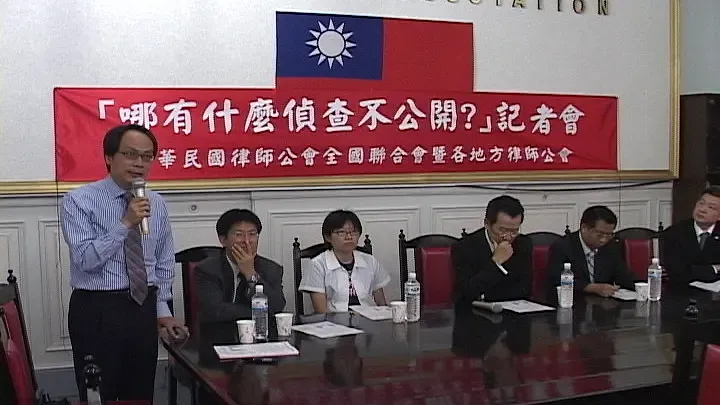
What Non-Disclosure of Investigation?!
Last edited: 2026-07-27
On television, we frequently see scenes of police chasing suspects through the streets, police stations actively showcasing criminal evidence and stolen goods, and suspects facing the media in handcuffs. In newspapers and magazines, crime reporting is meticulously detailed; the suspect's name, personal data, and details of the crime are fully disclosed, completely fulfilling the journalistic principles of who, what, when, where, and why.
Recognizing that the principle of "non-disclosure of investigation" has been reduced to an empty slogan by prosecutors and police, the Taiwan Bar Association, local bar associations, the Taiwan Association for Human Rights, and the Judicial Reform Foundation have joined forces to record broadcasts violating non-disclosure regulations in real time daily starting March 1st of this year, while also comprehensively collecting evidence from print media. Executive Director of the JRF, Attorney Lin Feng-cheng, stated that the six-month observation will be concluded and the results made public in August 2009.
However, have we ever considered whether the Code of Criminal Procedure contains the principle of the presumption of innocence? Even if a prosecutor determines there is criminal suspicion and indicts the defendant, the case must still go through court trial to determine whether the defendant is guilty. Court trials happen more than once, and defendants convicted in the first instance still have the right to appeal. If this is the case, why are the media accustomed to reporting all details of a case during the police investigation stage, and why has everyone grown so accustomed to it and unsurprised? If it is discovered after trial that the defendant was wronged, who will step forward to clear the name of the wrongly accused defendant?
Regarding this long-standing situation where prosecutors, police, and investigators violate the principle of non-disclosure of investigation under Article 245 of the Code of Criminal Procedure, what reflection and countermeasures our society should have has always been an unresolved and important human rights issue in Taiwanese society.
To this end, the Taiwan Bar Association, local bar associations, the Taiwan Association for Human Rights, and the Judicial Reform Foundation have joined forces, starting March 1st of this year for a period of six months, to hire researchers to monitor noon and evening television news broadcasts every day, instantly recording reports that violate non-disclosure regulations. Comprehensive evidence collection is also being conducted concurrently for print media in an effort to present the truth.
Today, precisely at the midpoint of this investigative project, we are reporting the survey results from March to May to the general public. The first part being made public consists of what was seen in television news segments: investigative evidence-gathering videos and photos clearly provided by the police, or footage recorded by street surveillance cameras. Following statistics, the data is as follows:

As can be clearly judged from the content of the videos we have released, investigative information from the relevant units has been leaked. This is no longer merely a matter of administrative negligence; at worst, it may even involve criminal liability.
In addition to releasing the recorded tapes from television news monitoring, following the press conference we will further visit the Ministry of Justice (including the Investigation Bureau), the National Police Agency, and the Coast Guard Administration to submit the relevant content for investigation, urging them to propose improvement measures and strictly penalize derelict personnel. Should the administrative agencies fail to meet the above requirements, we will directly file a complaint with the Control Yuan, demanding that Control Members impeach the administrative heads and officials guilty of dereliction and negligence, and correct the relevant agencies to propose concrete countermeasures to safeguard human rights.
Where on earth have we placed Article 245 of the Code of Criminal Procedure—the principle of non-disclosure of investigation—which was enacted to protect the privacy of defendants and investigative secrecy, and to prevent media trials? The dignity of the law and the protection of human rights require everyone's joint concern. Please continue to "pay attention"; we will summarize our findings for everyone after the investigative project concludes at the end of August, and take action against illegal and derelict officials until rectifications are made.
Attendees
Attorney Lin Feng-cheng, Executive Director, Judicial Reform Foundation
Attorney Kao Yung-cheng, Secretary-General, Taipei Bar Association
Ms. Tsai Chi-hsun, Secretary-General, Taiwan Association for Human Rights
Attorney Ku Li-hsiung, Chairman, Taiwan Bar Association
Attorney Yeh Chien-ting, Convener of the Criminal Procedure Law Committee, Taiwan Bar Association
This article is an AI-generated translation of the original Chinese text. In the event of any discrepancy, the Chinese version shall prevail.