
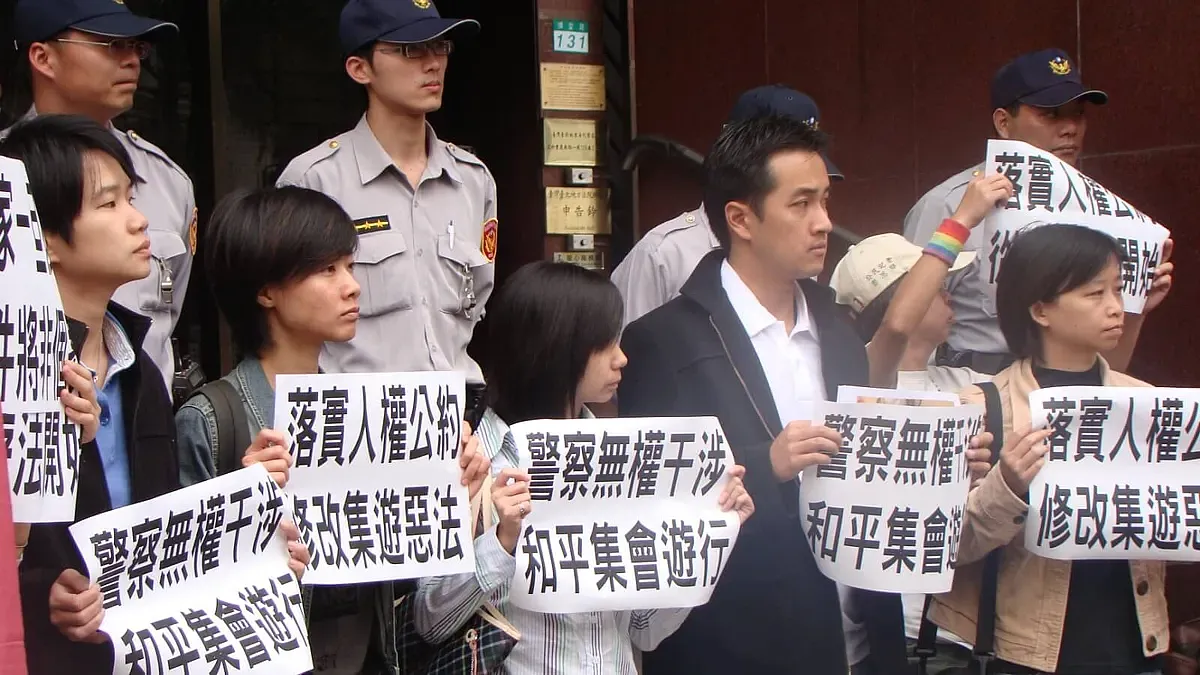
Are the Two International Human Rights Covenants Truly Ready? "I Accuse – Police State" Press Conference
Last edited: 2026-07-27
After the JRF filed a complaint at the Taipei District Prosecutor's Office on November 5, 2008, accusing Li Han-ch'ing, Chief of the Peitou Precinct, of unlawfully entering Sunrise Records, illegal search, and coercion, the Taipei District Prosecutor's Office concluded the investigation on April 24, 2009—spanning nearly half a year—by issuing a non-prosecution disposition for Li Han-ch'ing and others. Despite calls from international human rights organizations such as Amnesty International, FIDH, and Freedom House condemning the government's suppression of freedom of assembly and association and police brutality in November of last year as violations of international human rights standards, combined with civil society's legal actions against officials, the outcome demonstrates that ordinary citizens remain helpless in the face of oppression and infringement by state violence.
In stark contrast to the Legislative Yuan's third reading and passage of the ratification bills for the "Two Covenants" and the "Enforcement Act of the Two Covenants" at the end of March, the public has witnessed only hypocrisy from the Ma administration through the Sunrise Records case and the recent amendment process of the Assembly and Parade Act. For this reason, the "Alliance for the Amendment of the Bad Assembly and Parade Act"—composed of civil society groups such as the Taiwan Association for Human Rights and the JRF—called on Taiwanese civil society to stand up for their rights. This morning (May 4) at 10:00 AM, in front of the Taipei District Court, they joined multiple victims of state violence from last year's visit by Ch'en Yun-lin to collectively voice support for the Sunrise Records case and "accuse" the police state.
Civil society groups also marched to the Ministry of Justice to submit a petition, demanding that the Ministry, as the coordinating agency for the "Two Covenants," urge the executive branch to review the draft amendments to the Assembly and Parade Act, which fail to comply with the "Two Covenants." The draft amendments symbolize progressive reform by removing certain criminal penalties for failing to comply with dissolution orders; however, they introduce new administrative penalties subject to consecutive fines. For small-scale, peaceful assemblies held without prior notification where participants refuse to disperse, police can impose consecutive fines ranging from NT$30,000 to NT$150,000, allowing police authorities to act as both "players and referees" during assemblies and undermining the freedom of assembly and association of vulnerable groups. Such regulations completely violate the spirit of the International Covenant on Civil and Political Rights that "peaceful assembly shall not be restricted." Vulnerable groups take to the streets to directly express public opinion precisely because they lack the resources to gain public speaking spaces. The Executive Yuan's version imposes severe fines, leaving small vulnerable groups with even less "capital" to speak out in the future and risking Taiwan's degradation into a "police state" recognized by the international community.

This article is an AI-generated translation of the original Chinese text. In the event of any discrepancy, the Chinese version shall prevail.