
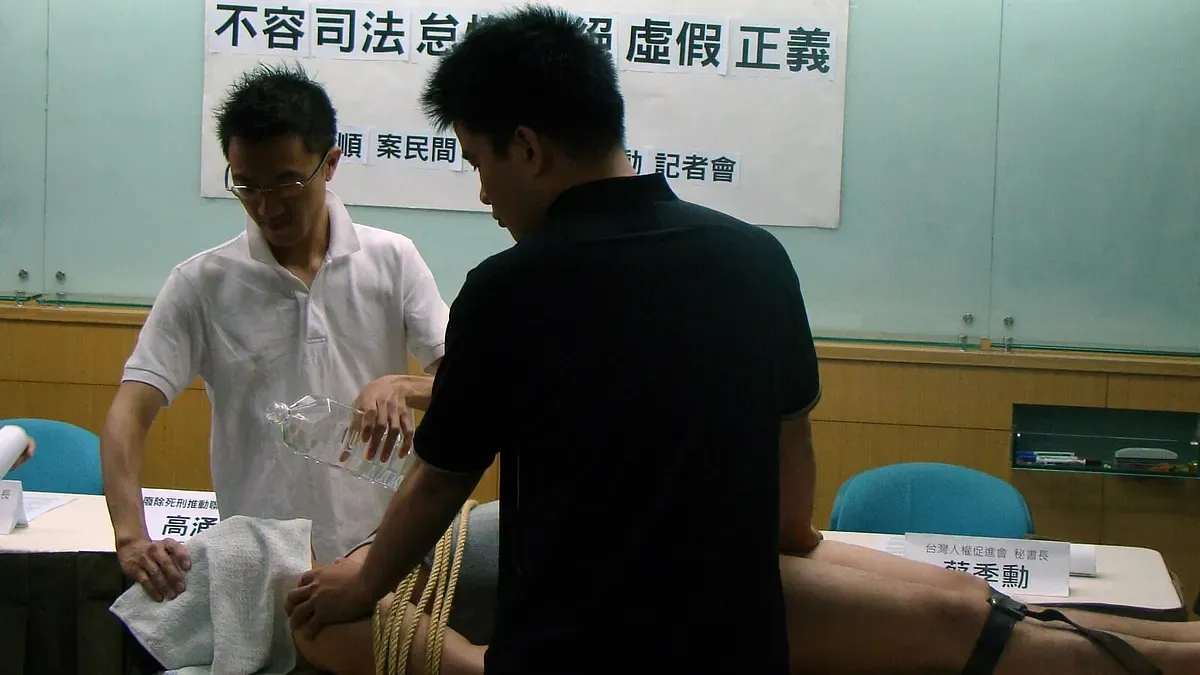
Taiwan's Judiciary is the Guilty One! Regarding the Tenth Remand Judgment Sentencing Defendant Chiou Ho-shun in the Lu Cheng Case to Death Again
Last edited: 2026-07-27
Regarding the Taiwan High Court's ruling on April 13, 2009, which once again found the defendants in the Lu Cheng case guilty and sentenced Chiou Ho-shun to death, Lin K'un-ming to 17 years of imprisonment, and Wu Shu-chen to 11 years of imprisonment, the Humanistic Education Foundation, the Judicial Reform Foundation, the Taiwan Association for Human Rights, and the Taiwan Alliance to End the Death Penalty expressed their disappointment with this judgment.
Governments have an obligation to bring criminals to justice. However, if people are subjected to unfair trials as a result, justice is not served. If individuals suffer torture or abuse by law enforcement officers, if innocent people are convicted, or if trials are manifestly unfair or perceived as such, the judicial system itself loses its credibility. If human rights are not fully guaranteed in police stations, interrogation rooms, detention centers, courtrooms, and prisons, it constitutes a failure of government and dereliction of duty.
The right to a "fair trial," encompassing "the presumption of innocence" and a "speedy trial," is a most fundamental international human rights standard. Since the 1948 Universal Declaration of Human Rights, it has been continually reaffirmed and developed through legally binding international covenants (such as the International Covenant on Civil and Political Rights recently passed by the Legislative Yuan in its third reading) to become binding international customary law.
The Lu Cheng case happens to be the ultimate negative textbook example of the "fair trial" principle. The accusations against the defendants were based entirely on confessions, which audio recordings from the interrogations later proved were extracted through police torture. Apart from these confessions, there is no direct evidence whatsoever proving that these defendants committed the crimes. Under the principle of the "presumption of innocence," these defendants should have been acquitted and released long ago. The High Court has repeatedly sentenced them to death, and the Supreme Court has repeatedly revoked the death sentences; going back and forth, they have been detained for over 20 years, which also violates the people's right to receive a "speedy trial."
The Legislative Yuan just passed the two international covenants and their enforcement laws on March 31 to domesticate international covenants, hoping that Taiwan can truly become a country where human rights are realized. We believe that practice is the most critical key to these covenants. The Lu Cheng case will inevitably be appealed in the future. We expect that when the Taiwanese judicial system faces the Lu Cheng case once again, it will not forget the fundamental rights of a "fair trial," the "presumption of innocence," and a "speedy trial." Otherwise, the guilty one is truly Taiwan's judiciary!
Press Contacts
Humanistic Education Foundation Hsiao I-min
Judicial Reform Foundation Yang Tsung-li
This article is an AI-generated translation of the original Chinese text. In the event of any discrepancy, the Chinese version shall prevail.