
Statement by the Foundation Regarding the Outbreak of Several High-Profile Major Corruption Cases Domestically
Last edited: 2026-07-27
Over the past few months, several high-profile major corruption cases have broken out domestically, involving individuals including a former president, former ministry heads, current city and county mayors, prominent business figures, and various others. The high rank of those involved, the wide extent of their connections, and the sheer scale of the sums involved are unprecedented.
After decades of joint efforts by all citizens, Taiwan has finally stepped out of the shadow of a political authoritarian regime and transformed into a democratic and free nation. However, public trust in the judiciary remains insufficient to this day. Aside from the efficiency and quality of the judiciary long being criticized by the public, the question of whether high-ranking officials and wealthy tycoons are treated for crimes the same as ordinary citizens constantly casts a huge shadow over judicial authority. Therefore, this Foundation expresses high appreciation for the Special Investigation Division and various local prosecutors' offices for overcoming all obstacles to investigate these corruption cases this time, and hopes they will truly ensure that no one is spared regardless of status, setting a new benchmark for our nation on the path toward a rule-of-law society.
However, we must also solemnly point out here that during the course of their investigations, the Special Investigation Division and local prosecutors' offices exhibited certain procedures that deserve the joint attention of all citizens, and even contain obvious flaws, including:
1. Failure to strictly observe the principle of non-disclosure of investigations
The principle of non-disclosure of investigations is explicitly stipulated in Article 245 of the Code of Criminal Procedure, and prosecutors naturally ought to abide by it. Unfortunately, although the Special Investigation Division has already appointed a spokesperson as a control mechanism for the disclosure of investigative information, it is an undeniable fact that media reports clearly exceeded the content of the spokesperson's statements. Although the Ministry of Justice issued two official letters in October demanding that the Special Investigation Division investigate whether there had been any leakage of secrets, the Special Investigation Division has yet to clearly account for the results to the public. First, the Special Investigation Division was negligent in preventing the leakage of investigative information; second, it failed to promptly investigate the channels of leakage afterward. Consequently, outside doubts questioning whether the Special Investigation Division leaked secrets itself continue to arise. The Special Investigation Division truly ought to immediately investigate and strictly punish relevant personnel in accordance with the law to respond to external doubts; otherwise, how can public criticism be silenced, and how can the legitimacy of the investigation be established?
2. The lack of a clear and consistent standard for whether to detain criminal suspects
During this period, the Special Investigation Division and local prosecutors' offices have detained multiple criminal suspects. However, regarding Mr. Ku Chung-liang (辜仲諒), who had already been indicted and placed on a wanted list in another case and was staying in Japan without returning—thereby already possessing the factual basis of flight—they failed to apply for his detention after his return, and even refrained from imposing an exit restriction on him on the grounds that his wife and children were suffering from rare diseases, giving rise to outside criticism regarding what standard the prosecutors apply in detaining defendants. Furthermore, the Special Investigation Division cited the fact that the defendant Chen Chen-hui (陳鎮慧) had "made a truthful statement" as the reason for revoking detention and releasing her. This once again makes one involuntarily ask whether the Special Investigation Division considers defendants to have an obligation to self-incriminate or to make truthful statements, and whether failing to make truthful statements becomes a ground for detention? If so, does this not substantiate outside criticisms of detaining people to extract confessions, and where does it place the defendant's right to remain silent? Are prosecutors not supposed to bear the burden of proof? Is the presumption of innocence still a fundamental principle of the Code of Criminal Procedure?
Take Yunlin County Magistrate Su Chih-fen (蘇治芬), who was directly detained and placed under detention without being summoned beforehand, as another example. Some questioned what standard was applied, yet the prosecutors claimed they had grasped extremely strong evidence and would definitely indict her within a few days. If their statement were true, and strong evidence had already been grasped, the defendant long ago lost any room for collusion; why not indict her immediately, and what necessity was there to detain the defendant? All these instances expose the fact that the current detention legal system grants prosecutors too much discretion and operational room, making it extremely easy to become a target for outside attacks if one is slightly careless. The difficulty in establishing judicial credibility is thus brought about.
Therefore, we demand that prosecutors immediately review the current detention legal system and discard narrow departmentalism. For instance, allowing the mere opinion of a prosecutor that a defendant has committed a serious crime to constitute a ground for detention is clear evidence of violating the presumption of innocence—let alone that the defendant at this stage has not yet been convicted by a trial, nor even indicted. As for the other ground for detention based on the defendant's risk of collusion, it is also highly debatable. If there are multiple co-defendants, and prosecutors wish to apply for the detention of a certain defendant on the grounds of collusion, they simply summon that defendant first, at which point they can demand detention on the grounds that other defendants have not yet appeared. If the order of summoning is reversed and other defendants are summoned first, the risk of collusion no longer exists. In short, whether there is a necessity to detain a defendant actually hinges on the prosecutor's choice. Is that fair?
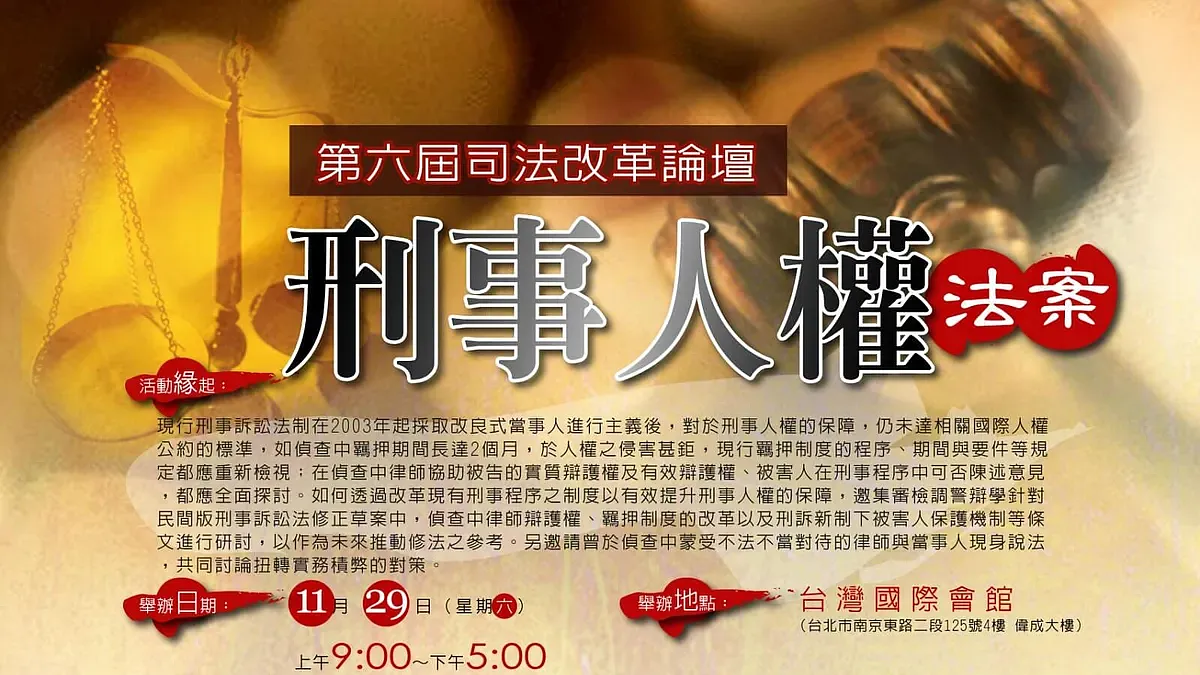
Pre-trial detention of defendants should never become the routine of prosecutorial investigations; if necessary, it should also belong to extremely exceptional circumstances. This Foundation, together with the Criminal Human Rights Legal Promotion Alliance composed of dozens of civil organizations, has jointly drafted the Amendment Draft to the Criminal Human Rights Provisions of the Code of Criminal Procedure based on international human rights standards and domestic criminal investigative practices. This draft substantially amends and supplements the provisions on detention (including the purpose, grounds, and duration of detention) in order to strive for a balance between human rights protection and the discovery of the truth.
We believe that while pursuing substantive justice, procedural justice must also be taken into consideration. We hereby put forward the above opinions for reference, and hope that all sectors of society will pool their wisdom and efforts to jointly work toward building a society that balances both human rights and the rule of law!
Attachments
This article is an AI-generated translation of the original Chinese text. In the event of any discrepancy, the Chinese version shall prevail.