
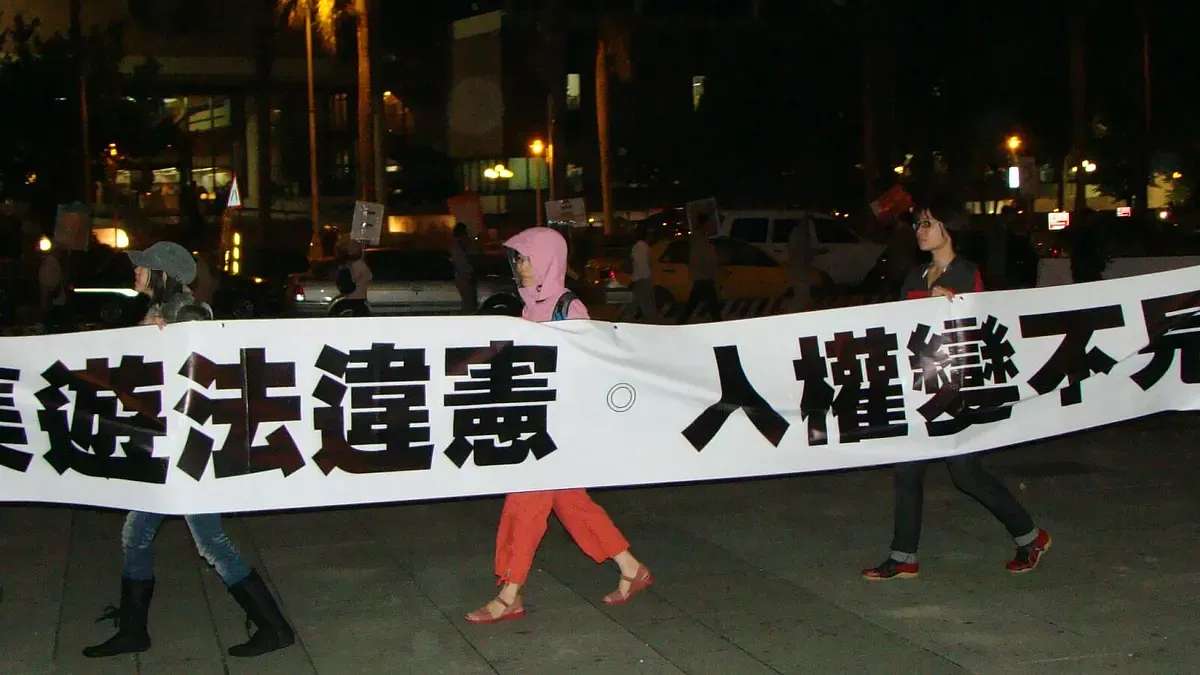
Opposing Abuse of Power by National Security and Police Authorities, Reviewing the Retention or Abolition of the Assembly and Procession Act: Supporting the Demands of the Wild Strawberry Student Movement
Last edited: 2026-07-27
Around the time of Association for Relations Across the Taiwan Straits President Ch'en Yun-lin's visit, national security and police personnel adopted unprecedentedly strict control measures to ensure the personal safety of visiting personnel. Not only did this risk abusing power to excessively suppress the expression of dissenting voices from civil society, but it also unfortunately caused multiple bloody clashes between police and citizens, exacting a heavy toll on society as a whole and the affected public.
To protest the police's abuse of power in suppressing people's freedom of expression and to highlight the unconstitutionality disputes surrounding the Assembly and Procession Act, a group of young students at Freedom Square and across Taiwan spontaneously initiated the "Wild Strawberry Student Movement," stepping forward bravely and fearlessly regardless of wind and rain to voice the public's sentiments. We highly affirm these students for standing up to pursue the ideals of a constitutional state, for their moderate and rational demands, and for their active exercise of fundamental rights guaranteed by the Constitution. In addition to supporting the students' demands, we also issue the following statements on behalf of various organizations:
- The freedom of expression of any individual shall be protected to the highest degree, and assembly, procession, and other freedoms of expression shall not be excessively infringed upon under the guise of security details and maintaining social order.
- Thoroughly review the amendment or abolition of the Assembly and Procession Act. If abolition is deemed unnecessary, it should at least be amended to a notification system or a design of notification by default with permission as an exception, so as to avoid granting police agencies excessive discretionary space or room for judgment.
- Abolish or delete special criminal provisions penalizing violations of the Assembly and Procession Act, adopting administrative penalties as sanctions instead. Those whose acts constitute criminal offenses under the Criminal Code shall be prosecuted in accordance with the law by reverting to the application of the Criminal Code.
- Re-evaluate the necessity of restricted zones for assemblies and processions. The designation of control areas by national security units or police agencies in the performance of their duties must be governed by law, must not arbitrarily exceed the necessary scope, and must take into account the reasonable needs of the public to express their opinions.
- The Control Yuan, the Ministry of Justice, and relevant agencies shall investigate and hold accountable those who abused their power or performed their duties unlawfully, and shall make public the investigation and handling results; citizens who have been arrested, detained, or otherwise subjected to unlawful treatment shall be promptly transferred to prosecutorial authorities for investigation and indictment.
- For students engaged in peaceful sit-ins, their freedom of expression shall be protected; schools and educational authorities shall not exert pressure, make threats, harass, or punish them under any pretext. Unless an assembly poses a clear and present danger to social order and public interest, police agencies shall not resort to coercive measures merely because an assembly or procession has not been applied for.
This article is an AI-generated translation of the original Chinese text. In the event of any discrepancy, the Chinese version shall prevail.