
Legislative Observation Group Observation Comments - Statement by the Alliance for Citizen Monitoring of Judicial Yuan Grand Justice Nominees
Last edited: 2026-07-27
I. Statistical Data
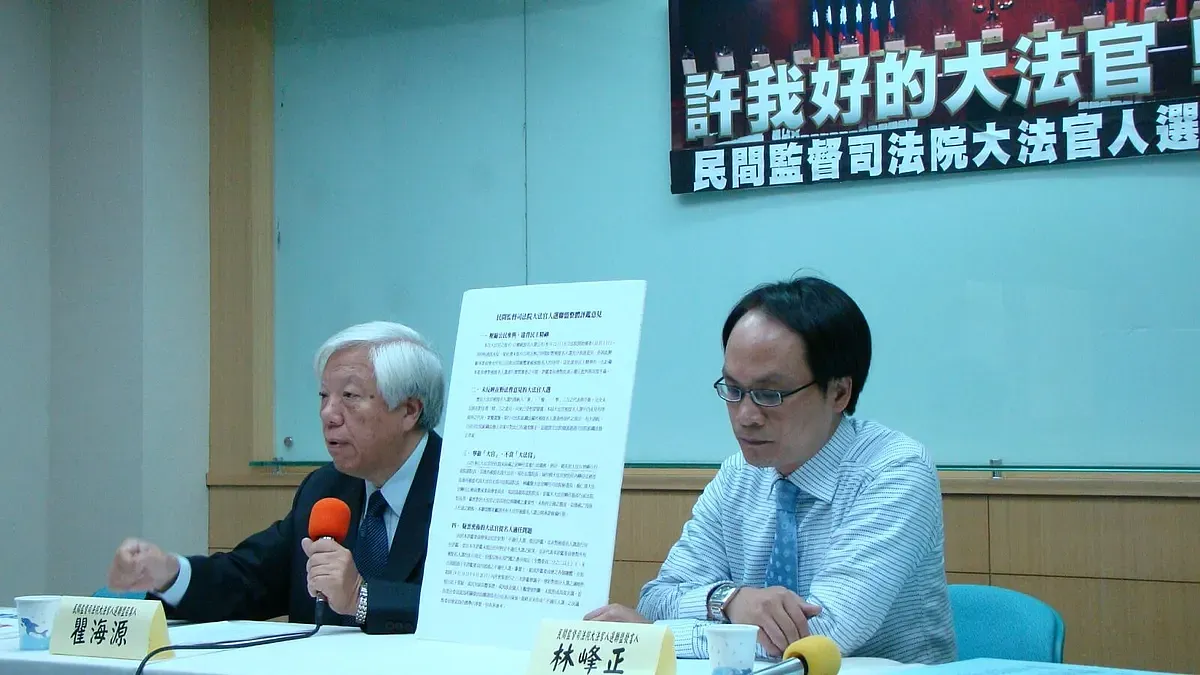
Following the release of its evaluation report on the Grand Justice nominees on September 30, the "Alliance for Citizen Monitoring of Judicial Yuan Grand Justice Nominees"—composed of groups including the Judicial Reform Foundation, Citizen's Form (Hsinshe), Taiwan Association for Human Rights, Taiwan Law Society, Taiwan Bar Association, and Taipei Bar Association—established the Legislative Observation Group for the Exercise of Grand Justice Consent Power on October 1. The group was stationed at the Legislative Yuan to observe and record the entire process of lawmakers questioning the nominees. As of the close of the Q&A session at 5:30 PM today, a total of 155 valid observation records were collected. The statistical data regarding the performance of the legislators who questioned the nominees is compiled in the table below.
Table 1: Substance of Inquiries
| Item | Rating | KMT | DPP |
|---|---|---|---|
| Quality | Very Low | 14.29% | 14.00% |
| Low | 32.14% | 14.00% | |
| Average | 38.39% | 40.00% | |
| High | 14.29% | 30.00% | |
| Very High | 0.89% | 2.00% | |
| Content | Very Hallow | 22.32% | 10.00% |
| Hallow | 32.14% | 22.00% | |
| Average | 25.00% | 32.00% | |
| Substantive | 18.75% | 30.00% | |
| Highly Substantive | 1.79% | 6.00% | |
| Political Undertone | Very Strong | 21.05% | 14.29% |
| Strong | 28.07% | 51.02% | |
| Average | 34.21% | 22.45% | |
| Weak | 9.65% | 8.16% | |
| None | 7.02% | 4.08% | |
| Ideology | Very Strong | 16.51% | 10.00% |
| Strong | 31.19% | 36.00% | |
| Average | 33.03% | 44.00% | |
| Weak | 11.01% | 10.00% | |
| None | 8.26% | 0.00% | |
| Personal Attack | Very Strong | 1.77% | 11.76% |
| Strong | 7.08% | 11.76% | |
| Average | 32.74% | 31.37% | |
| Weak | 14.16% | 21.57% | |
| None | 44.25% | 23.53% | |
| Off-Topic | Completely Off-Topic | 23.21% | 12.24% |
| Somewhat Off-Topic | 32.14% | 22.45% | |
| Average | 21.43% | 36.73% | |
| On-Topic | 18.75% | 24.49% | |
| Completely On-Topic | 4.46% | 4.08% |
Table 2: Questioning Attitude
| Item | Rating | KMT | DPP |
|---|---|---|---|
| Rationality | Very Irrational | 5.66% | 10.42% |
| Irrational | 16.04% | 18.75% | |
| Average | 37.74% | 27.08% | |
| Rational | 33.02% | 39.58% | |
| Very Rational | 7.55% | 4.17% | |
| Grandstanding | Very Severe | 8.85% | 8.00% |
| Severe | 20.35% | 28.00% | |
| Average | 30.09% | 30.00% | |
| Not Severe | 29.20% | 20.00% | |
| None at All | 11.50% | 14.00% | |
| Verbal Abuse | Very Severe | 2.65% | 8.16% |
| Severe | 6.19% | 6.12% | |
| Average | 24.78% | 38.78% | |
| Not Severe | 24.78% | 16.33% | |
| None at All | 41.59% | 30.61% | |
| Humiliation | Very Severe | 2.65% | 12.24% |
| Severe | 7.08% | 6.12% | |
| Average | 23.01% | 40.82% | |
| Not Severe | 26.55% | 14.29% | |
| None at All | 40.71% | 26.53% |
Table 3: Overall Performance
| Item | Rating | KMT | DPP |
|---|---|---|---|
| Overall Performance | Excellent | 0.00% | 0.00% |
| Good | 18.69% | 35.42% | |
| Average | 29.91% | 33.33% | |
| Poor | 37.38% | 22.92% | |
| Extremely Poor | 14.02% | 8.33% |
II. Observation Comments
The Legislative Yuan's review of the consent power for Grand Justices this time continued the old practice of conducting the review via a whole committee to question nominees regarding their suitability. The review meeting was scheduled for only one day, and although the committee originally planned to commence at 9:00 AM, it was delayed until 9:55 AM due to a lack of a quorum. This demonstrates that the legislators' emphasis on the review of the Grand Justice consent power is truly in need of improvement. In addition, the Alliance provided a question bank totaling 31 questions for all legislators to reference when questioning the nominees.
Overall, the Alliance believes that compared to last year's relatively calm review meeting, most legislators remained bound by the habit of questioning executive officials, making it difficult to use this process as a reference for exercising consent power (i.e., voting) on Friday (October 3). From a civil society perspective, the Alliance specifically puts forward the following observation comments:
- The Grand Justice nominees this time were nominated by the President belonging to the majority party in the legislature. Through Legislative Yuan consultations, the number of legislators taking the podium to question nominees was allocated proportionally among political parties. With fewer opposition lawmakers registered to speak compared to last year's review meeting, the atmosphere was calmer. Overall, the attitude toward questioning the nominees was more respectful, with fewer instances of verbal abuse and humiliating language.
- Media attention toward the Grand Justice nominees was low, leaving the public unable to understand how the suitability of the Grand Justice candidates relates to their own interests.
- During questioning, some legislators demanded that Grand Justice nominees provide brief "yes" or "no" answers, depriving the nominees of the opportunity to respond more in-depth to the issues raised. The process of argumentation and reasoning by nominees demonstrates a responsible attitude toward the issues raised by legislators; yet, some legislators cut nominees off when they attempted to elaborate further, or even denied them the opportunity to defend and state their positions.
- Grand Justice nominees all expressed a lack of understanding regarding the issue of gender mainstreaming, and maintained total silence regarding the definition of sexual harassment. This highlights the nominees' insufficient concept of gender equality, raising concerns about the future stance and attitude of Grand Justices on gender human rights and related issues.
- Before the Legislative Yuan's review procedure began, the Alliance continually called on legislators to adopt an attitude of respect toward the office of Grand Justice, conducting necessary and meaningful Q&A rationally, and provided a question bank for legislators' reference regarding content. However, during the review process, the political issues raised by most legislators still differed vastly from whether the nominees were fit for the office of Grand Justice, while basic attitudes concerning many future issues pivotal to constitutional development and human rights protection were rarely questioned.
III. Recommendations
-
Prior to the Q&A procedure, the Legislative Yuan should provide a questionnaire for nominees to answer in advance for review reference.
During this Q&A session, because most legislators excessively focused on a small number of ideology-related issues, it was difficult to adequately address the many focal points of constitutional interpretation that the newly appointed Grand Justices will face upon taking office. Therefore, the Alliance recommends that prior to future Q&A procedures conducted by the Legislative Yuan, party caucuses should submit questions to be consolidated by the Legislative Yuan into a questionnaire for the nominees, giving them a reasonable amount of time to complete it. This can serve as a reference for legislators during actual questioning, be made public to society to demonstrate transparency, and provide a basis for the public to monitor and examine the conduct and arguments of Grand Justice nominees after taking office.
-
Consideration should be given to using a single nominee as the subject of review, rather than the current practice of conducting Q&A for multiple nominees simultaneously.
This Q&A session grouped five nominees together, conducting questioning over a single day. Practical implementation frequently resulted in a single nominee being asked the majority of questions, while other nominees had difficulty finding the opportunity and time to answer. To improve this phenomenon, the Alliance recommends using a single nominee as the unit of questioning, with each party caucus sending representatives to ask questions. For example, if the questioning time for each nominee is predetermined to be two hours, and the order of questioning is determined by drawing lots, it should proceed accordingly. This would prevent certain nominees from having extremely few opportunities to express their opinions, and by focusing questioning on a single person, it would also reduce the likelihood of repeatedly raising the same questions.
-
The Legislative Yuan should extend the Q&A time to facilitate sufficient time for dialogue between legislators and Grand Justice nominees.
There were five nominees entering the Q&A procedure this time. Excluding each nominee's ten-minute self-introduction, the actual Q&A time was only four hours and thirty minutes, averaging less than one hour per person. Unless the Legislative Yuan is merely putting on a show, allocating less than one hour of questioning to a Grand Justice nominee who will serve an eight-year term and shoulder the heavy responsibility of constitutional interpretation is disproportionate compared to the review of a master's thesis, which takes at least half a day. The Legislative Yuan should carefully consider extending the Q&A time to respond to the reasonable expectations of society.
This article is an AI-generated translation of the original Chinese text. In the event of any discrepancy, the Chinese version shall prevail.