
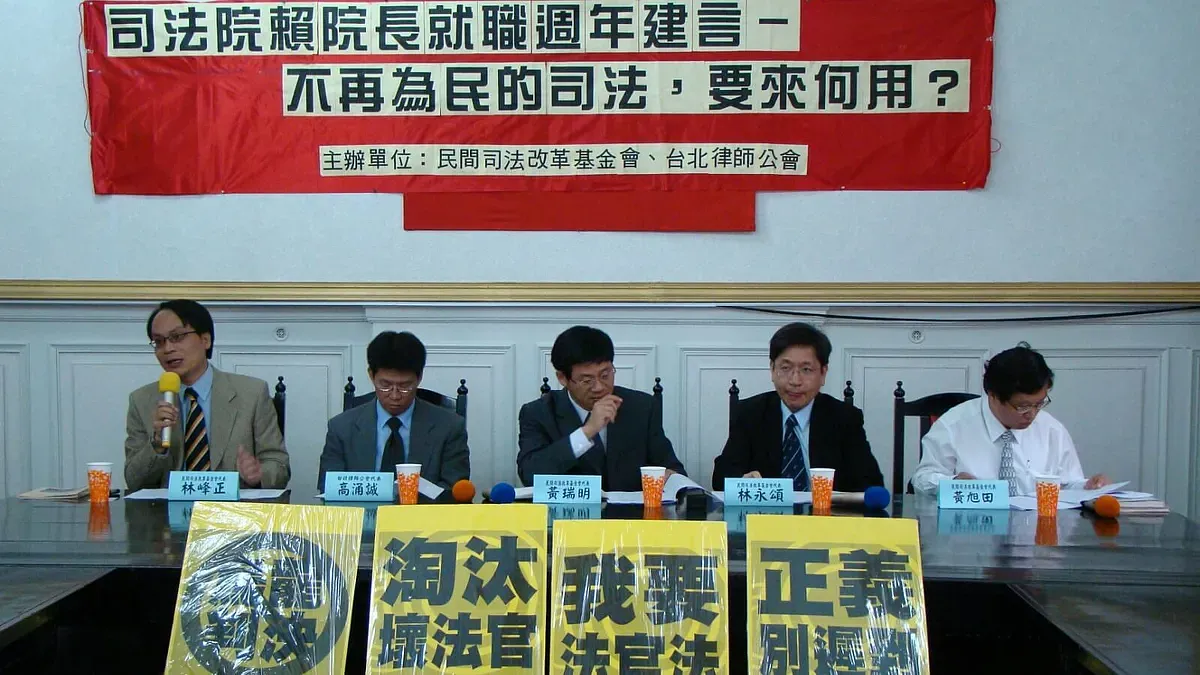
What is the Use of a Judiciary That No Longer Serves the People? Recommendations on the First Anniversary of Judicial Yuan President Lai In-jaw's Taking Office
Last edited: 2026-11-03
On August 31, 2007, former President Chen Shui-bian nominated Grand Justice Lai In-jaw to serve as President of the Judicial Yuan. On September 5, the JRF held a press conference releasing an 'Open Letter to Nominee for President of the Judicial Yuan, Grand Justice Lai In-jaw,' expressing three major demands for judicial reform: 'We do not want bad judges, we want the Judges Act'; 'We do not want justice delayed, we want timely and efficient trials'; and 'We do not want botched judgments, we want qualified, professional judges.'
The clear demands we put forward are the long-term goals of the JRF's commitment to judicial reform, and we believe they also reflect the shared sentiments of the general public nationwide. In addition to clearly expressing these demands, we also hoped that President Lai, upon taking office, would inform us of a possible implementation timeline and make concrete commitments. After President Lai officially assumed office, our Chairperson and several Standing Executive Committee members visited President Lai at the Judicial Yuan on October 23, 2007, and April 15, 2008, to present our recommendations in person, fully embodying the principle of saying all one knows and saying it without reservation. During both meetings, President Lai allowed us to speak our minds as much as possible and treated us with utmost courtesy. However, regarding the judicial reform opinions we raised, he mostly indicated that these matters were of great magnitude and required ample time for research and evaluation before effective and side-effect-free concrete countermeasures could be adopted.
Looking back at President Lai's year at the helm of the Judicial Yuan, he has traveled tirelessly across courts nationwide to listen to judges' opinions, enduring great hardship. The bills submitted by the Judicial Yuan to the Legislative Yuan for deliberation over the past year—such as Article 17-1 of the Court Organization Act, which expands the duties of judicial affairs officers (whose functions are similar to judicial assistants); Article 165-2, 310-1, and 366-1 of the Code of Criminal Procedure, which simplify the evidence presentation procedure and the recording of judgment reasoning; and the draft Judicial Yuan Organization Act, which struggles to respond to the 1999 National Judicial Reform Conference conclusion on building a judicial personnel pyramid—all reflect President Lai's policy focus on alleviating judges' workloads. However, we must also point out that the Judicial Yuan has failed to propose policies to enhance the quality of judgments and safeguard the people's right to litigation.
We agree that a reasonable workload for judges is absolute foundation for the success of judicial reform, and building a reasonable working environment for judges is a core responsibility that the Judicial Yuan cannot shirk. However, our greatest concern is that if the means adopted by the Judicial Yuan to achieve the aforementioned goals end up reducing the degree of protection afforded to the people's right to litigation, that is something the JRF cannot accept and the moment when we must stand up and voice our strong dissent. As demonstrated by both domestic and foreign historical experience, 'judicial bureaucratization' is the trap into which the judicial system most easily falls. How to prevent judicial bureaucratization should be the focus of judicial reform. We observe that recent judicial reform programs promoted by various countries around the world share a central ideology: narrowing the gap between the judiciary and the people, and avoiding judicial bureaucratization. Yet, looking around, while the Judicial Yuan actively pushes forward the aforementioned bills, it has yet to offer effective countermeasures regarding the Judges Act—which could weed out bad judges and improve the quality of judgments—stalling in the Legislative Yuan. Furthermore, it treats progressive reforms on human rights-related clauses in the Code of Criminal Procedure with cold indifference, prioritizing instead amendments such as simplifying the drafting of judgments, which conspicuously smorgasbord favors judges. This cannot help but arouse concern over whether the ideal of a judiciary serving the people has been completely shelved by judicial bureaucrats.
The Judicial Yuan is the judicial reform general headquarters holding the nation's judicial resources. If it repeatedly fails to propose a clear reform vision to lead official and civil efforts, but instead endlessly trivializes that reducing judges' workload is the sole panacea for reform, we fear that long before any tangible results of judicial reform are seen, the legitimacy of the Judicial Yuan's reforms will have completely evaporated, reducing the ideal of a judiciary for the people to mere slogans. Regarding President Lai's four-year term, the game has just finished its first quarter: the team claiming to represent reform has achieved nothing, and the coach simply continues to comfort the supporting spectators that there are still three quarters left and plenty of time, yet fails to show any ideal tactics to turn the tide. If the coach does not quicken his pace, we fear time will run out and end in defeat.
At this juncture of President Lai's one-year anniversary in office, witnessing the complete absence of a judicial reform vision and chaotic, murky reform policies—let alone any public and clear execution timeline commitments—the JRF should no longer continue to wait and stand on the sidelines. Instead, we must actively provide opinions and maintain continuous supervision in order to respond to the earnest expectations of all citizens for judicial reform. Of course, we are not naive enough to think that merely expressing such opinions means we can sit back and reap the rewards; continuous supervision is a necessary tool. Starting today, we are launching an online poll regarding the Judicial Yuan and President Lai. The results will be announced on the eve of Judicial Day on January 11 next year. We ask the Judicial Yuan to take this seriously and subject itself to the test of public opinion. The best countermeasure is to immediately respond to the three demands raised by the JRF on September 5, 2007, and produce good policies that move the people. Otherwise, what is the use of a judiciary that no longer serves the people?
Post-Conference Press Release
The Judicial Reform Foundation and the Taipei Bar Association held a press conference today (Oct. 1) titled 'Recommendations on the First Anniversary of Judicial Yuan President Lai's Taking Office - What is the Use of a Judiciary That No Longer Serves the People?' criticizing the shortcomings in Judicial Yuan President Lai In-jaw's judicial policies over his first year in office. They demanded that President Lai immediately propose reform plans and responses to the three demands raised by civil society upon his taking office a year ago: 'We do not want bad judges, we want the Judges Act'; 'We do not want justice delayed, we want timely and efficient trials'; and 'We do not want botched judgments, we want qualified, professional judges.'
Huang Jui-ming, Chairperson of the JRF, stated that over the past year since taking office, President Lai has proposed amendments to the Code of Criminal Procedure through legislators and has visited various local courts to consult judges on their opinions and demands. However, regarding the issues of trial quality and trial delays reflected behind the current judicial phenomena presented in the newly released book 'Thirty Years of Wandering Courts,' no concrete policy responses from the President of the Judicial Yuan have yet been seen. The Judicial Yuan has focused excessively on alleviating judges' burdens and increasing bureaucratic welfare while lacking dialogue with and listening to the voices of the people, resulting in problems of judicial bureaucratization, self-isolation, and a lack of oversight, pushing it further and further away from public opinion.
Kao Yung-cheng, Secretary-General of the Taipei Bar Association, pointed out that the case flow management trial courts currently being piloted in the Taipei District Court and Shilin District Court represent a major reform affecting citizens' rights to litigation. However, the study period prior to the pilot was too short, and the Judicial Yuan merely held explanatory sessions without broadly inviting various sectors to express their opinions, highlighting that judicial administration has long ignored civil voices. Furthermore, President Lai's judicial reform policies leave the public unable to see a clear overarching direction.
Lin Yung-sung, a Director of the JRF, mentioned that past Presidents of the Judicial Yuan all convened national judicial reform conferences, broadly inviting all sectors to pool wisdom on judicial reform issues. However, over President Lai's first year in office, one hears only of the hardships of judges, not the suffering of the people. The JRF has visited President Lai twice, continuously requesting that he propose judicial reform policies for his term, yet to date, no clear policies on judicial reform have been seen from the Judicial Yuan. Regarding the conclusions of the 1999 National Judicial Reform Conference, whether implemented or not, they should be discussed with civil society and various sectors rather than decided behind closed doors by the Judicial Yuan. President Lai emphasizes in various settings that reform should be taken slowly, but how long can the people wait?
Huang Hsu-tian, a Director of the JRF, stated regarding the Judges Act that the public hopes to see promoted: Is President Lai willing to commit to achieving it during his term? If he cannot provide civil society with a timeline for legislating the Judges Act, does it mean that weeding out bad judges is an optional matter for President Lai? The system of consensual selection of judges in civil litigation is helpful in reducing judges' caseloads, but the background data on the list of judges provided by the Judicial Yuan was insufficient, leaving the public unaware of detailed judge profiles, resulting in very low usage and eventual abolition. The Judicial Yuan's insufficient efforts to promote it are the main reason for this system's failure. Has the Judicial Yuan ever conducted an in-depth review?
Lin Feng-cheng, CEO of the JRF, stated: Do major changes to criminal procedure systems, such as the principle of single indictment, really require no broad communication and discussion with all sectors? The system of legal counsel presence during police and prosecutorial interrogations for the first time, along with the amendment of human rights clauses in the Code of Criminal Procedure, are systems of immense help to citizens' litigation rights and the reduction of judges' burdens; yet, no active promotion by the Judicial Yuan is seen. Therefore, the JRF will launch an online poll targeting public satisfaction with President Lai's administration, his suitability for office, and the effectiveness of judicial reform. The results will be announced on the eve of Judicial Day on January 11 next year. It is hoped that before the poll results are announced, the Judicial Yuan and President Lai can present a more forward-looking and actionable judicial reform timeline.
This article is an AI-generated translation of the original Chinese text. In the event of any discrepancy, the Chinese version shall prevail.