
Civil Society Coalition for the Monitoring of Judicial Yuan Grand Justice Nominees Releases Evaluation Report
Last edited: 2026-11-03
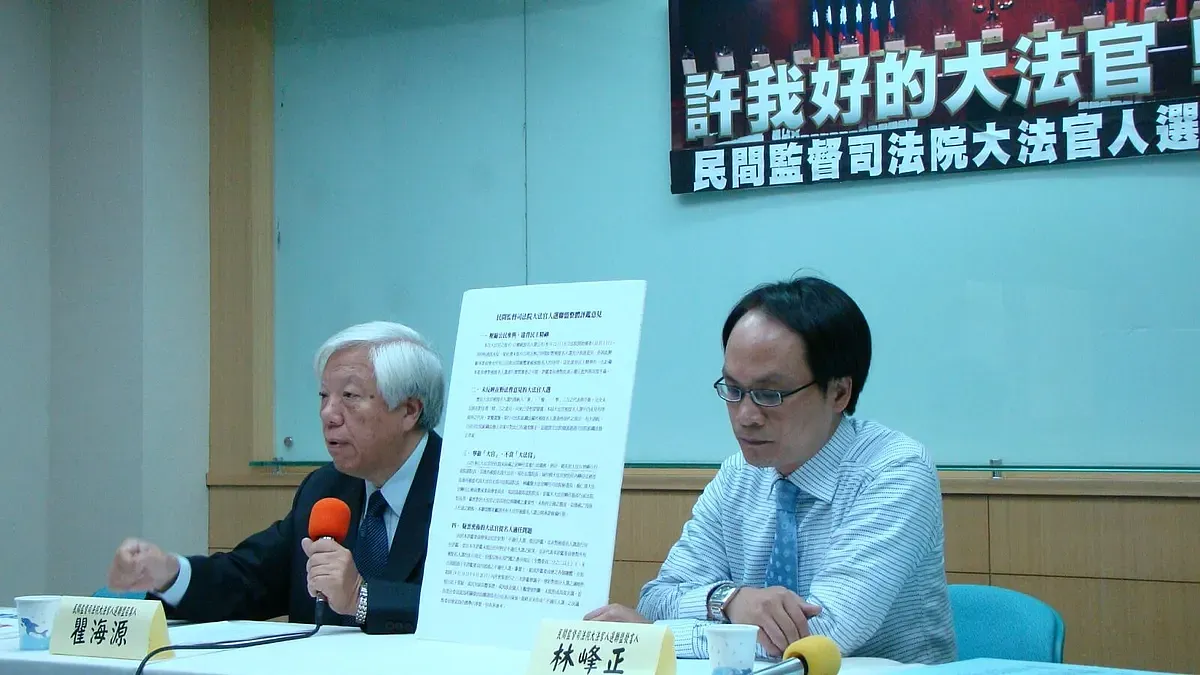
The Civil Society Coalition for the Monitoring of Judicial Yuan Grand Justice Nominees—comprising six civic groups including the Taiwan Association for Public Interest, Taiwan Law Society, Taiwan Association for Human Rights, Taipei Bar Association, Taiwan Bar Association, and Judicial Reform Foundation—re-launched in July of this year and began evaluating the five Grand Justice nominees nominated by President Ma in September. On the eve of the Legislative Yuan's review process and exercise of its consent power, the Coalition held a press conference at 10:00 a.m. on September 30 at the National Taiwan University Alumni Club to formally release the contents of its evaluation report and a question bank for Q&A to serve as a reference for legislators.
Professor Ch'en Hai-yuan, convener of the Coalition, stated that to remind the Legislative Yuan to exercise its consent power regarding Grand Justice nominees rationally and prudently, the Coalition has specially designed 31 sets of constitution-related questions for political party caucuses and legislators as a reference for ad hoc Q&A during the legislative session reviewing the nominees. Meanwhile, to prompt the Legislative Yuan to raise its review standards and avoid humiliating and overly ideological Q&A, the Coalition also mobilized various civic groups to conduct full-process monitoring of the Legislative Yuan's review proceedings on the morning of tomorrow (October 1) in Conference Room Red House 202 of the Legislative Yuan, and will release the Coalition's observational opinions after the review concludes.
Regarding the Presidential Office's passive attitude toward civil society participation, Coalition Convener Professor Ch'en Hai-yuan also levied criticism, opining that President Ma, who has a legal background, failed to attach importance to the constitutional system, and instead delegated the work of the Grand Justice Review Recommendation Committee to Vice President Hsiao, who specializes in finance, before leaving the final selection to the President.
In addition, regarding the evaluation of the current Grand Justice nominees, Professor Ch'en Hai-yuan put forward the Coalition's general opinions based on the evaluation report. First, the hasty timeline from the President's nomination to its submission to the Legislative Yuan for review has compressed the opportunities for civil society to participate in the review and evaluation, which blatantly violates the democratic spirit of civic monitoring. Second, the current Grand Justice nominees only incorporate representatives from the "bench" and "academia," completely failing to reflect the opinions of the "bar" from the independent legal profession. Furthermore, multiple past Grand Justices failed to serve out their full terms before transferring to other administrative positions, treating the position of Grand Justice as a stepping stone to "officialdom," which clearly falls short of society's expectations for the role of a "Grand Justice."
At the close of the press conference, Attorney Lin Fêng-cheng, executive director and spokesperson of the Coalition, addressed the "suitability" of the five Grand Justice nominees. Based on the facts listed by the Evaluation Committee, he raised the Coalition's questions regarding two of the nominees, Professor Huang Mao-jung and Judge Yeh Pai-hsiu, and expressed hope that the two nominees would respond during the Legislative Yuan's Q&A.
Regarding Professor Huang Mao-jung, among the 194 academic papers and publications provided in his presidential message, only 19 papers came from other journals, while the remaining 175 papers all originated from the Root Law Journal founded by Professor Huang himself. For a legal scholar, his professional academic performance is rather questionable. Moreover, when Professor Huang served as a訴願 (petition) commissioner and re-petition commissioner of the Taipei City Petition Committee in 1989 (ROC 88), he violated recusal regulations, leading the Administrative Court to revoke the original re-petition decision, which demonstrates his failure to strictly observe the principle of recusal. In addition, his wife and close relatives operate Chih-Ken International Information Co., Ltd., which is related to his legal expertise. Although it engages in legal information-related businesses, its commercial clients include public agencies such as the Taipei City Law and Regulation Commission, the Taipei City Petition Committee, and the Examination Yuan; furthermore, the business units under Chih-Ken International include services related to credit card debt settlement for a fee. For a legal professional, this appears quite unsuitable for his future status as a Grand Justice.
As for Judge Yeh Pai-hsiu, at the end of the autobiography attached to the presidential message, he stated, "I consider myself a suitable candidate to serve as a Grand Justice of the Judicial Yuan, and sincerely hope for 'your Excellency's discernment.'" His intention of "seeking official rank" in the text is clearly greater than the requirement for integrity and backbone expected of a "Grand Justice." Furthermore, in past administrative court judgments rendered by Judge Yeh, the gist of the land expropriation administrative court judgments in which he participated shockingly contradicted the gist of Judicial Yuan Interpretation No. 400. Whether he respects the role and status of the constitutional guardian entrusted to Grand Justices—whom he will become—is an issue worthy of careful examination by civil society.
Overall Evaluation Opinions of the Civil Society Coalition for the Monitoring of Judicial Yuan Grand Justice Nominees
The "Evaluation Committee for Nominees of the Civil Society Coalition for the Monitoring of Judicial Yuan Grand Justices" (hereinafter referred to as the "Evaluation Committee") hereby proposes the following overall evaluation opinions regarding the current Grand Justice nomination operations and nominees:
1. For the current Grand Justice nominations, the timeline from the announcement of the presidential nominees (September 12) to the commencement of the Legislative Yuan's review (October 1) was excessively hasty, depriving society of a reasonable and sufficient amount of time to fully express opinions regarding the nominees, thereby compressing the time available for this Committee and all citizens and civic groups to scrutinize the nominees. This is contrary to the democratic spirit and obstructs the possibility of substantive review of the nominees by this Committee. The Evaluation Committee expresses severe criticism and high dissatisfaction in this regard.
2. Past Grand Justice nominees have only incorporated representatives and maintained a balance among the three parties of the "bench," "prosecution," and "academia," completely failing to reflect the opinions of the independent legal profession—the "bar"—which has long been subject to considerable criticism. It is truly a matter of regret that no representatives from the legal profession are seen among the nominees for Grand Justices of this term. The qualification requirements for nominees under the current Judicial Yuan Organization Act lack comprehensiveness. The current draft amendments to the Judicial Yuan Organization Act have made appropriate revisions in this regard, and it is hereby urged that the Legislative Yuan expeditiously pass the draft amendments to the Judicial Yuan Organization Act (see Appendix 1).
3. In the past, multiple Grand Justices transferred to other administrative positions before their terms expired. For example, Grand Justice Lai Ying-chao transferred to serve as Vice Premier of the Executive Yuan, was subsequently re-nominated as a Grand Justice, and currently serves as President [of the Judicial Yuan]; Grand Justice Cheng Chung-mo transferred during his term to serve as Minister of Justice, was then re-nominated as a Grand Justice and served as Vice President of the Judicial Yuan; Grand Justice Lin Kuo-hsien transferred to serve as Secretary-General of the Judicial Yuan; Grand Justice Yang Jen-shou transferred to serve as President of the Commission on the Disciplinary Sanctions of Public Functionaries, and currently serves as President of the Supreme Court; Grand Justice Peng Feng-chih transferred to serve as President of the Supreme Administrative Court, etc. This clearly shows a failure to maintain a correct attitude toward the lofty status and critical powers of a Grand Justice, seemingly viewing the position merely as a stepping stone for personal official career advancement. This Coalition solemnly urges all Grand Justice nominees to publicly commit to serving out their full terms.
4. Since this Evaluation Committee is positioned to evaluate and target "unsuitable nominees" rather than conducting a confidence evaluation of the nominees (see Appendix 2), the current evaluation did not yield the result of identifying any specific unsuitable nominee. This does not mean that this Evaluation Committee expresses affirmation for all nominees; rather, it merely reflects that under the high-threshold voting rule (two-thirds or more of all committee members), no unsuitable nominee received passing votes from more than 10 evaluation committee members. In fact, during the three intensive evaluation meetings held by the various groups constituting the Evaluation Committee over a short period (September 18 to September 26), some questions were raised regarding the eligibility of certain nominees. Due either to a lack of concrete evidence or to matters involving personal subjective value judgments, a high consensus could not be formed. Consequently, some members considered the relevant information still insufficient and reserved their positions, ultimately failing to adopt a resolution on "unsuitable nominees." Nevertheless, the Committee believes that the following circumstances should still be cited as facts for public reference. For example:
- Regarding Mr. Huang Mao-jung: The list of publications provided by him shows that over 90 percent of his publications were published in the Root Law Journal which he edits (out of 194 papers, only 19 were published outside the Root Law Journal). As a full-time law professor, his prolonged failure to publish academic papers in the National Taiwan University Law Journal of his employing university or other professional law journals is baffling. Secondly, there was Administrative Court Judgment No. 3000 of 1999 (ROC 88) (Appendix 3), the reasoning of which pointed out that Mr. Huang Mao-jung simultaneously served as a petition commissioner and a re-petition commissioner for a certain petition case, violating recusal regulations and causing the Administrative Court to overturn the original re-petition decision. His failure to strictly observe the principle of recusal appears to be an oversight. Finally, as a law professor, Mr. Huang Mao-jung's wife and close relatives operate a company related to his legal profession, engaging in legal information-related business and commercial activities, which seems rather unsuitable for his future status as a Grand Justice. Mr. Huang Mao-jung should clearly state how he intends to handle this issue in the future.
- Regarding Mr. Yeh Pai-hsiu: His statement at the end of his autobiography, "I consider myself a suitable candidate to serve as a Grand Justice of the Judicial Yuan, and sincerely hope for 'your Excellency's discernment'" (Appendix 4), uses obsequious language that is evidently distant from the professional requirement that a Grand Justice should uphold professional conscience and stand firm for what is right. Furthermore, while he has specialized and repeatedly published works on the issue of public expropriation, the judgments concerning land expropriation compensation in which he participated appear to fail to truly implement the spirit of Judicial Yuan Interpretation No. 400 (e.g., Taipei High Administrative Court Judgments No. 282 of 1989 [ROC 89], No. 2906 of 1989 [ROC 89], No. 3545 of 1990 [ROC 90], and No. 713 of 1994 [ROC 93], etc.) (Appendix 5).
Appendices
- Draft Amendments to the Judicial Yuan Organization Act
- Organization and Evaluation Regulations of the Evaluation Committee for Nominees of Judicial Yuan Grand Justices
- Administrative Court Judgment No. 3000 of 1999 (ROC 88)
- Autobiography of Grand Justice Nominee Yeh Pai-hsiu
- Taipei High Administrative Court Judgments No. 282 of 1989 (ROC 89), No. 2906 of 1989 (ROC 89), No. 3545 of 1990 (ROC 90), and No. 713 of 1994 (ROC 93)
This article is an AI-generated translation of the original Chinese text. In the event of any discrepancy, the Chinese version shall prevail.