
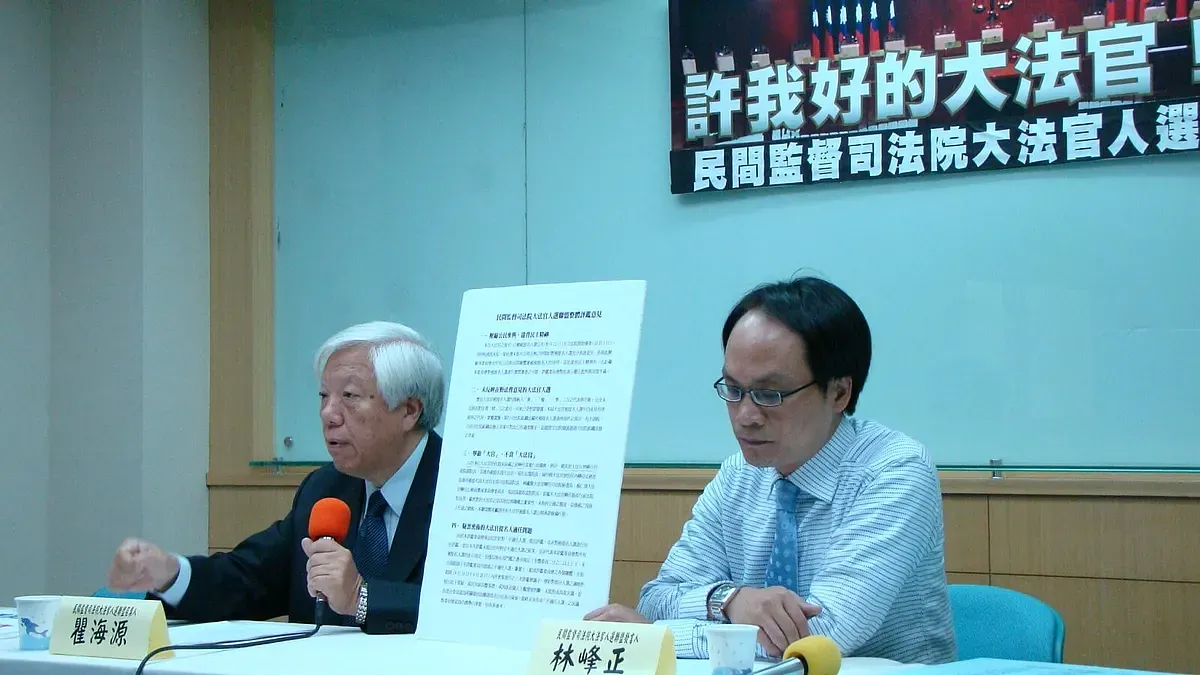
Give Us Good Grand Justices ~ Citizens' Coalition for the Monitoring of Judicial Yuan Grand Justice Nominees
Last edited: 2026-07-27
Since early August this year, the Office of the President announced the establishment of the Review Committee for Judicial Yuan Grand Justice Nominees, calling on all sectors of society to recommend Grand Justice candidates to the President, in order to facilitate the President in filling the current vacancies on the Council of Grand Justices in accordance with constitutional provisions.
Established in 2003 by the Taiwan Law Society, Taiwan Association for Human Rights, Taiwan Association for University Rights, Taiwan Bar Association, Taipei Bar Association, and Judicial Reform Foundation, this Coalition aims to provide recommendations from a civil society perspective to the President, who holds the power to nominate Grand Justices, urging them to carefully select appropriate candidates to serve as guardians of the Constitution. Upon official nominations by the President, the Coalition establishes an evaluation committee to publicly express views on the nominees' suitability. If any nominee is deemed truly unsuitable, the Coalition actively lobbies the legislature to cast dissenting votes during the consent review process. Furthermore, the Coalition provides question banks for legislators to reference during the Legislative Yuan's consent review process and conducts full on-site monitoring of the legislative review.
To fulfill the aforementioned mission, the Coalition formally wrote to the Office of the President in early August this year, hoping to request a meeting with the President to present the Coalition's demands (see attachment). Regrettably, the Office of the President did not officially reply until the morning of September 8, stating that because the President is busy with major national policies such as boosting the economy, he has no time to receive members of the Coalition, though he will still exercise his nomination power prudently. While the Coalition understands the difficulties of the President's busy public service and untiring efforts, we nonetheless express our indescribable regret for not being able to present our recommendations in person regarding Grand Justice candidates, who are crucial to the long-term blueprint of constitutional governance.
At this juncture when the Office of the President has submitted the nomination message for Grand Justices to the Legislative Yuan, the Coalition has launched the evaluation work for the nominees. Professor Chou Chih-hung serves as the chairperson, conducting professional evaluations of the five nominees and issuing an evaluation report, with the firm goal of reporting the evaluation results to the public prior to the Legislative Yuan's formal review, to serve as a reference for legislators in exercising their consent power.
The Coalition was launched respectively in 2003 and 2007, inviting experts and scholars to jointly monitor the selection process of Grand Justices in our country, hoping to ensure that the voice of civil society is not absent. With the President nominating Grand Justices once again, the Coalition will continue its monitoring, contributing in a small way to the establishment of a sounder constitutional system.
Citizens' Coalition for the Monitoring of Judicial Yuan Grand Justice Nominees
Convener
Ch'u Hai-yuan
Spokesperson
Lin Feng-cheng
List of Evaluation Committee Members
Huang Hsiu-tuand, Professor, Department of Political Science, Soochow University
Hung Yu-hung, Professor, Institute of Philosophy of Mind and Cognition, National Yang-Ming University
Liao Fu-t'e, Associate Research Fellow, Preparatory Office of the Institute of Legal Studies, Academia Sinica
Chou Chih-hung, Associate Professor, Graduate Institute of Education and Law, National Taipei University of Education
Wu Yu-tsung, Associate Professor, Department of Law, Shih Hsin University
Ch'en I-ch'ien, Assistant Professor, Graduate Institute of Gender Studies, Shih Hsin University
Lai Hsiu-ju, Senior Journalist, Central News Agency
Yang Cheng-hsien, Attorney, Executive Committee Member of Taiwan Association for Human Rights
Kao Yung-cheng, Attorney, Secretary-General of Taipei Bar Association
Li Yuan-te, Attorney, Chairperson of the Constitutional and Administrative Law Committee of Taipei Bar Association
Tsai Pi-sung, Attorney, Chairperson of the Non-litigation Matters Research Committee of Taipei Bar Association
Lin Yung-fa, Attorney, President of Taiwan Bar Association
Hsieh Wen-t'ien, Attorney, Standing Board Director of Taiwan Bar Association
Ku Chia-chun, Attorney, Standing Board Director of Taiwan Bar Association
Chang Hsun-chia, Attorney, Secretary-General of Taiwan Bar Association
Lin Feng-cheng, Attorney, CEO of Judicial Reform Foundation
Main Points and Demands of the Meeting between the Citizens' Coalition for the Monitoring of Judicial Yuan Grand Justice Nominees and President Ma Ying-jeou
Your Excellency President Ma Ying-jeou:
In 2003, President Chen Shui-bian nominated fifteen Grand Justice candidates, including the President and Vice President of the Judicial Yuan, pursuant to Article 5 of the Additional Articles of the Constitution, submitting them to the Legislative Yuan for the exercise of consent power. At that time, the Coalition publicly made an appeal to President Chen regarding the nomination matters, conducted individual evaluations of the nominees after the official nominations, and organized an observation delegation to the Legislative Yuan to monitor the review procedure, hoping that the nominees would meet public expectations and that the review process would not devolve into partisan vicious infighting. Last autumn, President Chen once again nominated eight Grand Justice candidates in accordance with constitutional provisions for the Legislative Yuan to exercise its consent power. The Coalition launched once again to express the concerns of civil society and carry out various related monitoring tasks.
As four of the Grand Justice candidates nominated by President Chen failed to pass the Legislative Yuan's review this time, Your Excellency will inevitably exercise the power of nomination conferred by the Constitution in the shortest possible time. To express the shared concerns of all sectors of society regarding Your Excellency's nomination of Grand Justices, the "Citizens' Coalition for the Monitoring of Judicial Yuan Grand Justice Nominees," jointly initiated by the Taiwan Association for University Rights, Taiwan Law Society, Taiwan Association for Human Rights, Taiwan Bar Association, Taipei Bar Association, and Judicial Reform Foundation, is launching for the third time to carry out relevant monitoring matters and present the following demands to Your Excellency in person:
1. Please exercise Your Excellency's constitutionally conferred power to nominate Grand Justices with prudence.
Nominating Grand Justices is inherently a constitutional power bestowed upon the President. However, interpretations by the Council of Grand Justices bear an indelible contribution and impact on the elevation of human rights protection standards and the establishment of the foundations of constitutional construction in our country. Nominating appropriate candidates to serve as Grand Justices can lay a sound cornerstone for the aforementioned work, and vice versa. Your Excellency's nomination power is not only a constitutional power, but furthermore a heavy obligation.
2. When nominating Grand Justices, Your Excellency should consider their moral integrity, scholarship and competence, professional performance, and understanding of constitutional law.
Specifically, the Coalition's views on Grand Justice candidates are as follows:
- Nominees for Grand Justices of the Judicial Yuan should possess positive qualifications with concrete deeds demonstrating their human rights ideals, democratic literacy, and professional competence.
- Nominees for Grand Justices of the Judicial Yuan must not have blemishes in moral integrity or engage in conduct inconsistent with the reputation of Grand Justices.
- Nominations of Judicial Yuan Grand Justices should not be based primarily on ethnicity, region, background of origin, or ideology.
- Nominations of Judicial Yuan Grand Justices should widely recruit talents from all sectors and should not follow the convention that those originating from the judicial system should occupy a certain proportion.
3. Grand Justice nominations must not become political spoils.
Although the Legislative Yuan's exercise of consent power may generate partisan disputes, Your Excellency should refer to the criticisms expressed by public opinion regarding the review process and results of the previous Control Yuan and Examination Yuan personnel nominations, and rather choose high idealism to strive for cross-partisan support. Otherwise, political spoils will only extend the mode of partisan confrontation to Grand Justices who ought to be transcendent and independent, with unimaginable consequences.
4. The Coalition will evaluate the Grand Justice candidates nominated by Your Excellency and publish a list of those evaluated as unsuitable.
After Your Excellency nominates the Grand Justices, the Coalition will form a Grand Justice Nominee Evaluation Committee composed of representatives from member groups and impartial figures in society, actively consult legal and political circles as well as impartial figures in society, and collect detailed information to conduct a comprehensive and in-depth evaluation of each Grand Justice nominee. Upon confirming those who are unsuitable, the Coalition will publish the list and detailed reasons. The Coalition will also monitor the process of the Legislative Yuan's exercise of consent power.
The above opinions are respectfully submitted for Your Excellency's kind consideration.
Wishing you the best of health and success,
Citizens' Coalition for the Monitoring of Judicial Yuan Grand Justice Nominees, Respectfully Submitted
This article is an AI-generated translation of the original Chinese text. In the event of any discrepancy, the Chinese version shall prevail.