
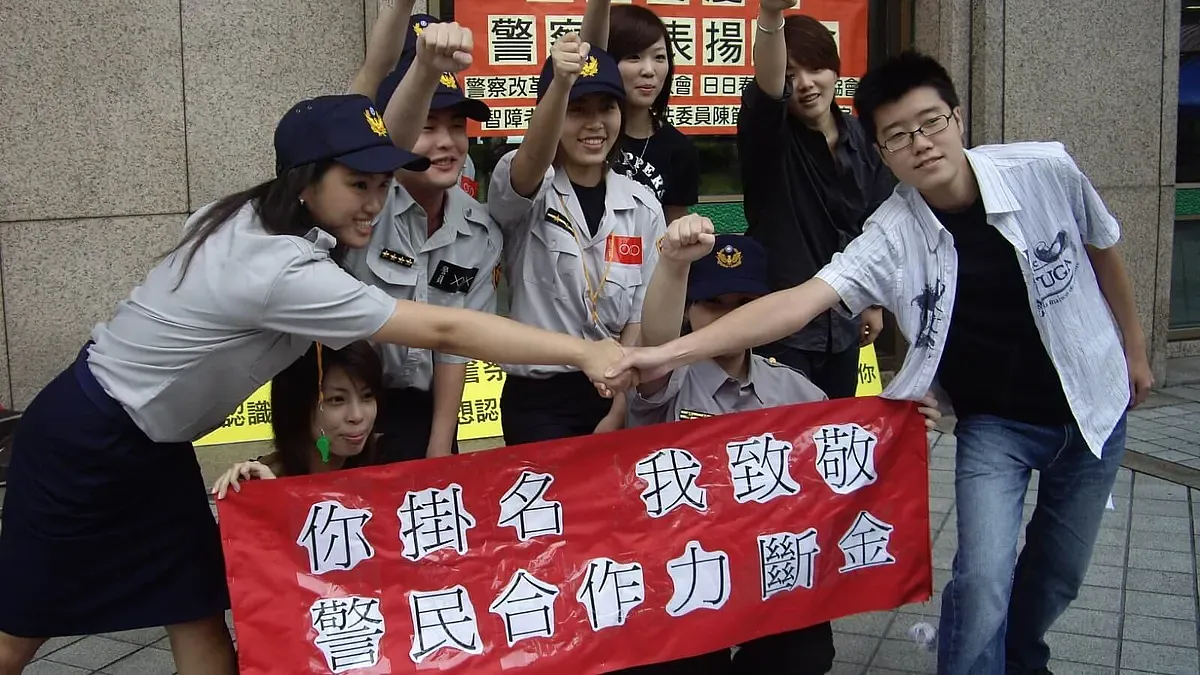
Civilian Police's Day Celebration and Commendation Ceremony ~ Making the Names of Good and Bad Police Officers No Longer a Secret
Last edited: 2026-07-27
Tomorrow, June 15, is the annual Police's Day. While the National Police Agency has historically commended many outstanding police officers, civil society groups also held a "Police's Day Celebration and Commendation Ceremony" to allow good police officers to be commended by the public and bad police officers to be scrutinized by citizens. The Police Reform Alliance, Judicial Reform Foundation, Collective of Sex Workers and Supporters (COSWAS), General Association of R.O.C. Parents of People with Intellectual Disabilities, and Legislative Member Ch'en Chieh-ju's Parliamentary Office jointly held the "97th Year Police's Day Celebration and Commendation Ceremony" today at the plaza in front of the South Exit 2 of Taipei Railway Station. Through satirical skits and awards ceremonies, they advocated for the transparency of police identification so that the names of good and bad police officers are no longer a secret.
Attorney Ma Tsai-ch'in, Convenor of the Police Reform Alliance and Executive Director of the Judicial Reform Foundation, stated that law enforcement personnel have long given the public an impression of a lack of transparency. Especially when police officers execute their duties with poor service attitudes or even engage in illegal and misbehaved acts, citizens are unable to identify the officer's characteristics and thus cannot file complaints or exercise oversight against misconducted officers in a timely manner. Likewise, citizens are unable to express gratitude or commendation to their affiliated units because they cannot know the names of high-performing officers. Due to the lack of personal identification characteristics among our country's police officers during law enforcement processes, the misconduct of a few officers stigmatizes the entire police force. Therefore, the higher the transparency of police law enforcement, the greater the public's trust will naturally be, and outstanding police officers will also be more willing to remain in the police profession to serve the public.
Attorney Ma Tsai-ch'in noted that law enforcement transparency can be divided into two parts: transparency of law enforcement personnel and transparency of the law enforcement process. Transparency of law enforcement personnel refers to the personal identification insignia of police officers. The JRF once conducted a public opinion poll on "police connectivity and law enforcement transparency." As high as 80% of the public believed that it is important for uniformed police officers on duty to embroider their names and badge numbers on prominent positions on their chests. Referring to police uniforms in European, American, and other countries around the world, there are similar regulations. Therefore, the National Police Agency should respect the will of the people and conform to international trends by allowing police uniforms to be embroidered with names and permanent identification numbers, thereby enhancing public trust in the police and further helping to elevate the quality of the police.
Sun I-hsin, Director of Legislative Member Ch'en Chieh-ju's Parliamentary Office and Deputy Secretary-General of the General Association of R.O.C. Parents of People with Intellectual Disabilities, mentioned that during the review of the central government general budget for the 96th fiscal year in the 4th session of the 6th Legislative Yuan, a primary resolution was passed requiring the National Police Agency to "starting from the 96th fiscal year, require uniformed police officers to clearly display their identification numbers and names on the prominent front of their chests, to be completed within one year." However, the National Police Agency has ignored the Legislative Yuan's resolution and has yet to implement it, merely emphasizing that the arm patches and numbers currently embroidered on the sleeves of officers are sufficient for identification. In reality, the numbers on the police arm patches are extremely small and difficult for the public to see. Therefore, regarding the National Police Agency's delaying implementation of the Legislative Yuan's resolution, a report will be filed with the Control Yuan demanding the National Police Agency to implement it immediately.
Hiroshima Ryoko, representative of the Collective of Sex Workers and Supporters, stated that sex workers counseled by the association often fear not knowing the identity of plainclothes police officers when encountering their law enforcement, and are even less able to confirm whether they are genuine police officers, thus causing many conflicts and human rights violations. If police identification can be made transparent, it will help vulnerable groups easily identify identities and effectively voice opinions when they need consultation, assistance, or wish to report improper law enforcement.
This article is an AI-generated translation of the original Chinese text. In the event of any discrepancy, the Chinese version shall prevail.
