
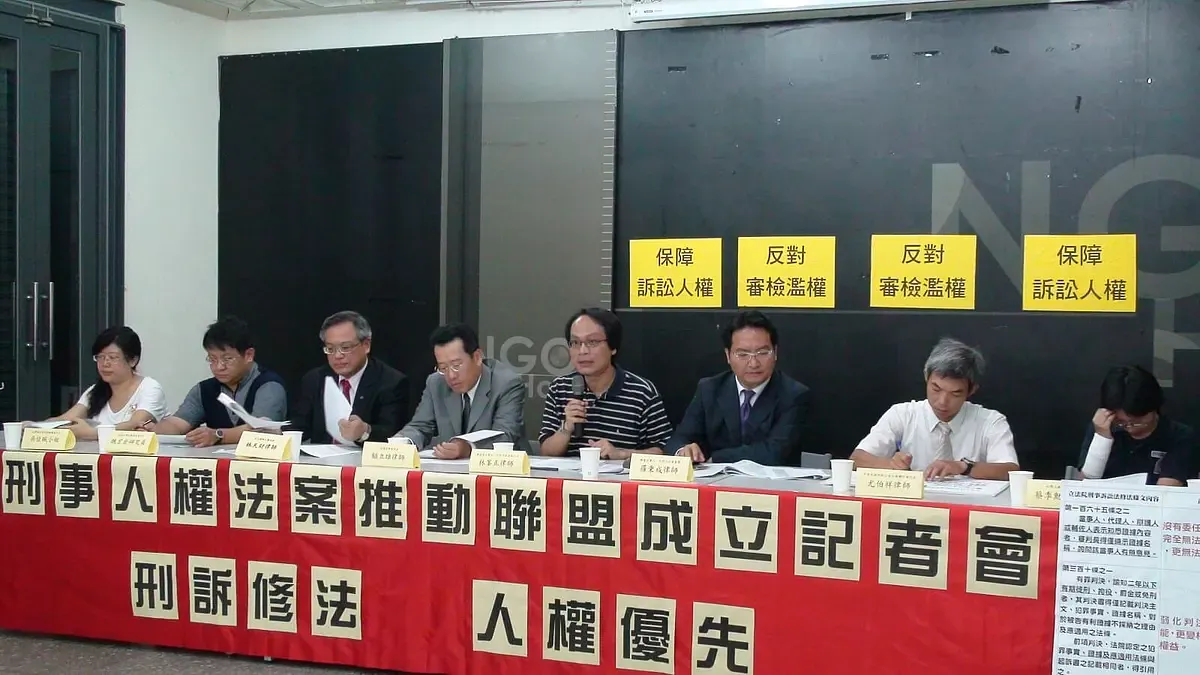
Criminal Procedure Reform, Human Rights First—Establishment of the Alliance for the Promotion of Criminal Human Rights Bills
Last edited: 2026-07-27
With the implementation of the newly revised "cross-examination" system in Taiwan's criminal procedure on September 1, 2003, the protection of criminal human rights still falls short of relevant international human rights convention standards. For instance, in cases of improper interrogation by prosecutors and police, criminal suspects or defendants are still unable to fully enjoy the right to defense within judicial proceedings. Furthermore, prosecutors often apply for detention under the pretext of serious crimes merely to facilitate the extraction of confessions, rather than considering whether the defendant truly poses a flight risk or a risk of colluding with others. Coupled with excessively prolonged detention periods, these practices constitute a severe infringement upon the constitutional freedom of the person. Regarding victims, due to insufficient protection mechanisms in criminal procedures, they may become "marginalized" and forgotten during the proceedings.
However, the Judicial Yuan, as the competent authority for the Code of Criminal Procedure, has ignored the importance of criminal human rights bills. Solely for the purpose of alleviating the workload of presiding judges, and at the cost of sacrificing the litigation rights guaranteed to the people by the Constitution, it has promoted amendments to Articles 165-2, 310-1, and 366-1 of the Code of Criminal Procedure through legislators. Currently, the Judiciary and Organic Laws and Statutes Committee of the Legislative Yuan has passed the partial provisions of Article 165-2 on first reading, while the other two articles have been deferred for review at a later date. This amendment simplifies the procedure for judges to present evidence, depriving defendants of the opportunity to defend themselves and allowing 95% of guilty verdicts to omit detailed accounts of the evidence and reasoning upon which the determination of criminal facts is based. This weakens the reasoning capacity of judgments, covertly deprives people of the right to appeal, and even restricts the scope of evidence investigation in appellate trials. Once passed, these draft amendments will inevitably cause a regression in Taiwan's human rights standards, having a profound impact.
Therefore, to safeguard people's litigation rights and elevate human rights protection, we have decided to pool civil society forces and establish the "Alliance for the Promotion of Criminal Human Rights Bills." Currently, the alliance members include over twenty civil society organizations, such as the 21st Century Constitutional Reform Alliance, All Taiwan Association for Holistic Education, Chinese Association for Human Rights, Taiwan Bar Association, Amnesty International Taiwan, Taipei Bar Association, Taoyuan Bar Association, Tainan Bar Association, Taiwan Association for Human Rights, Taiwan Law Society, Taiwan Association for Promotion of Peace, National Alliance of Taiwan Women's Associations, Taiwan Labour Front, Taiwan Alliance to End the Death Penalty, Chinese Federation of Labour, Taiwan Tongzhi Hotline Association, National Association for Community Universities, Judicial Reform Foundation, Legal Aid Foundation, Kaohsiung Bar Association, Third Society, Parents' Association of Intellectual Disabilities, Taiwan, Hsinchu Bar Association, Chiayi Bar Association, Green Party Taiwan, and the Awakening Foundation.
The organization representatives attending today's press conference include: Lo P'ing-ch'eng, Convener of the Alliance and Attorney and Board Member of the Judicial Reform Foundation; Lin Fêng-chêng, Deputy Convener of the Alliance and Attorney and CEO of the Judicial Reform Foundation; Yu Po-hsiang, representative of the Taiwan Bar Association; Lin T'ien-ts'ai, representative of the Taipei Bar Association; Ku Li-hsiung, representative of the Taiwan Law Society; Tsai Chi-hsun, Secretary-General and representative of the Taiwan Association for Human Rights; Ch'en Chün-yen, representative of the Taiwan Labour Front; Wu Chia-p'ei, representative of the Taiwan Alliance to End the Death Penalty; Hsueh Shun-wen, representative of the Chinese Federation of Labour; Wei Hung-chin, researcher and representative of the National Association for Community Universities; Yang Ming-hao, representative of the Third Society; and a representative of the Parents' Association of Intellectual Disabilities, Taiwan.
Alliance Convener Attorney Lo P'ing-ch'eng stated that the Judicial Yuan, as the competent authority for the Code of Criminal Procedure, has repeatedly ignored the importance of criminal human rights bills, pushing for amendments to Articles 165-2, 310-1, and 366-1 of the Code of Criminal Procedure through legislators merely to alleviate the burden on judges. Under the current provisions of the Code of Criminal Procedure, a person can be detained an unlimited number of times, the voices of victims cannot be heard in court, and even the most basic right of lawyers to have barrier-free access to criminal suspects and defendants is completely absent. The detention system is the greatest challenge to human rights. We demand that detention periods be benchmarked against Japanese regulations, limiting detention during the investigation stage to ten days, so that prosecutors may only apply for detention when evidence is sufficient for indictment, rather than engaging in time-unlimited detention to extract confessions.
Attorney Lo P'ing-ch'eng pointed out that addressing the current deficiencies in human rights protection within the Code of Criminal Procedure, the Alliance has proposed a civil society version of the amendments to the Code of Criminal Procedure. The draft includes implementing and strengthening the right to defense for lawyers during investigations, ensuring barrier-free access and communication between lawyers and defendants, clarifying the specific rights of lawyers to be present when defendants are interrogated by prosecutors and police, and explicitly mandating that prosecutors fulfill the obligation to disclose grounds for detention to defendants and their lawyers when applying to the court for detention. It also coordinates the progressive implementation of mandatory lawyer presence during a defendant's first police interrogation, hoping to progressively align once again with international standards of human rights protection. Simultaneously, it grants victims of criminal offenses—who have been neglected under the current system—more adequate rights to express their opinions during trial proceedings.
Alliance Deputy Convener Attorney Lin Fêng-chêng noted that the Judiciary and Organic Laws and Statutes Committee of the Legislative Yuan passed the partial provisions of Article 165-2 of the Code of Criminal Procedure on first reading yesterday, while Articles 310-1 and 366-1 were deferred for review at a later date. Although Article 165-2 of the Code of Criminal Procedure includes a proviso stating that "this shall not apply where a defendant without defense counsel objectively has no possibility of knowing the contents of the evidence," for a defendant without a lawyer, a judge might simply read out the names of the evidence at a very rapid pace to complete the evidence presentation procedure. The defendant would not know how to express whether they understood what the judge said, and if they wish to appeal, they would still have to prove they had never accessed the evidentiary materials, adding further variables to the success of an appeal. We hope that the Legislative Yuan, during the second reading and cross-caucus consultations, will directly amend the provision to restrict the simplification of evidence presentation procedures exclusively to defendants who have defense counsel, while strictly prohibiting simplification for the majority of defendants without lawyers, thereby safeguarding the rights of defendants.
Attorney Lin Fêng-chêng stated that Mr. Huang Wen-hsiung, Chairperson of Amnesty International Taiwan, plans to invite professionals from the London headquarters to Taiwan to study whether Taiwan's current Code of Criminal Procedure complies with international human rights standards, and to offer official authorities recommendations on directions for amending provisions that fail to meet human rights standards.
Attorney Yu Po-hsiang, representative of the Taiwan Bar Association, mentioned that the amendments to Articles 165-2, 310-1, and 366-1 of the Code of Criminal Procedure pose an immediate and clear threat to the people's litigation rights, with Article 310-1 posing the greatest threat. Once passed, it will mark the twilight of the presumption of innocence, rendering the strict proof rule non-existent. The provisions of Article 310-2 allow judges to omit writing reasons for their conviction mindset, making it easy for judges to write judgments of conviction and difficult to write judgments of acquittal. Currently, the accuracy rate of judgments has not yet reached a trustworthy level; the amendments proposed by the Judicial Yuan should not be passed, and the human rights clauses of the civil society version should be incorporated instead.
Attorney Ku Li-hsiung, representative of the Taiwan Law Society, mentioned that the amendments proposed by the Judicial Yuan through legislators do not help good judges at all; instead, they benefit bad judges. Because judging is a conscientious vocation, even if the amendments pass, they will not help good judges form their mental state or write judgments. To alleviate the pressure of cases on judges, prosecutors need to be more rigorous in indictments, gather evidence more comprehensively, and even write better indictments, so that the judges' workload will not increase. Legal amendments should return to improving litigation quality rather than simply modifying a few articles merely to alleviate the burden on judges, which triggers a crisis of public trust.
Attorney Lin T'ien-ts'ai, representative of the Taipei Bar Association, stated that the judiciary exists to serve the people, and legal reforms should be accompanied by complementary measures oriented toward long-term interests. Currently, the Judicial Yuan has deviated from the basic direction of serving the people, and legal reforms should focus on three aspects:
- For crime victims, much like in Hollywood movies, victims should be allowed to sit beside prosecutors to express their opinions.
- For defendants, allowing them to be free from fear, we expect prosecutors, police, investigators, and judges not to use detention applications to intimidate defendants, and to grant them respect for basic human rights.
- For lawyers, we expect prosecutors, police, and investigators to grant lawyers basic respect and not to restrict lawyers' right to defense through intimidation of obstructing official duties or restriction of lawyer-client access.
Wei Hung-chin, researcher and representative of the National Association for Community Universities, stated that from the perspective of basic human rights, the amendments proposed by the Judicial Yuan lead to a retreat in human rights protection. From the standpoint of protecting human rights, the drafting of guilty verdicts should be more rigorous to better conform to human rights standards.
Tsai Chi-hsun, Secretary-General and representative of the Taiwan Association for Human Rights, noted that the promotion of the civil society version of the amendments to the Code of Criminal Procedure requires continuous explanation and education to the public so that citizens can understand the importance of human rights bills.
Appendix
Objections of the Alliance for the Promotion of Criminal Human Rights Bills Against the Judicial Yuan's Supported Draft Amendments to Articles 165-2, 310-1, and 366-1 of the Code of Criminal Procedure
| Contents of the Legislative Yuan's Criminal Procedure Amendment Articles | Explanation of Amendments | Reasons for the Alliance's Opposition |
|---|---|---|
|
Article 165-2 Where parties, agents, defense counsel, or assistants indicate that they are aware of the contents of the evidence, the presiding judge may merely announce the name of the evidence and ask the parties whether they have any comments. |
1. This article is newly added. 2. In criminal proceedings, where the contents of evidence are known to the parties, agents, defense counsel, or assistants, if it is still necessary to present, recognize, read aloud, communicate the gist of, or deliver for inspection each piece of evidence one by one, it not only adds nothing to the procedural rights of the parties but also needlessly consumes their labor and time. Therefore, it is explicitly stipulated that where parties, agents, defense counsel, or assistants indicate that they are aware of the contents of the evidence, the presiding judge may merely announce the name of the evidence and ask the parties whether they have any comments. 3. In the aforementioned circumstances, since this article explicitly simplifies the investigation procedure and exempts compliance with Articles 164, 165, and 165-1 regarding the successive announcement of the contents of various pieces of evidence, it naturally also dispenses with the application of Article 288-1. As for the probative force of evidence, the court shall still apply Article 288-2 to afford parties, agents, defense counsel, or assistants an appropriate opportunity for debate, which goes without saying. |
In criminal proceedings, evidence contents should originally be presented one by one, recognized, read aloud, communicated by gist, or delivered for inspection to fulfill the required evidence presentation procedure and afford defendants ample opportunity for defense. As a result of this simplified procedure through amendment, those bearing the brunt will be defendants who have not retained lawyers as defense counsel. Lacking professional assistance, it will be difficult for them to comprehend evidence contents within a very short time in court, let alone argue in their own defense. One fears that in the future, one will only see judges reading out evidence names in a very short time, while defendants are at a loss and unable to express opinions, yet the procedure is thus completed. The due process guarantees that defendants ought to enjoy will thereby be increasingly hollowed out. |
|
Article 310-1 A judgment of conviction sentencing a defendant to imprisonment for not more than two years, short-term imprisonment, a fine, or exemption from punishment may record only the main text of the judgment, the criminal facts, the names of the evidence, the reasons for rejecting evidence favorable to the defendant, and the applicable legal provisions. Where the criminal facts determined by the court, the evidence, and the applicable legal provisions in the judgment described in the preceding paragraph are identical to those recorded in the indictment, they may be incorporated by reference. |
1. The focus of concern for parties regarding a judgment of conviction mostly lies in the sentence length, criminal facts, evidence supporting conviction and sentencing, and reasons for not adopting evidence favorable to the defendant. Therefore, for cases with relatively light declared sentences, it is sufficient for the judgment to record only the aforementioned matters and applicable legal provisions, so as to appropriately simplify the contents of the judgment, making it simple, clear, and easy to read, and aligning with the reasonable expectations of parties regarding the judgment contents. Accordingly, paragraph 1 is amended with reference to the provision on the upper limit of short-term custodial sentences eligible for probation under Article 74, paragraph 1 of the Criminal Code. 2. To achieve conciseness and clarity, where the evidence relied upon by the court to determine facts and the applicable legal provisions are identical to those recorded in the indictment, they may also be incorporated by reference. Paragraph 2 is amended accordingly. |
|
|
Article 366-1 Evidence that has already been investigated by the original instance court and may serve as evidence may be directly used by the second-instance court as the basis for its judgment. |
1. This article is newly added. 2. While the second-instance procedure in criminal litigation should indeed conduct a complete review of the portion of the original instance judgment that has been appealed, materials possessing evidentiary competence that have already undergone lawful investigation in the original instance and may serve as evidence need not be repeatedly subjected by the second-instance court to investigation procedures such as presentation, recognition, reading aloud, communication of gist, or delivery for inspection pursuant to Articles 164, 165, and 165-1. Doing so not only adds nothing to the litigation rights of the parties but also runs counter to procedural economy, precluding the realization of efficient criminal trials. Therefore, this article is added to explicitly stipulate that evidence already investigated by the original instance and capable of serving as evidence may be directly used by the second-instance court as the basis for its judgment. |
|
This article is an AI-generated translation of the original Chinese text. In the event of any discrepancy, the Chinese version shall prevail.